




Search
Related News
- 00
0000-00
How safe train control technology reduces headway without raising risk - 00
0000-00
How rail vehicle aeroacoustics affects pass-by noise at high speeds - 00
0000-00
When do composite aircraft structural materials outperform aluminum? - 00
0000-00
When does condition based predictive maintenance pay off for traction converters - 00
0000-00
What aerospace materials engineering certification should verify for fastener traceability
How safe train control technology reduces headway without raising risk




For technical evaluation teams, the question behind safe train control technology is usually sharper than the public discussion suggests. It is not simply whether a signaling system can run trains closer together. It is whether shorter headway can be achieved while keeping braking separation, route protection, degraded-mode behavior, and hazard response inside an acceptable safety envelope. That is where the real assessment begins.
In dense metro and high-capacity suburban corridors, pressure on headway comes from both ridership growth and infrastructure limits. Building new lines is slow and expensive. Extracting more throughput from existing track often depends on signaling and control. But reducing time between trains is only credible when train localization, movement authority calculation, communications integrity, onboard enforcement, and interlocking logic work as one fail-safe system. If any one of those layers is weak, “capacity improvement” quickly turns into operational fragility.
Why lower headway normally increases risk
Traditional fixed-block systems divide the railway into predefined track sections. A following train can only proceed when enough blocks ahead are clear. This is conservative by design, and in many networks it has delivered acceptable safety for decades. The trade-off is that fixed blocks do not reflect the actual dynamic position and braking profile of each train very precisely. They protect safety by adding margin through infrastructure segmentation.
As operators try to reduce headway, those margins become harder to manage. The closer trains run, the more important it becomes to know exactly where a train is, how fast it is moving, what braking curve applies under current conditions, and whether the route ahead remains protected. Shorter intervals also leave less room for uncertainty from wheel slip, odometry drift, communication delay, or dispatcher intervention. In other words, lower headway does not automatically raise danger, but it sharply reduces tolerance for ambiguity.
That is why safe train control technology is not just about faster control logic. It is about replacing coarse safety assumptions with continuously verified information and fail-safe enforcement.
How moving block changes the headway equation
The biggest shift comes from continuous train positioning combined with moving block principles, commonly associated with advanced CBTC architectures. Instead of relying only on fixed track occupancy sections, the system calculates a safe movement authority based on the real-time position of the train ahead, its protected envelope, the following train’s braking capability, route conditions, and safety margins defined by the application.
That matters because the separation between trains is no longer tied only to the length of infrastructure blocks. It becomes a dynamic safe braking distance plus uncertainty margins. In well-designed applications, this allows closer spacing without “borrowing” safety from operating staff or timetable optimism.
Still, technical evaluators should be careful here. Moving block does not eliminate margin; it redistributes margin into software logic, localization confidence, braking models, and system response time. The safety case therefore depends less on visible hardware segmentation and more on verifiable control architecture.
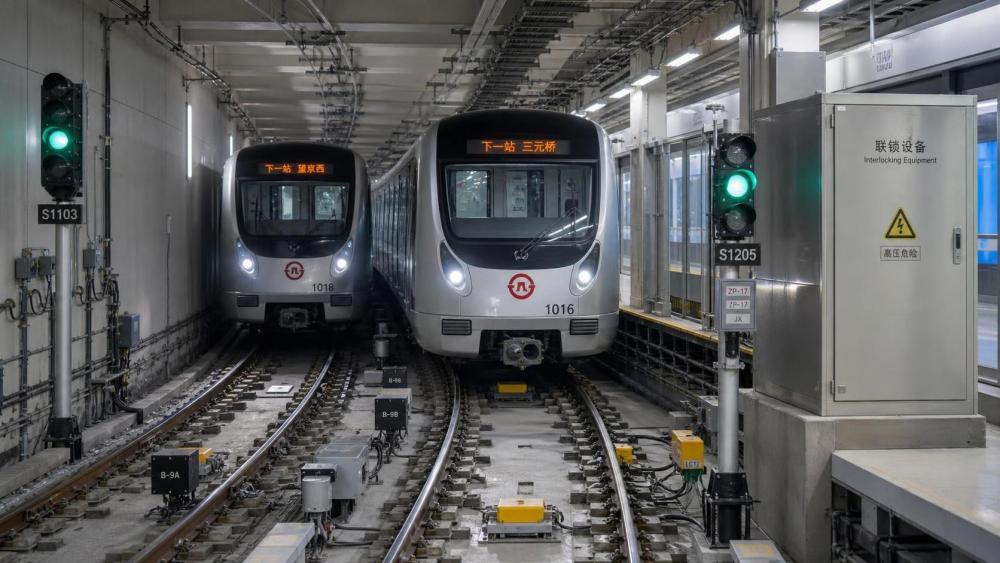
The four technical foundations that make shorter headway credible
1. Continuous and trustworthy train positioning
Headway reduction starts with knowing where each train actually is. Modern safe train control technology usually combines onboard odometry with reference correction methods such as balises, transponders, or other wayside inputs, depending on the system architecture. The point is not merely to locate the train, but to bound the uncertainty of that location. A system that reports position frequently but cannot guarantee confidence limits is not ready for aggressive headway reduction.
This is also where environmental and operational realities matter. Tunnel conditions, wheel wear, contamination, braking variability, and mixed rolling stock can all affect localization and braking model accuracy. Evaluation should focus on how the supplier handles drift detection, loss of reference, degraded localization, and re-synchronization.
2. Safe movement authority with conservative braking curves
A train can only run closer if the system can continuously calculate a movement limit that remains safe even when something does not go to plan. That means braking curves are not idealized best-case values. They are normally based on worst-case or conservatively bounded assumptions defined by the project safety case. Gradient, adhesion assumptions, train performance class, and equipment state all influence how much separation is truly safe.
When people say a system can “reduce headway,” what they often mean technically is that it can reduce the uncertainty buffer around braking separation. That is a much more useful way to think about it during evaluation.
3. Fail-safe design, not just high availability
A common mistake is to discuss capacity and safety as if they were mainly an availability issue. Availability matters, but safety rests on fail-safe behavior. If communication is interrupted, if train integrity status is uncertain, if route locking cannot be confirmed, or if position confidence drops below threshold, the system must react predictably and safely, even if that means reducing throughput.
The practical test is straightforward: what happens when the system is partially blind, partially delayed, or partially inconsistent? Safe train control technology earns trust not in nominal operation, but in how it degrades.
4. SIL4-grade architecture and redundancy
For train protection and movement authority functions, projects commonly look to SIL4-level safety integrity under relevant railway safety standards, with detailed allocation depending on subsystem scope and national requirements. Technical evaluators know this is not a marketing label. It requires hazard analysis, failure mode treatment, software assurance discipline, and evidence that dangerous failures are reduced to the required level by design and verification.
Redundancy is part of that, but redundancy alone proves little. Two channels that fail under the same condition do not create meaningful protection. The better question is whether the architecture addresses common-cause failure, data consistency checks, safe state transition, and independent monitoring in a way that survives realistic fault scenarios.
What technical evaluators should actually examine
When comparing train control solutions, headline claims about minimum headway are only a starting point. A more useful review framework includes the following points:
- What assumptions sit behind the advertised headway: rolling stock uniformity, platform dwell control, communication latency, turnout density, terminal operations, or depot interface?
- How is train position confidence established, corrected, and bounded under degraded conditions?
- What braking model is used, and how conservative is it under wet rail, low adhesion, or mixed fleet conditions?
- How does the system behave during communication loss, wayside failure, onboard failure, or temporary loss of route status confirmation?
- Which functions are safety-critical, which are availability-critical, and where is the transition between automatic and restrictive modes?
- What evidence is available for software validation, hazard closure, and interface control with interlocking, ATS, platform systems, and legacy assets?
This is one reason intelligence platforms such as AATS have value beyond general industry news. In rail signaling, as in aerospace propulsion or advanced materials, performance claims only make sense when traced back to design assumptions, safety margins, certification pathways, and lifecycle maintenance realities. AATS covers that intersection well: moving block control, SIL4 safety systems, predictive maintenance, infrastructure MRO, and project evaluation all affect whether a train control upgrade works on paper or in service.
Headway is not determined by signaling alone
Even the best safe train control technology cannot compensate for every operational bottleneck. Dwell time variation, passenger flow, traction and braking consistency, platform door synchronization, crossover layout, and dispatching strategy all shape practical throughput. On some lines, signaling is the main constraint. On others, it only reveals the next constraint more quickly.
That distinction matters during procurement and upgrade planning. A system may be technically capable of shorter headway, yet the line may not achieve that figure in service without rolling stock tuning, timetable redesign, or infrastructure adjustments. Technical evaluation should therefore separate theoretical safe separation from operationally sustainable headway.
Where project risk usually hides
Risk often hides at interfaces. Legacy interlockings, mixed generations of onboard equipment, migration from fixed block to moving block, and nighttime cutover windows can introduce more uncertainty than the core control algorithm itself. Brownfield projects are especially sensitive. A technically elegant system can still underperform if interface responsibility, test coverage, and fallback operating rules are not defined early.
Cybersecurity also deserves more attention than it sometimes gets in early-stage reviews. For connected train control architectures, safety and cybersecurity are different disciplines, but not separate in effect. A loss of trusted data flow can trigger restrictive modes, reduced capacity, or unsafe ambiguity if not properly designed against. The exact compliance path depends on the market and project specification, so this area usually requires close review of applicable standards and operator requirements.
A practical standard for judging “safe” capacity gains
The most useful standard is not whether a supplier promises lower headway. It is whether the system can demonstrate that every reduction in separation is backed by stronger certainty in train state, route state, braking enforcement, and fault response. Safe train control technology reduces headway by shrinking uncertainty, not by relaxing protection.
That is the core logic technical evaluators should keep in view. If a proposal relies on optimistic operating assumptions, vague degraded-mode descriptions, or unsupported safety claims, the capacity benefit is probably less solid than it appears. If, on the other hand, the architecture clearly shows continuous positioning, dynamic movement authority, fail-safe fallback behavior, and SIL4-grade assurance with project-specific evidence, then shorter headway can be a disciplined safety outcome rather than a risk trade.
Before moving forward, it is usually worth confirming a few project-specific points: required minimum headway under peak conditions, rolling stock performance spread, localization method, degraded-mode operating rules, interface boundaries, and the exact standards the authority or operator expects the supplier to satisfy. Those details decide whether the technology is merely advanced or genuinely fit for service.
Related News
- How safe train control technology reduces headway without raising riskAug 23, 2026Safe train control technology explained: learn how moving block, SIL4 design, and fail-safe control cut headway while protecting braking distance, reliability, and real-world rail capacity.
- EASA Tightens SIL4 Rules for EU-Bound CBTC ExportsAug 09, 2026CBTC exports to the EU face tighter SIL4 compliance as EASA updates rules. Learn the March 2027 deadline, IV&V impact, and how suppliers can protect market access.
- How Unmanned Rail Operations Signaling Affects Headway, Safety, and Recovery TimeAug 07, 2026Unmanned rail operations signaling shapes headway, safety, and recovery time. Discover how CBTC, positioning accuracy, and degraded-mode design determine real driverless rail performance.
- EASA Extends SIL4 Rules to CBTC CertificationAug 07, 2026EASA extends SIL4 rules to CBTC certification, reshaping market access, audits, and procurement. Learn what suppliers, bidders, and EU-focused buyers must prepare now.