




Search
Related News
- 00
0000-00
How train crossing pressure waves in China affect nearby structures - 00
0000-00
How fatigue fracture analysis testing identifies crack initiation risks - 00
0000-00
How a CBTC fallback system keeps trains moving after link loss - 00
0000-00
When should a transit system engineering consultant join an EPC project? - 00
0000-00
What drives aerospace forging price for titanium engine casings?
Tags
How a CBTC fallback system keeps trains moving after link loss




How a CBTC Fallback System Keeps Trains Moving After Link Loss
When a train loses its normal communications link in a CBTC-equipped railway, the immediate question is not whether the system can display an alarm. It is whether the railway can still establish where every affected train is, what movement authority remains valid, who is responsible for separation, and how passengers can be moved without turning a localized fault into a network-wide suspension.
That is the practical job of a CBTC fallback system. It provides a controlled path from normal moving-block operation into a degraded mode that is still safe, understandable, and operable under pressure. The goal is not to preserve full CBTC capacity after a link loss. In most cases that would be unrealistic. The goal is to retain enough verified information, supervision, and operating discipline to keep trains moving at an appropriate reduced level of service.
For drivers, dispatchers, control-room operators, maintainers, and infrastructure teams, the distinction matters. A well-designed fallback arrangement does not simply “switch to manual.” It defines what manual operation means, where it is permitted, what speed restrictions apply, how route integrity is checked, and when a train may return to normal automatic protection.
Link loss is not one failure condition
In CBTC, continuous two-way communication supports moving-block separation, train-to-wayside status exchange, and real-time movement authority updates. When that exchange is interrupted, the actual risk depends on the cause and scope of the interruption. A single train may have an onboard radio problem. A group of trains may be affected by a wayside access-point fault. A broader outage may involve fibre transmission, zone-controller availability, power supply, interference, or a configuration issue introduced during maintenance.
These faults can look similar from the cab: a loss of communication indication, a mode change, and reduced or withdrawn movement authority. Operationally, however, they are very different. If only one train is affected while the rest of the line remains under normal CBTC supervision, the control centre must protect the boundary between the degraded train and moving-block traffic. If an entire zone loses communications, the response may involve route-by-route control, restrictive block working, or temporary closure of the affected area.
This is why operators should resist treating “radio failure” as a single procedure. The first few minutes should be used to classify the fault: onboard, localized wayside, zone-wide, intermittent, or uncertain. Until the scope is confirmed, the safe assumption is usually the conservative one.
What the fallback arrangement needs to preserve
Normal CBTC operation can calculate safe separation using continuously refreshed train position, speed, braking characteristics, route status, and communications status. After link loss, not all of that information may remain available at the same confidence level. The fallback system therefore has to replace continuous moving-block logic with a safer, simpler operating basis.
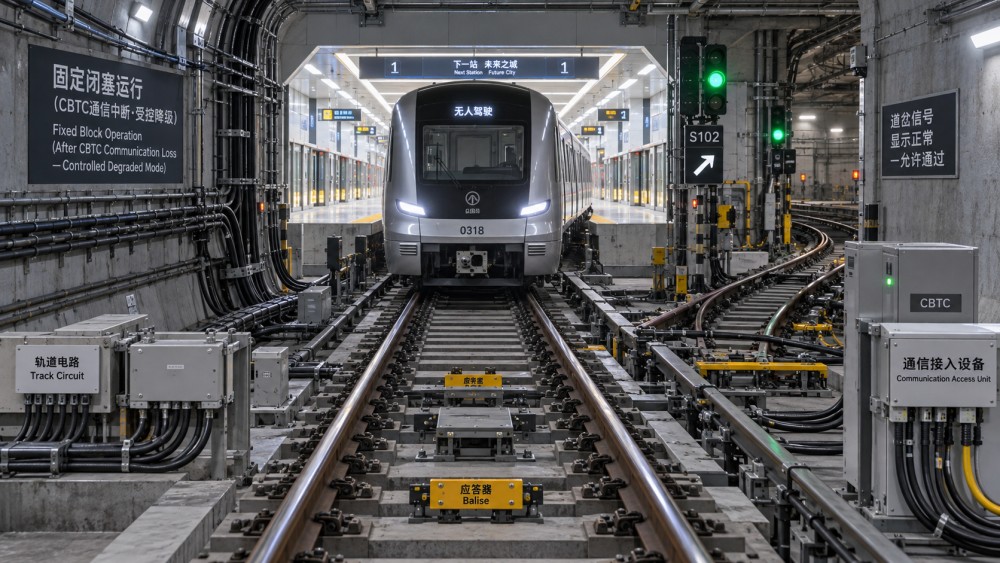
Depending on the railway design, that basis may include fixed-block track circuits, axle counters, interlocking route locking, onboard odometry, balise-based position references, train integrity assumptions, restrictive speed supervision, or driver-authorized movement under instructions from the control centre. The exact mix is project-specific. What matters is that the selected mode has a clear safety case and that operations staff understand its limitations.
A useful fallback design answers four questions without ambiguity:
- Can the train’s location be confirmed to a safe level for the intended movement?
- Can the route ahead be protected against conflicting movements?
- Who controls train separation while normal movement authority updates are unavailable?
- What evidence is required before the train transitions back into the normal CBTC mode?
If any of these answers relies on informal interpretation, the fallback process will be fragile when the network is busy, staff are changing shifts, or several faults occur at once.
The operating sequence after communications are lost
A reliable CBTC fallback system is as much an operating sequence as it is a technical architecture. The train should first enter a defined protective state. In many designs, this means an automatic brake application or a supervised reduction in speed when valid authority can no longer be maintained. The reason is straightforward: the train must not continue relying on information that may no longer be current.
Once stopped or stabilized in the prescribed degraded mode, the driver reports the condition using the available operational channel. This may be a separate railway radio, platform communications, emergency telephone, or another approved method. The control centre then checks whether the loss is isolated or widespread and determines the train’s last known position, route setting, adjacent train locations, and any restrictions on the section ahead.
The next movement is often the most sensitive part of the event. It may be a limited move to the next station, a controlled movement to clear a junction, or a return to a location where the train can be reset, inspected, or removed from service. The instruction should not be reduced to “proceed cautiously.” It needs an identifiable limit of movement, an applicable speed regime, confirmation of route protection, and a method for reporting arrival or stopping short.
In dense metro operations, clearing a train from a crossover or platform throat can be more valuable than trying to restore headway immediately. A train stopped in the wrong place can block several routes, delay following trains that still have CBTC service, and complicate passenger evacuation if the fault develops further. Good control-room judgment often means accepting a short-term reduction in throughput to regain a stable operating layout.
Fallback modes should match the available evidence
The table is deliberately broad because systems differ. Some lines retain a conventional signaling layer for fallback; others depend more heavily on CBTC architecture and have specific restricted-manual provisions. A buyer or operator evaluating a solution should ask for the actual mode-transition logic, interface dependencies, and operating rulebook—not just a statement that “fallback is supported.”
Train positioning becomes the central issue
After communication loss, the control centre may still have a last reported position, but last reported is not the same as currently verified. A train may have coasted, braked, rolled back within a permitted tolerance, or stopped between known reference points. This is where positioning confidence matters more than the sophistication of the normal-mode algorithm.
A mature fallback strategy defines how position is re-established. That may involve trackside detection, passage over a known reference point, a driver confirmation at a marker, reconciliation with interlocking indications, or a controlled movement under restrictive conditions until a reliable reference is obtained. The method must account for the line’s geometry. Tunnels, turnbacks, depot leads, junctions, and areas with closely spaced points are far less forgiving than a straight open section.
Operators should be especially careful at the boundary between CBTC territory and conventional signaling, where a station approach has limited sighting distance, or where a train is approaching a platform occupied by another unit. In these places, a vague location estimate can quickly become an operating constraint. It is usually better to hold a following train at a known safe point than to recover a few seconds through aggressive degraded working.
The driver needs usable instructions, not a thick manual
Fallback performance is often judged by system diagrams, but the driver’s cab experience is where the design either works or fails. During a link-loss event, the driver needs to know the current mode, whether movement is permitted, whether the train is speed-supervised, what route limit applies, and how to contact control. Ambiguous human-machine interface messages can create delay even when the underlying technical protection is sound.
Procedures should distinguish clearly between a train that can proceed in a protected restricted mode and one that requires explicit authority for each movement. Drivers should not be expected to diagnose radio architecture, determine whether the failure lies onboard or wayside, or infer the operational response from multiple alarms. Their role is to secure the train, communicate accurate observations, follow the authorized mode, and report the outcome of each instruction.
Training also has to cover the awkward conditions: a communication loss immediately after departure, a stop between stations, a fault while approaching a junction, a failed reset, or a second train reporting the same symptom. Tabletop exercises are useful, but practical simulations are more revealing because they expose timing, terminology, and handover problems that procedure writers may miss.
Control-room discipline prevents a local fault becoming a service collapse
The control centre must manage two different tasks at once: safely authorizing degraded movement and protecting the rest of the timetable. These priorities can conflict. Trying to preserve every scheduled train path while a degraded-mode train sits at a critical junction is a common way to create a larger disruption.
A practical response is to establish clear control boundaries early. Hold trains before the affected area at locations where they can dwell safely. Avoid feeding more trains into an uncertain zone. Reserve key routes for the movement that will restore the most operating flexibility, such as clearing a platform, releasing a crossover, or returning a defective train to a siding. Passenger information should reflect the actual operating plan rather than an optimistic estimate issued before the fault scope is known.
Maintenance teams, meanwhile, need enough event data to separate a transient communication interruption from a repeatable equipment fault. Onboard logs, wayside network alarms, access-point status, power events, and recent configuration changes can all matter. But troubleshooting should not interfere with the live operating decision. Restore service first within the approved safety framework; investigate root cause through the established maintenance process.
What should be tested before the railway needs fallback
A CBTC fallback system should be validated as an operational capability, not merely demonstrated as a laboratory mode change. Tests should include the transition itself, communications between driver and control, route release behavior, train detection interfaces, recovery after reset, and the return from degraded operation to normal CBTC control. The last point is frequently underestimated. Re-entering normal mode requires confidence that train position, direction, route status, and communications are again consistent.
The testing plan should also reflect the railway’s real service pattern. A branch line with long headways has different exposure from a high-frequency urban corridor. High-speed and mainline applications introduce longer braking distances, mixed traffic interfaces, and more demanding consequences if a train’s location is uncertain. Where SIL4 safety functions are part of the wider signaling architecture, the project documentation should make clear which functions remain active in each degraded mode and which protections are replaced by procedural controls.
For procurement teams and authorities, the useful questions are concrete: What happens when a single onboard radio fails? What happens when an entire communication zone is unavailable? What manual actions are required from the driver? Which legacy detection systems or interlocking functions does the fallback mode depend on? How is the degraded timetable defined? A supplier’s answers should be traceable to the system design, test evidence, maintenance concept, and local operating rules.
A fallback system is part of lifecycle resilience
CBTC is often discussed in terms of shorter headways and higher line capacity. Those are valid benefits in normal conditions. Yet operators live with the whole lifecycle: radio component replacement, software revisions, network maintenance, vehicle retrofits, staff competence, incident reviews, and changing demand patterns. Fallback capability is what connects high-performance automation with day-to-day resilience.
For rail organizations assessing signaling technology, the strongest solution is rarely the one that promises uninterrupted performance under every fault. It is the one that makes its limitations visible, contains a fault predictably, and gives people clear authority to act. Global Aerospace & Advanced Transit Systems follows this same practical thread across CBTC, moving-block control, rolling-stock systems, maintenance planning, and transport safety: reliability is not only about preventing failure, but about managing the moment when normal assumptions no longer hold.
After link loss, trains can continue moving—but only when the railway has already decided how safety, positioning, communication, and responsibility will be maintained. That decision belongs in the design, the rulebook, the test program, and the routine training schedule long before the first real alarm appears.
Related News
- How a CBTC fallback system keeps trains moving after link lossSep 24, 2026CBTC fallback system: learn how rail operators maintain safe train movement, restore positioning, and limit disruption after communication link loss.
- How safe train control technology reduces headway without raising riskAug 23, 2026Safe train control technology explained: learn how moving block, SIL4 design, and fail-safe control cut headway while protecting braking distance, reliability, and real-world rail capacity.
- EASA Tightens SIL4 Rules for EU-Bound CBTC ExportsAug 09, 2026CBTC exports to the EU face tighter SIL4 compliance as EASA updates rules. Learn the March 2027 deadline, IV&V impact, and how suppliers can protect market access.
- How Unmanned Rail Operations Signaling Affects Headway, Safety, and Recovery TimeAug 07, 2026Unmanned rail operations signaling shapes headway, safety, and recovery time. Discover how CBTC, positioning accuracy, and degraded-mode design determine real driverless rail performance.