




Search
Related News
- 00
0000-00
What drives aerospace forging price for titanium engine casings? - 00
0000-00
How rail fail safe systems prevent unsafe routes during signal faults - 00
0000-00
What should a rail signaling supplier provide for SIL4 projects? - 00
0000-00
What drives thermal barrier coating cost for turbine blade repairs? - 00
0000-00
What drives rail grinding vehicle cost over its service life?
How Unmanned Rail Operations Signaling Affects Headway, Safety, and Recovery Time




For technical evaluators, unmanned rail operations signaling is not a peripheral subsystem. It is the operating logic that determines whether a driverless line can safely run more trains per hour, contain failures before they escalate, and return to timetable after disruption without long manual intervention. In practice, headway, safety, and recovery time are not three separate performance indicators. They are tightly coupled outcomes of signaling architecture, train control philosophy, communications resilience, and the way degraded modes are designed.
That is why unmanned rail operations signaling should be assessed less as a feature set and more as a system-level capability. A line can advertise GoA4 automation, moving block control, or SIL4 compliance, yet still underperform if train positioning degrades in tunnels, platform interfaces are not deeply integrated, or fallback modes force overly conservative operations after minor faults. The real technical question is not whether the line is driverless. It is whether the signaling system can sustain capacity, protect hazards, and recover service under realistic operating conditions.
Headway is shaped by confidence margins, not just automation level
A common market misconception is that unattended train operation automatically delivers shorter headway. It does not. Automation removes the variability associated with manual driving, but the achievable headway still depends on how much uncertainty the signaling system must absorb.
In conventional fixed-block operation, trains are separated by predefined sections of track, which tends to leave unused capacity between trains. In communications-based train control, especially moving block architectures, separation is calculated dynamically using train position, speed, braking performance, movement authority, and safety margins. That is the foundation for reducing headway. But the practical gain comes only if the system can trust the input data with high integrity and low latency.
For technical evaluators, the key variables behind short headway include:
- train localization accuracy and refresh rate;
- certainty of train integrity detection;
- deterministic communications performance between train and wayside;
- braking curve modeling under varying adhesion and load conditions;
- dwell time consistency at stations;
- platform screen door coordination where applicable.
When any of these variables become less certain, the signaling system compensates by increasing safety margins. That directly pushes headway upward. So when a supplier claims a minimum theoretical interval, evaluators should ask under what operational assumptions it was achieved: peak passenger load, degraded radio coverage, temporary balise loss, mixed rolling stock, or normal dry-rail conditions only.
On heavily used urban lines, a few seconds of additional margin per train can materially reduce hourly throughput. This is where system engineering matters more than headline automation claims. The best-performing driverless networks are usually not those with the most aggressive nominal headway targets, but those whose signaling design keeps confidence margins stable across a wide range of real service conditions.
CBTC moving block improves capacity, but only when the whole control chain is disciplined
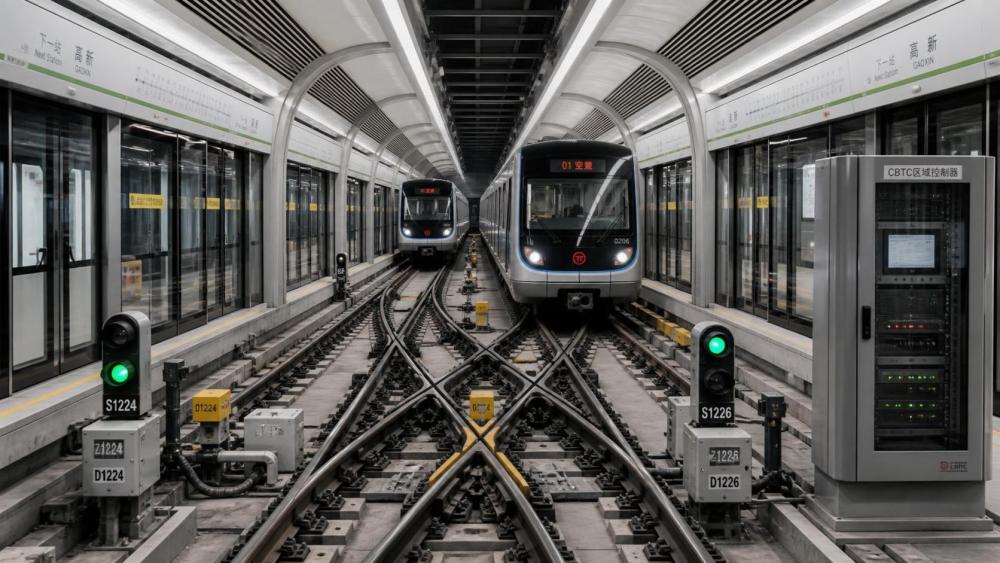
CBTC is often treated as the enabling technology for unmanned operations, and that is broadly correct. Yet for technical assessment, “CBTC” is too broad a label to be useful on its own. What matters is how the implementation handles continuous train positioning, movement authority calculation, zone control, interlocking integration, and loss-of-communication scenarios.
Moving block logic can reduce separation because it tracks the train more precisely than fixed blocks. But its performance depends on the continuity of the control chain. If trainborne odometry drifts and requires frequent correction, if radio handover causes intermittent delays, or if interlocking interfaces introduce latency, the capacity benefit narrows. In driverless systems, these issues are more consequential because there is no onboard driver to compensate operationally for signaling uncertainty.
Evaluators should pay attention to how the architecture manages:
- multi-sensor positioning, typically combining odometry with trackside reference points;
- safe braking envelope calculation for each train type;
- continuous bidirectional communication under tunnel, depot, and transition-zone conditions;
- interoperability with ATS, platform systems, and depot automation;
- graceful degradation from moving block to more restrictive operating modes.
One of the recurring industry lessons is that nominal moving block capability is less important than degraded-mode discipline. On paper, many systems perform well under normal conditions. In service, the differentiator is how much capacity is lost when a train disappears temporarily from high-confidence communication or when a subsystem falls back to a restricted state. If fallback operation becomes too conservative, recovery time extends and the original headway advantage disappears during the very periods when the network is under stress.
Safety in unattended operation depends on architecture, not on the absence of a driver
In public discussion, driverless rail safety is sometimes framed as a human-versus-machine argument. That is not a useful engineering lens. In unattended operation, safety depends on whether the system has transferred critical functions from human execution to verifiable, fail-safe, and redundant technical controls.
The benchmark language in this area often includes SIL4 for core train protection functions. That matters, but it should not be used as a shortcut for total system safety. SIL4 applies to defined safety functions and their development assurance, not to every operational risk in the railway. A technically mature evaluation therefore looks beyond the certification label and asks how hazards are allocated and controlled across the full architecture.
For unmanned lines, critical safety functions typically include:
- safe train separation and overspeed protection;
- route locking and flank protection through interlocking;
- door control and platform interface protection;
- automatic rollback protection on gradients;
- detection and management of train immobilization;
- safe evacuation and incident response logic;
- cybersecure control of trainborne and wayside assets.
The absence of a driver increases the importance of edge-case handling. Obstacle management, passenger emergency response, fire scenarios, intrusion detection, and platform incidents require coordination between signaling, supervisory control, rolling stock, communications, and station systems. A system may be robust in train protection terms while still exposing operational safety weakness if these interfaces are loosely integrated.
This is why technical evaluators should be cautious with narrow compliance-based comparisons. Safety performance in unattended operation comes from layered defense: fail-safe signaling, redundant communications, independent supervision, robust diagnostics, and well-tested operating rules for abnormal situations.
Recovery time is the most underexamined signaling metric in driverless projects
Procurement discussions often focus on ultimate capacity and safety certification, while recovery time receives less early scrutiny. Yet in live operation, recovery performance often determines whether a line is considered resilient or fragile.
Recovery time is affected by how quickly the signaling system can detect a fault, isolate the affected area, preserve safe movement elsewhere, and restore normal authority after the issue is cleared. In unattended systems, this depends heavily on automated fault management because there is limited capacity for manual onboard troubleshooting.
A useful distinction is between protection and restoration. Many signaling systems are strong at protection: when uncertainty appears, they stop trains safely. The harder engineering challenge is restoration: how to re-establish validated train position, recover route availability, and resume optimized service without excessive blanket restrictions.
Several design choices have direct impact on recovery time:
- whether failures are zonal or can cascade across larger control territories;
- how train position is revalidated after communications interruption;
- whether automatic route setting resumes immediately after subsystem restart;
- how quickly supervisory systems generate actionable diagnostics for control center staff;
- whether degraded operation supports continued service at reduced capacity rather than full stoppage.
For example, a temporary loss of radio communication does not have to become a prolonged network event. In a well-designed architecture, the affected train can be contained, neighboring movements can be managed conservatively but selectively, and the system can resume normal control once communication integrity is restored. In a weaker design, the same event may trigger broad service suspension because the fallback logic is too coarse.
Technical evaluators should therefore ask for evidence not only of fail-safe behavior, but of recovery sequencing: fault detection time, localization time, operator diagnostic support, re-entry logic, and historical mean time to resume normal service under common failure modes.
Positioning accuracy is not a narrow subsystem issue
Train positioning is often discussed in component terms, but its impact is strategic. In unmanned rail operations signaling, positioning uncertainty affects all three target metrics at once. It increases separation margin, complicates hazard control, and slows restoration after faults.
Most driverless rail applications rely on a combination of onboard odometry and fixed reference correction, often through transponders or equivalent trackside references. The technical challenge is not only nominal accuracy. It is error bounding over time, especially under wheel slip, contamination, maintenance variation, and complex alignment conditions.
Evaluators should consider:
- how the system detects and bounds cumulative odometry error;
- reference point spacing and resilience to missed reads;
- performance in adverse adhesion conditions;
- consistency between trainborne positioning and wayside logic;
- recovery method when train position confidence is lost.
These issues become more important where operators seek very short headway or highly automated depot-to-mainline transitions. Positioning robustness also affects maintenance planning, because repeated correction problems may signal not only sensor issues but wheel condition, calibration drift, or trackside equipment degradation.
Standards matter, but interface discipline matters more during project execution
From a standards perspective, technical teams will naturally review safety assurance, RAMS processes, software lifecycle discipline, and electromagnetic compatibility requirements. Relevant frameworks may include the CENELEC railway standards family such as EN 50126, EN 50128, and EN 50129, depending on jurisdiction and project specification. Functional safety expectations, cybersecurity requirements, and national rail authority approvals may also apply. Exact applicability should be verified project by project because local adoption differs.
Still, many implementation risks arise not from the absence of standards, but from interface ambiguity. Unmanned operation requires tight definition of responsibilities between signaling, rolling stock, telecom, PSD suppliers, OCC software, depot systems, and civil infrastructure constraints. Recovery problems in service often trace back to interface assumptions that were never stressed hard enough during integration.
For that reason, factory and site validation should not stop at proving nominal movement authority. The more valuable tests are often the awkward ones: partial communication loss, sensor disagreement, train reboot, platform door mismatch, manual rescue procedures, and transition into restricted modes. These scenarios reveal whether the signaling design supports stable operations or merely passes formal acceptance.
What technical evaluators should challenge in supplier claims
When reviewing proposals, evaluators should be skeptical of isolated figures such as minimum headway, availability percentage, or certification status unless they are linked to operating context. Questions worth pressing include:
- What assumptions sit behind the quoted headway, and how does it change in degraded mode?
- How is train position confidence maintained and restored after anomalies?
- What evidence exists from lines with comparable passenger density, dwell variability, and infrastructure complexity?
- How localized are typical failures, and what prevents network-wide capacity collapse?
- What parts of the architecture are proprietary, and how does that affect lifecycle support and upgrades?
- How are cybersecurity events handled without creating unsafe operational paralysis?
These questions matter commercially as well as technically. A signaling solution that looks efficient under ideal conditions but recovers slowly from routine faults can impose long-term operational cost, passenger disruption, and reputational risk far beyond its initial procurement profile.
In that sense, the value of unmanned rail operations signaling is best measured not by whether it enables driverless service in principle, but by whether it preserves three things simultaneously: close but credible separation, safety under uncertainty, and rapid restoration after disruption. Any evaluation that looks at only one of those dimensions will miss the real operating economics of automation.
Related News
- How safe train control technology reduces headway without raising riskAug 23, 2026Safe train control technology explained: learn how moving block, SIL4 design, and fail-safe control cut headway while protecting braking distance, reliability, and real-world rail capacity.
- EASA Tightens SIL4 Rules for EU-Bound CBTC ExportsAug 09, 2026CBTC exports to the EU face tighter SIL4 compliance as EASA updates rules. Learn the March 2027 deadline, IV&V impact, and how suppliers can protect market access.
- How Unmanned Rail Operations Signaling Affects Headway, Safety, and Recovery TimeAug 07, 2026Unmanned rail operations signaling shapes headway, safety, and recovery time. Discover how CBTC, positioning accuracy, and degraded-mode design determine real driverless rail performance.
- EASA Extends SIL4 Rules to CBTC CertificationAug 07, 2026EASA extends SIL4 rules to CBTC certification, reshaping market access, audits, and procurement. Learn what suppliers, bidders, and EU-focused buyers must prepare now.