




Search
Related News
- 00
0000-00
How rail fail safe systems prevent unsafe routes during signal faults - 00
0000-00
What should a rail signaling supplier provide for SIL4 projects? - 00
0000-00
What drives thermal barrier coating cost for turbine blade repairs? - 00
0000-00
What drives rail grinding vehicle cost over its service life? - 00
0000-00
How an aerospace quality management system supports Nadcap compliance
How rail fail safe systems prevent unsafe routes during signal faults




A signal fault rarely arrives with a clear label saying “danger.” More often, it appears as a missing telegram, a stale track-circuit indication, a disagreement between redundant processors, an unexpected relay state, or a communication timeout between a wayside controller and a train. In a railway environment, uncertainty itself must be treated as a safety concern.
That is the central purpose of rail fail safe systems: when the signaling system cannot prove that a route is safe, it must prevent the route from being set, retain a restrictive aspect, or bring the train movement authority back to a safe limit. The design principle is simple to state but demanding to implement: a fault must not create or maintain permission for a conflicting or unprotected movement.
For quality personnel and safety managers, this topic extends far beyond equipment reliability. It affects hazard analysis, software configuration control, proof testing, maintenance release, incident investigation, and the evidence needed to demonstrate that a safety function remains valid throughout its operational life.
Fail-safe does not mean fault-free
A common misunderstanding is that a fail-safe railway system never fails. Real signaling assets do fail. Relays wear, axle counters lose a section count after interference, cables are damaged, field devices lose power, and software interfaces receive invalid data. A fail-safe architecture accepts this reality and defines what the system must do when correct operation can no longer be confirmed.
In conventional signaling, the familiar example is the signal that falls to red when its controlling circuit loses energy. In digital interlockings and CBTC environments, the same philosophy is expressed through protected logic: an invalid occupancy status, lost vital communication, failed position confidence, or processor discrepancy is converted into a restrictive output rather than a permissive command.
That distinction matters. A service-affecting failure may delay trains, require manual operation, or reduce line capacity. A safety-threatening failure could permit a train into an occupied block, across a wrongly aligned turnout, or toward a conflicting movement. Rail fail safe systems are engineered to favor the first outcome over the second.
What must be proven before a route can be released
Route setting is not a single command. It is a chain of safety conditions that must remain valid from the moment a route is requested until it is released. Although implementations differ between relay interlockings, electronic interlockings, ETCS-based networks, and CBTC moving-block systems, the logic generally asks the same questions:
- Is the route clear, based on validated train detection or train position information?
- Are all points or switches in the required position, locked, and detected?
- Are flank protection and overlap requirements satisfied where applicable?
- Is there any incompatible route already established or being requested?
- Are level crossings, platform screen doors, bridge controls, or other route-dependent interfaces in their safe states?
- Are the interlocking processors, field interfaces, communications, and power conditions healthy enough to support a permissive movement?
A permissive signal aspect or movement authority should be issued only after these conditions are positively established. If an input becomes unknown, the vital logic must not interpret “unknown” as “clear.” This is one of the most important controls in railway safety assurance.
For example, if a point machine reports neither a confirmed normal nor confirmed reverse position, the interlocking should not continue to trust its previous state. The affected route is normally prevented from clearing, and existing authorities may be constrained according to the system’s hazard response. Similarly, when an axle counter section is disturbed and its occupancy state cannot be trusted, the section is treated as occupied until a controlled reset process has restored confidence.
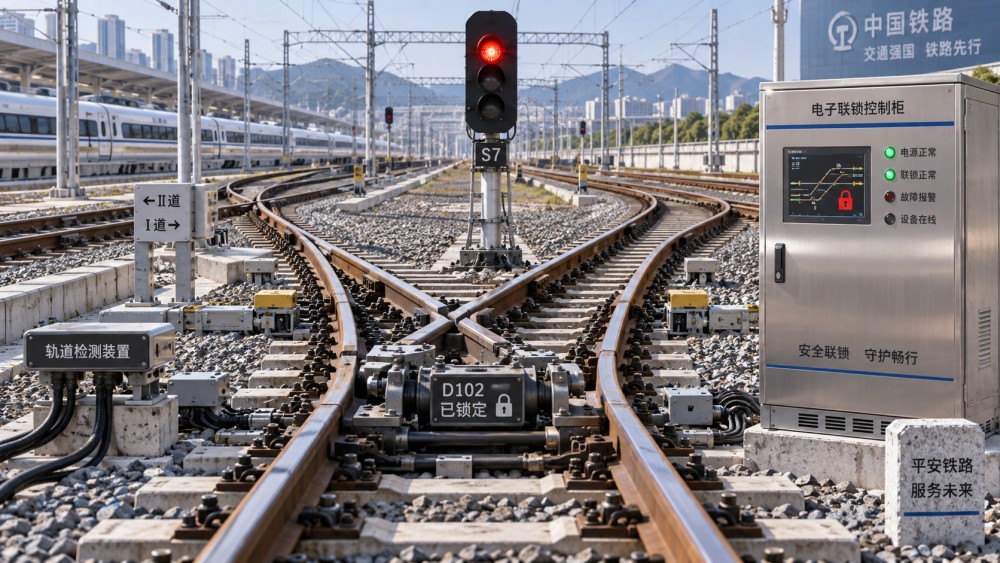
How rail fail safe systems respond to the most consequential fault types
Loss of train detection confidence
Track circuits and axle counters are essential because route safety depends on knowing whether a train, vehicle, or obstruction may be present. A broken rail can, in some track-circuit applications, produce a more restrictive indication, while an axle counter section may enter an “occupied” or “unknown” state following a counting irregularity. The exact behavior depends on the technology and application conditions, but the safety objective remains constant: no route may rely on an unproven clear section.
Quality teams should pay close attention to reset controls. Resetting an axle counter is not merely an operational convenience; it changes the safety basis for a section of track. Access authorization, reset conditions, event logging, local verification procedures, and protection against inadvertent reset all require disciplined review.
Switch detection and route-locking faults
A turnout can be mechanically moved but not safely locked, or it may be detected in a position that does not match the commanded route. Fail-safe logic uses independent detection contacts, locking circuits, timing controls, and route locking to ensure that a signal cannot clear prematurely. Once a train has approached or entered a route, the route is usually locked against cancellation or point movement until release criteria are met.
The critical issue is not only whether the point machine operates during a routine test. Inspectors need to verify that failures such as loss of detection, contradictory indication, motor overrun, wiring reversal, and power interruption produce the specified restrictive state. A point that cannot be proved safe must be operationally treated as unavailable.
Vital processor disagreement
Modern electronic interlockings often use redundant processing channels, frequently arranged in a comparison-based or voting architecture. These channels perform the same vital calculation independently. When outputs agree and diagnostics confirm healthy operation, the system can command field equipment. When a discrepancy occurs, the architecture is designed to inhibit unsafe outputs and record the fault for investigation.
Redundancy alone is not enough. Two processors running identical software can share the same systematic defect. For that reason, railway safety engineering also relies on requirements management, formal verification where appropriate, independent assessment, controlled software versions, defensive coding practices, and rigorous test coverage. Hardware duplication reduces random failure exposure; disciplined lifecycle assurance addresses systematic failure risk.
Communications failure in CBTC and moving-block operation
CBTC systems depend on continuous or frequent exchange of position, speed, movement authority, and route data. If train-to-wayside communication degrades, the system must transition predictably. Depending on the operating concept, this may mean reducing speed, enforcing a restrictive fallback authority, reverting to fixed-block protection, stopping the train, or placing the affected area under manual procedures.
The safe response should not be judged only by whether a train stops. It should be judged by whether the transition preserves separation, prevents conflicting route release, communicates the correct status to operators, and avoids introducing new hazards during degraded operation. A technically safe stop that leaves dispatchers with ambiguous route status can still create a difficult recovery environment.
Interlocking is the barrier that prevents an unsafe route
The interlocking is often described as the “brain” of signaling, but for safety managers it is more useful to see it as a controlled barrier between operational intent and train movement. A dispatcher may request a route. An automatic route-setting function may request one faster. Neither request is permission in itself.
The interlocking checks the route table, conflict matrix, track occupancy, point positions, locking status, and associated protections before it allows a signal to clear or sends a movement authority. Where a fault affects any condition required for route integrity, the safe action is usually route denial, signal replacement to danger, authority shortening, or controlled system shutdown.
Route locking is particularly important during a fault. Without it, a route could theoretically be altered after a train has accepted a movement authority but before it has passed the protected points. Approach locking, back locking, sectional route release, and emergency release functions are therefore governed by carefully defined timing and operational constraints. Emergency release must never become an informal workaround for traffic pressure.
Safety integrity: what SIL4 evidence should actually show
In many mainline and urban rail applications, vital signaling functions are developed against the CENELEC railway standards framework, including EN 50126 for RAMS lifecycle processes, EN 50128 for railway software, and EN 50129 for safety-related electronic systems. Current projects may also reference successor or related IEC/EN standards depending on the jurisdiction and procurement baseline. SIL4 is commonly associated with functions where failure could have severe consequences, but a SIL label alone does not prove that a complete installation is safe.
A credible safety case should connect the safety claim to the real railway application. It needs to show, among other things, the defined hazards, operational assumptions, system boundaries, allocation of safety functions, design evidence, verification results, independent assessment activities, and residual risks. It should also explain how changes are controlled after commissioning.
For a fail-safe route-setting function, evidence may include:
- Hazard analysis covering conflicting movements, wrong-side failures, loss of detection, and human intervention.
- Requirements traceability from the operational rule through interlocking data and software logic to test results.
- Factory and site acceptance tests that inject credible faults, not only normal operating commands.
- Verification of route tables, point control circuits, signal aspects, overlap logic, and interface conditions.
- Configuration records proving which application data, firmware, and safety-approved versions are installed.
- Maintenance instructions that preserve the validated safety function after replacement, adjustment, or modification.
Where quality assurance often finds the real weakness
Many railway signaling failures do not originate in the core safety logic. They emerge at boundaries: a revised route table not reflected in the test script; a replacement input module installed with the wrong configuration; a cable termination that passes continuity testing but reverses an indication; a temporary maintenance bypass left active; or a software update deployed without a complete regression assessment.
This is why safety-critical quality control must follow the full configuration chain. Hardware serial numbers, application data versions, wiring records, test certificates, change notices, and operational instructions should be mutually consistent. If they cannot be reconciled, the organization does not have dependable evidence that the released system matches the assessed system.
Another weak point is the treatment of intermittent faults. A communication dropout that self-recovers may look harmless in a maintenance log, yet repeated recoveries can reveal an unstable interface, electromagnetic compatibility issue, power-quality problem, or network timing defect. Trend review is therefore as important as responding to individual alarms.
Testing the restrictive state, not just the normal state
Acceptance testing can become overly focused on demonstrating that routes set correctly under ideal conditions. That proves functionality, but fail-safe performance is revealed when conditions are deliberately made abnormal. A useful test strategy includes fault injection at the level permitted by the safety plan: disconnecting or simulating loss of indication, creating inconsistent detection states, interrupting communications, applying invalid messages, removing redundant channels, and checking recovery after power restoration.
The expected result should be explicit. “System alarm generated” is not enough. Test records should confirm whether the signal returned to danger, whether a movement authority was withdrawn or shortened, whether points remained locked, whether conflicting routes stayed blocked, whether the event was timestamped, and whether recovery required authorized action.
Human factors belong in this testing as well. Controllers and maintainers need clear indications of what has failed, what movement restrictions now apply, and what actions are prohibited. Ambiguous alarms encourage unsafe improvisation, especially during peak disruption.
A practical review checklist for safety and quality managers
When reviewing rail fail safe systems, ask a direct question: what exact condition causes this route to become restrictive, and how do we know that condition is enforced? Then trace the answer through design, test, operation, and maintenance.
- Identify every input that is essential to route safety and define its safe state for loss, corruption, delay, and contradiction.
- Confirm that permissive outputs require positive proof, rather than relying on the absence of an alarm.
- Review route-locking, emergency-release, and degraded-mode rules with actual operational scenarios.
- Check that safety-related application data is independently reviewed and protected against unauthorized changes.
- Examine fault logs for repeat events, intermittent communication losses, unexpected resets, and unresolved diagnostic patterns.
- Verify that maintenance bypasses, test modes, and temporary jumper arrangements are controlled, recorded, and removed.
- Ensure post-change testing reflects the final installed configuration, not an earlier design baseline.
Safe railway movement depends on more than a red signal or a redundant computer. It depends on a disciplined system that converts doubt into protection, keeps incompatible routes apart, and gives operators a controlled path through failure. When rail fail safe systems are specified, tested, and maintained with that mindset, signal faults may still disrupt the timetable—but they do not have to become unsafe routes.
Related News
- How rail fail safe systems prevent unsafe routes during signal faultsSep 20, 2026Rail fail safe systems prevent unsafe routes during signal faults through restrictive logic, route locking, and proven safety controls. Discover key safeguards.
- How signaling redundancy design for metro systems limits single-point failuresSep 04, 2026Explore signaling redundancy design for metro systems: prevent single-point failures with independent CBTC paths, failover testing, and resilient operations.
- Electronic Interlocking System vs Legacy Signaling: What MattersJul 15, 2026Electronic interlocking system vs legacy signaling: compare safety, capacity, diagnostics, integration, and lifecycle cost to choose the smarter rail upgrade path.
- Digital Rail Signaling Systems: Key Factors for Safer Network UpgradesJul 08, 2026Digital rail signaling systems are reshaping safer network upgrades. Explore key factors like interoperability, SIL4 safety, migration planning, and lifecycle value.