




Search
Related News
- 00
0000-00
How CBTC supports subway train density management at peak hours - 00
0000-00
How traction converter losses affect high-speed rail efficiency - 00
0000-00
How train crossing pressure waves in China affect nearby structures - 00
0000-00
How fatigue fracture analysis testing identifies crack initiation risks - 00
0000-00
What Nadcap aerospace forgings approval means for part quality
How CBTC supports subway train density management at peak hours




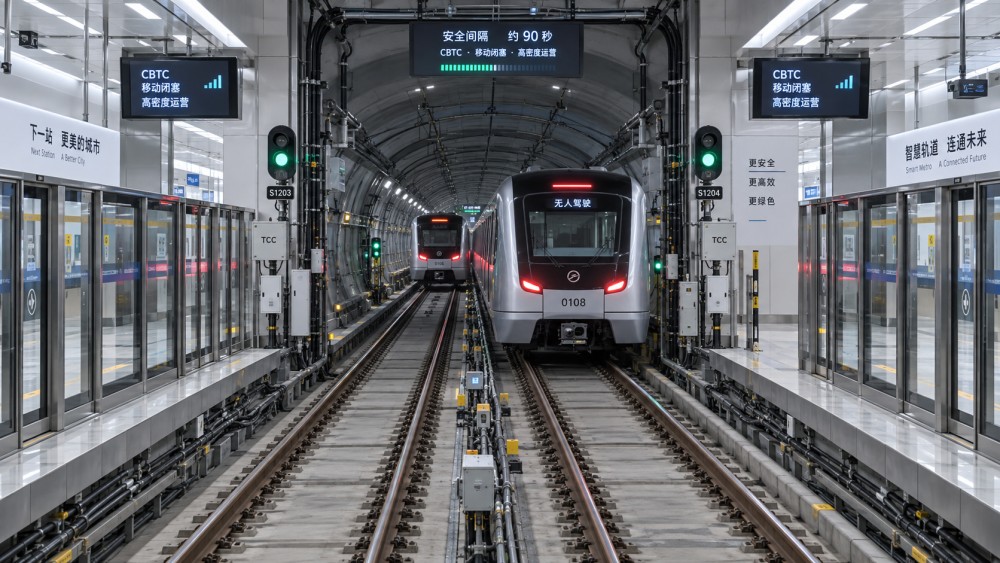
Peak-period subway train density management is not solved by simply placing more services into the timetable. Once trains operate close together, small variations in station dwell time, passenger boarding, traction performance, or route availability can propagate quickly through the line. Communication-Based Train Control (CBTC) supports higher train density by replacing broad, fixed separation assumptions with continuous information about where trains are, how they are moving, and what safe movement authority remains available.
The practical value of CBTC is not that it makes every metro line run at the same minimum headway. Its value is that it lets the signaling and control system manage separation dynamically while enforcing safe speed and braking limits. At peak hours, this gives operators more usable capacity from existing track, provided that station operations, rolling stock performance, communications, and recovery procedures can support the intended service level.
Why fixed-block signaling reaches a capacity limit
In a conventional fixed-block arrangement, the railway is divided into track sections. A following train must remain outside protected blocks behind the leading train, even when the leading train has already moved far enough ahead that a shorter spacing would be safe. This approach is robust and well understood, but it can leave capacity unused because the protection distance is determined by block length and conservative worst-case conditions rather than the real-time position of each train.
That limitation becomes visible during crowded periods. A train delayed at a platform may prevent the next train from entering an upstream block. The following service then slows or stops earlier than operationally necessary, passengers accumulate on its platforms, and the delay begins to spread. Adding another scheduled train can make this worse if the line has already reached its practical signaling or station-handling limit.
CBTC changes the basis of separation. Instead of relying only on the occupancy state of fixed track circuits, it combines train-borne position information, route status, speed supervision, and train-to-wayside communications. The control system can then calculate a movement authority suited to the train’s current condition and the train ahead. This is the foundation for more responsive subway train density management.
Moving block makes spacing responsive, not arbitrary
The most familiar CBTC capacity mechanism is moving-block operation. A moving block is not a literal moving section of track. It is a continuously calculated safety envelope behind the leading train. The following train receives a limit of movement that accounts for the leading train’s reported position, train length, braking characteristics, speed, safety margins, track geometry, and the system’s confidence in position and communication status.
When the leading train accelerates away from a station, the following train can receive an updated authority and begin accelerating sooner than it would under a coarse fixed-block arrangement. When the leading train brakes, the following service is automatically supervised so that its permitted speed remains safe. The spacing is therefore based more closely on actual braking separation rather than a predetermined block layout.
That does not mean trains can run “as close as possible.” Safe headway remains constrained by braking curves, train response time, route conflicts, station dwell time, junction operation, and the ability to clear platform areas reliably. Moving block reduces unnecessary spacing; it does not remove the physical and operational constraints that set the line’s usable capacity.
Train positioning and speed supervision are equally important
High-density operation depends on knowing train location with sufficient integrity and availability. CBTC normally derives position from onboard sensors and uses wayside references or other methods to correct accumulated error. The exact architecture varies, but the operational purpose is consistent: the system must maintain a reliable estimate of where the train is and whether that estimate remains valid.
Positioning quality affects both safety and capacity. If the system has to apply a larger uncertainty margin, it must reserve more separation distance. If it loses confidence in position or communications, it may transition to a more restrictive operating mode. A capacity claim based only on nominal moving-block headway can therefore be misleading unless it also addresses degraded-mode behavior and the frequency of transitions into it.
Automatic train protection enforces the permitted speed profile. This matters particularly when drivers or automatic train operation systems are managing trains through closely spaced station approaches. The protection function supervises overspeed, movement authority limits, and braking intervention. In practical terms, it prevents a local effort to recover time from turning into an unsafe reduction in separation.
Peak capacity is often limited at stations, not between stations
CBTC can reduce line headway, but it cannot make passengers board and alight instantly. On busy urban lines, station dwell-time variation is frequently the controlling issue. A train that holds its doors longer than planned occupies the platform and delays the train behind it. If the next train arrives too closely, passengers may face a crowded platform while the service waits outside the station.
This is why the best CBTC design assessment starts with the actual bottleneck. If train separation on open track is the limitation, moving block and automated regulation may release meaningful capacity. If the limiting factor is a small interchange platform, slow door cycling, passenger circulation, terminal turnback, or a conflicting junction movement, signaling modernization alone will not achieve the expected density.
CBTC still helps in these cases because it can regulate arrivals more intelligently. Rather than allowing trains to compress until they queue at a station throat, an automatic train supervision layer can adjust running time, holding, and departure sequencing. The objective is not merely the shortest theoretical headway. It is a stable flow in which trains arrive at platforms with enough spacing to absorb normal dwell variation.
Headway and service reliability must be assessed together
A timetable can show an aggressive interval between departures while the railway performs poorly in service. The distinction is important. The minimum technical headway is the shortest interval that may be possible under defined conditions. The sustainable operating headway is the interval a line can repeatedly deliver while dealing with ordinary passenger fluctuations, minor equipment delays, and routine operational interventions.
For peak operation, sustainable headway is usually the more useful measure. A plan that operates near the absolute signaling limit leaves little recovery margin. A delayed train may then create a dense queue, and recovery can take longer than the original disturbance. Conversely, a slightly less aggressive plan can carry passengers more predictably when it preserves margin at critical stations and junctions.
How CBTC supports regulation when service begins to degrade
CBTC is often discussed as a train separation technology, but its operational benefit also comes from the interaction of automatic train protection, automatic train operation, and supervisory control. With accurate train state information, the control center can see emerging gaps and close-in services earlier than would be practical with manual monitoring alone.
Automatic train operation can improve consistency in acceleration, braking, and station stopping. Consistency matters because train density depends on repeatable behavior. If each train approaches a platform at a different speed or stops at a different point, dwell time and following distance become less predictable. Automation can reduce that variability, although it cannot compensate for overcrowded platforms or an unavailable route.
At the supervisory level, service regulation should be designed around consequences rather than a single rule such as “hold every early train.” Holding may restore spacing in one part of the line while creating platform crowding elsewhere. The control strategy needs to consider passenger demand, downstream platform capacity, terminal capacity, turnback state, and the availability of alternative routes or sidings.
During a disruption, the ability to degrade safely is as important as nominal performance. A CBTC system should define what happens when a train loses communications, when train localization becomes unavailable, when a wayside zone controller fails, or when a route cannot be set. Reduced functionality may require lower speed, larger separation, restricted manual operation, or temporary fallback signaling. These modes determine whether a line can maintain a reduced but orderly service instead of suffering a broad operational collapse.
What to examine in a CBTC capacity assessment
A credible assessment links the signaling design to the entire operating railway. Looking only at a supplier’s stated headway capability does not establish that the network can run that service pattern. The following questions expose whether the proposal has been tested against real constraints:
- What is the limiting location? Identify whether the constraint is open-line separation, station dwell, a junction, a terminal turnback, depot access, or power and platform capacity.
- Which assumptions define braking separation? Review train braking performance, adhesion assumptions, gradient, train length, speed, response time, and position uncertainty. Capacity depends on the margins built into these assumptions.
- How is dwell-time variability represented? A uniform dwell-time assumption may be adequate for a first concept, but peak-service validation needs variation at the busiest stations.
- What happens in degraded modes? Examine the resulting operating capacity after communications, localization, onboard equipment, or wayside functions are impaired. Nominal moving-block operation is only part of the operating case.
- Can the rolling stock support the control strategy? Door reliability, propulsion response, braking consistency, onboard CBTC interfaces, and train-borne equipment maintenance all affect regularity.
- Are junctions and terminals modelled explicitly? A high-capacity main line can still be constrained by conflicting routes, platform reoccupation time, reversing moves, or crossing traffic.
Simulation is useful when it represents these interactions rather than presenting a clean, disturbance-free timetable. The useful output is not just an average headway. It is the distribution of delays, queue formation at constrained locations, recovery time after disturbances, and the operating margin left at the busiest points.
Safety integrity should not be separated from capacity claims
CBTC supports capacity because it is a safety-critical control system, not because it relaxes safety. Functions such as movement authority calculation, train separation, overspeed protection, and vital communications handling must be designed so that failures lead to safe behavior. In metro procurement and upgrade work, the relevant question is whether the safety architecture supports the planned operating concept under both normal and fault conditions.
For example, a highly available communications network can support continuous movement-authority updates, but the system must also respond safely to delayed, corrupted, or missing messages. Redundancy, diagnostics, fault isolation, and controlled fallback modes affect availability and therefore capacity. A design with strong nominal throughput but frequent restrictive fallback can be less useful than one with a modestly higher nominal separation but stable operation.
Interoperability also deserves attention in modernization projects. Existing interlockings, platform screen doors, passenger information systems, traction power controls, radio networks, and rolling stock interfaces can influence commissioning risk and operational resilience. The CBTC design must define ownership of each interface, failure behavior across that interface, test responsibilities, and the transition arrangement during cutover.
Common mistakes in subway train density planning
One common mistake is treating moving block as a guaranteed capacity result. It is a capability, not an outcome independent of the railway around it. A line with uneven station dwell times or constrained terminals may receive less benefit than a line where fixed-block spacing is the dominant limitation.
Another is designing for the best observed train performance rather than the service fleet’s dependable performance. Headway calculations should use conditions that can be sustained by trains in normal operational condition, not exceptional runs with ideal adhesion, rapid boarding, and no route conflict.
A third mistake is viewing fallback as a commissioning detail. Peak-hour operating plans need explicit rules for how the railway continues when a component or communication path is unavailable. Those rules affect staffing, passenger management, timetable recovery, and the practical value of the upgrade.
Finally, capacity work can fail when it is isolated from maintenance planning. Train-borne sensors, antennas, wayside equipment, radios, and data interfaces require inspection, fault diagnosis, configuration control, and spares support. The system’s ability to preserve reliable close operation depends on maintaining the integrity of these elements over its lifecycle.
A practical decision sequence
Before selecting a CBTC scope or accepting a peak-capacity target, establish the current source of delay and the future operating pattern. Map the busiest stations, junctions, terminal movements, and planned changes to ridership or service structure. Then test whether the proposed control architecture improves the specific limiting condition.
Next, examine the end-to-end operating concept: normal moving-block service, automatic regulation, manual intervention, degraded modes, recovery after disruption, and interface behavior. This prevents a narrow comparison of radio technology or nominal headway figures from driving the decision.
For organizations comparing signaling technologies, rolling-stock interfaces, and lifecycle implications, specialist transit intelligence resources such as Global Aerospace & Advanced Transit Systems can help frame the discussion around moving-block control, safety integrity, maintenance exposure, and procurement risk. The useful outcome is a capacity case that explains not only how closely trains may run, but how reliably the railway can keep them moving when peak conditions are less than ideal.
Related News
- How CBTC supports subway train density management at peak hoursSep 26, 2026Subway train density management: discover how CBTC uses moving-block control, real-time supervision, and smarter regulation to boost peak-hour capacity safely.
- How a CBTC fallback system keeps trains moving after link lossSep 24, 2026CBTC fallback system: learn how rail operators maintain safe train movement, restore positioning, and limit disruption after communication link loss.
- How safe train control technology reduces headway without raising riskAug 23, 2026Safe train control technology explained: learn how moving block, SIL4 design, and fail-safe control cut headway while protecting braking distance, reliability, and real-world rail capacity.
- EASA Tightens SIL4 Rules for EU-Bound CBTC ExportsAug 09, 2026CBTC exports to the EU face tighter SIL4 compliance as EASA updates rules. Learn the March 2027 deadline, IV&V impact, and how suppliers can protect market access.