








A missing lot number or disconnected inspection record can turn a routine aerospace fastener check into a costly investigation, delaying production and complicating safety decisions.
For quality control and safety teams, aerospace manufacturing digital transformation offers a practical way to close these traceability gaps through connected records and controlled workflows.
Linking batch identifiers, material certificates, production records, and inspection results helps manufacturers trace fasteners through production, delivery, installation, and maintenance wherever those records are available.
The critical improvement is precise containment: identifying affected stock and assemblies quickly, while preserving trustworthy evidence about material origin, processing history, inspection results, and release authorization.
What must a trustworthy fastener traceability record show?
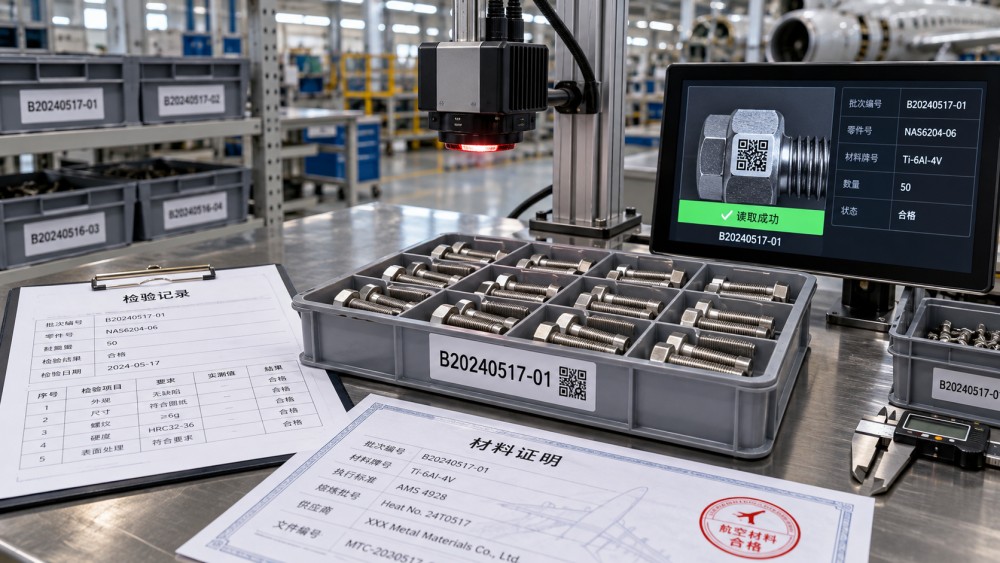
A useful traceability system must answer four questions: what the fastener is, where it came from, what happened to it, and where it went.
For aerospace fasteners, identity usually starts with the part number, applicable specification or drawing revision, manufacturer, and lot identifier. Some applications also require individual serialization.
Traceability depth should follow contractual, regulatory, design, and customer requirements. Individual serialization is not automatically necessary for every rivet, bolt, nut, or washer supplied.
Material heat numbers and manufacturing lot numbers describe different groupings. The system must preserve their relationship without assuming that either identifier uniquely represents the other.
Processing records may include forming, machining, heat treatment, thread rolling, coating, nondestructive testing, and dimensional inspection, depending on the product specification and manufacturing route.
Final records should connect applicable certificates, inspection outcomes, nonconformances, concessions, and authorized release decisions. A certificate alone cannot establish the complete history of a shipment.
Location and quantity records complete the picture. Teams need visibility into receiving, storage, production issue, returns, shipment, and installation records at the required traceability level.
Where do traceability gaps usually enter the process?
Most gaps arise at handoffs: when suppliers submit documents, receiving teams relabel containers, operators split batches, or production moves fasteners between storage and assembly stations.
A spreadsheet may list a supplier lot correctly while an inspection report uses an internal batch number. Without an explicit relationship, investigations depend on manual reconstruction.
Container splits create another common failure. If one accepted lot becomes several bins, each child container must retain its source identity and relevant acceptance status.
Mixing fasteners from different lots requires particular care. Where permitted, the system must preserve every contributing lot; otherwise, procedures should prevent mixing and require segregation.
Rework and outside processing introduce additional relationships. A returned coating batch, for example, needs a documented connection to the fasteners sent and the processing performed.
Photographs, scanned certificates, and shared folders can support investigations, but searchable files alone do not establish reliable links between material, processing, inspection, and physical inventory.
Before selecting technology, quality teams should map these handoffs and identify where identity, quantity, status, or approval information can become separated from the actual fasteners.
How do connected systems prevent these failures?
Digital transformation becomes useful when business systems exchange controlled identifiers and events. Buying software without defining these relationships can simply reproduce existing gaps electronically.
The enterprise resource planning system typically manages purchasing and inventory. Manufacturing execution systems capture production events, while quality management systems control inspections, nonconformances, and dispositions.
Document management systems preserve certificates and approved records. Integration should connect these sources through stable identifiers, while clearly assigning ownership for each category of information.
At receiving, staff can scan a container label, match its supplier lot to purchase requirements, and attach verified certificates before assigning an internal inventory identity.
Automated document extraction can reduce typing, but critical fields still need validation. Ambiguous heat numbers, missing pages, or mismatched specifications should trigger review before acceptance.
During production, scans can record lot consumption, container transfers, inspection completion, and assembly association. Transactions should occur at the physical handoff to reduce retrospective guesswork.
A barcode or Data Matrix code identifies a record; it does not prove authenticity. RFID likewise improves capture only when labeling, read performance, and exceptions are controlled.
How does digital traceability improve defect containment?
The strongest operational benefit is a faster, evidence-based answer to a specific concern: which inventory, shipments, and assemblies could contain fasteners from an affected population?
Consider a hypothetical case where a processor reports that one heat treatment load may have failed to meet an approved requirement for a fastener family.
A connected system can trace that load to manufacturing lots, remaining containers, deliveries, and recorded assembly consumption. It should also identify missing or ambiguous downstream links.
Quality personnel can then apply controlled holds to relevant inventory and work orders. Customer notifications and product dispositions still require authorized assessment under applicable procedures.
The investigation should check both directions: backward to material and processing history, and forward to every known destination of the potentially affected fasteners or containers.
Quantity reconciliation strengthens the result. Received, processed, scrapped, returned, shipped, and remaining quantities should balance within defined rules, with unexplained differences investigated before narrowing containment.
Digital records support proportionate containment only when their completeness is established. An absent installation link cannot be treated as evidence that an aircraft is unaffected.
What makes digital evidence dependable during audits?
Audit readiness depends on record integrity, retrieval, and context. A dashboard showing complete records is insufficient if users can overwrite inspection results without retaining history.
Controls should include role-based access, attributable approvals, timestamps, revision history, and audit trails. Corrections should preserve the original entry and document who changed it and why.
Electronic approvals must meet applicable customer, regulatory, and organizational requirements. A typed name or shared login should not be assumed to provide an acceptable authorization record.
Inspection data also needs context: the applicable requirement, measurement units, acceptance criteria, equipment identity, and relevant calibration status. A pass flag alone provides limited evidence.
Interfaces require validation against intended use. Test missing messages, duplicate transactions, delayed updates, and conflicting statuses, including whether quarantined inventory can accidentally remain available elsewhere.
During outages, controlled fallback procedures must preserve identity and authorization. Reconciliation after recovery should detect duplicated transactions, omitted events, and any conflicting release decisions recorded.
Retention, backups, recovery testing, and readable exports matter throughout the required record lifecycle. Records must remain accessible even when suppliers, applications, or hosting arrangements change.
Which standards and supplier documents should teams check?
Applicable requirements vary by product, customer, jurisdiction, and organizational role. Start with contractual obligations and approved procedures, then map each requirement to specific evidence and controls.
AS9100 includes identification and traceability requirements, where applicable, alongside controls for documented information and product release. Software installation by itself does not demonstrate conformity to them.
AS9102 first article inspection records can contribute relevant evidence when required. They do not replace ongoing production acceptance records or establish traceability for every subsequent shipment.
Nadcap accreditation may be relevant to outsourced special processes when contractually required. Verify the supplier’s approved scope and status against the process and timing involved.
Airworthiness release documentation, including FAA Form 8130-3 or EASA Form 1, is context-dependent. These forms are not universally required for every aerospace fastener shipment received.
Receiving controls should verify required documentation against the actual delivery. Check manufacturer identity, part number, lot references, quantities, specification references, and any customer-specific certification requirements.
Digital traceability can expose inconsistencies and support counterfeit-part prevention, but it cannot independently prove material authenticity. Supplier qualification and appropriate verification remain essential quality controls.
How should quality teams introduce the system?
Begin with one fastener family or a contained production flow that has recurring traceability problems. Document the existing process and establish a measurable performance baseline.
Define the required traceability level before configuring software. Decide which events require lot identification, container identification, assembly association, or individual serialization, and record the rationale.
Standardize identifiers and mandatory fields across participating teams. Include rules for supplier aliases, leading zeros, revision formats, duplicate lot references, and permitted changes to records.
Agree on supplier data expectations early. Smaller suppliers may need a controlled portal or document submission process before they can support structured system-to-system data exchange.
Test the physical workflow with receiving staff, inspectors, warehouse operators, and production personnel. Labels must remain legible and scanning must work under actual operating conditions.
Run a mock containment exercise using a known lot and a deliberately introduced record exception. Verify retrieval, quantity reconciliation, inventory holds, and authorized resolution procedures.
Expand after the pilot meets agreed acceptance criteria. Assign ongoing ownership for master data, interface monitoring, access reviews, supplier changes, and unresolved traceability exceptions across departments.
Which measures show whether the investment is working?
Measure investigation time from the initial concern to a verified affected population. Separate system retrieval speed from the time needed to assess incomplete or contradictory evidence.
Track traceability completeness at defined handoffs, certificate matching accuracy, unresolved exceptions, and the age of missing records. Specify denominators so performance cannot improve through selective reporting.
Monitor unauthorized inventory use attempts and hold propagation failures. These measures show whether digital controls influence actual material movement, rather than merely improving record presentation.
Evaluate costs using the organization’s own baseline: investigation labor, production holds, expedited replacements, audit preparation, and unnecessary containment. Avoid assuming that every benefit becomes cash savings.
For quality and safety teams, aerospace manufacturing digital transformation succeeds when trusted records support timely decisions, controlled material use, and defensible containment across the fastener lifecycle.
The practical test is straightforward: select a lot, reconstruct its history, identify its destinations, and explain every exception. Reliable performance here demonstrates meaningful traceability improvement.