




Search
Related News
- 00
0000-00
How digital transformation improves aerospace fastener traceability - 00
0000-00
GE Aerospace Completes Key Open Fan Low-Pressure Turbine Tests in Poland - 00
0000-00
How creep limits high-temperature materials for advanced propulsion - 00
0000-00
Honeywell Joins Xiamen Aviation Park, Complementing Taikoo Landing Gear Repairs - 00
0000-00
How single-crystal casting expertise builds aerospace process moats
Can a rail signaling systems manufacturer support legacy interlocking?




Yes—a rail signaling systems manufacturer can support legacy interlocking, but compatibility must be demonstrated, not assumed. Retaining relay equipment, extending an older electronic interlocking, and connecting either to a modern control center are different engineering tasks. Each requires evidence that the proposed changes preserve the safety functions of the installed railway.
For technical evaluators, the real question is not simply whether a supplier can establish communication. It is whether that supplier understands the existing installation, can define a defensible safety boundary, and can maintain the resulting configuration throughout its service life. A successful demonstration is useful; an approved, maintainable integration is the objective.
Define what “legacy support” means before comparing suppliers
A tender asking for “legacy compatibility” leaves too much room for interpretation. One manufacturer may offer spare-parts repair, another may supply a protocol gateway, and a third may propose replacing most of the interlocking. All could describe their offer as support.
Separate the requirement into specific work packages. This makes technical proposals comparable and exposes gaps before commercial commitments become difficult to reverse.
Also identify the exact equipment versions involved. A product family name does not establish compatibility with every processor revision, firmware release, communications card, or site-specific application. Procurement should define the supported configuration, not merely the brand.
The first engineering task is discovering what is actually installed
On an established railway, the drawings, maintenance records, and physical installation may not tell precisely the same story. Previous alterations, emergency repairs, undocumented substitutions, and obsolete diagnostic tools can complicate the starting point.
A credible manufacturer will therefore ask for more than the original design package. Expect requests for current control tables, signaling plans, relay circuit diagrams, cable schedules, application-data versions, fault history, and operating rules. Site inspection and controlled checks may be needed to reconcile these records.
The output should be an agreed as-found baseline. Any uncertainty affecting a safety function must be resolved or explicitly managed before design approval. Treating missing information as an assumption to be checked during commissioning creates avoidable pressure at the most time-constrained stage.
Asset condition matters just as much as documentation. An interface may be technically sound while aging wiring, deteriorated insulation, unreliable power supplies, or unsupported processor modules remain the dominant availability risks. Integration should not be used to conceal an installation that can no longer be maintained confidently.
Where a rail signaling systems manufacturer must prove compatibility
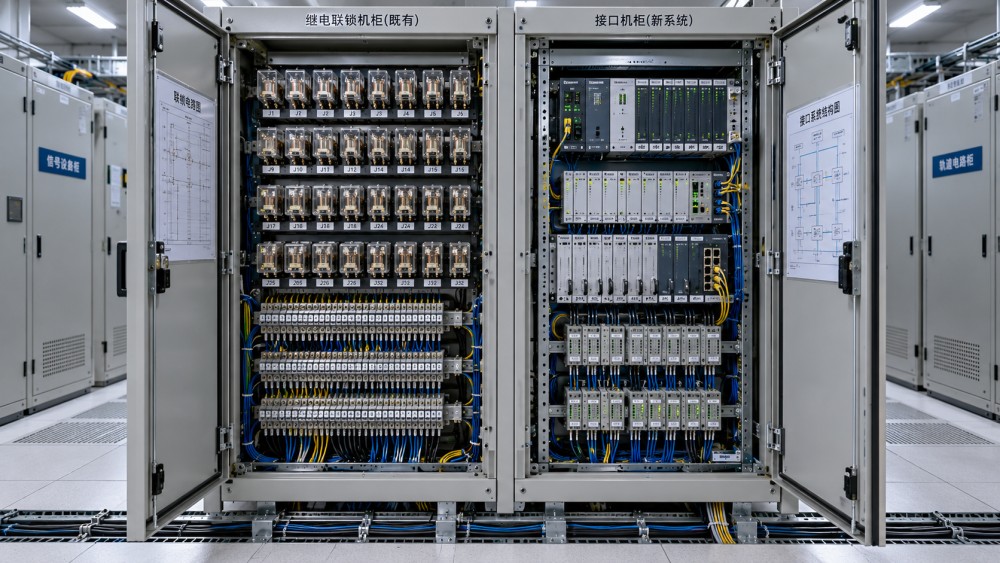
The most revealing part of an evaluation is the proposed interface boundary. Ask the manufacturer to show which equipment issues commands, which equipment validates them, and which equipment retains responsibility for route locking, point locking, train detection dependencies, and signal clearance.
A new supervisory system would normally request routes rather than bypass the interlocking’s safety logic. If the proposal moves a safety responsibility across that boundary, it requires more than a communications change: the architecture, hazard analysis, and assurance evidence must reflect the transfer.
Electrical compatibility is not just matching voltage
For relay installations, evaluation may include contact arrangements, relay characteristics, circuit loading, isolation, surge protection, earthing, and electromagnetic compatibility. A nominally suitable output can still interact incorrectly with the receiving circuit because of leakage current, pulse duration, or failure behavior.
Ask how the proposed design handles open circuits, short circuits, welded contacts, loss of supply, and unintended energization. The required response depends on the circuit’s function and the railway’s principles; there is no universal “de-energized equals safe” shortcut for every interface.
Protocol compatibility is not semantic compatibility
With electronic interlockings, a gateway may exchange valid messages while interpreting their operational meaning incorrectly. Route cancellation, emergency release, local control, maintenance inhibition, and degraded operation deserve particular attention.
The interface specification should define message meaning, command acknowledgment, sequencing, timeout behavior, data freshness, startup synchronization, and recovery after interruption. It should also distinguish “command received” from “command executed” and from “field state confirmed.” Confusing those states can mislead operators even when the interlocking itself remains protective.
Communications faults need an operationally safe response
Test delayed, duplicated, corrupted, missing, and out-of-order messages, together with link failure and restoration. Define what happens to pending commands and displayed indications when data becomes stale. Restarting a gateway must not silently replay an obsolete command or present unverified information as current.
Where transmission carries safety-related information, the communications assurance approach must address the relevant transmission threats. Where it carries only supervisory information, the manufacturer must still show that failures cannot undermine the safety boundary or create unacceptable operational ambiguity.
Ask for a safety argument, not a certificate collection
Certificates and previous approvals can support supplier qualification, but they do not automatically approve a new integration. A certified component may be used outside its assessed conditions, and a proven interface may behave differently with another site’s circuitry or application data.
The manufacturer should explain the applicable assurance framework and how it fits the jurisdiction, infrastructure manager’s rules, and project scope. Relevant references may include EN 50126 for the RAMS lifecycle, EN 50129 for safety-related electronic signaling systems, and the applicable railway software standard. Confirm the required editions and acceptance arrangements rather than assuming one standards list applies everywhere.
Likewise, a SIL4 claim is not blanket evidence that every connected subsystem, interface, or migration stage is acceptable. Safety integrity requirements must follow the allocated functions and hazard analysis.
Request a project-specific evidence structure covering:
- Requirements traceability: a clear link from operational and safety requirements to design decisions and verification results.
- Hazard management: identified interface hazards, controls, assumptions, responsible parties, and closure evidence.
- Configuration control: identification of hardware, software, application data, drawings, and approved changes.
- Verification and validation: defined responsibilities, independence appropriate to the assurance regime, and acceptance criteria.
- Assessment and approval: the intended role of independent assessors, the infrastructure manager, and the relevant approving authority.
One useful challenge is to ask the supplier to trace a single safety-critical function from requirement through interface design to test evidence. A coherent answer reveals more than a large document index.
Build the test plan around failures and transitions
A laboratory demonstration of normal route setting is only a starting point. Legacy integration becomes demanding when equipment disagrees, communications recover unexpectedly, or operators enter a degraded mode.
Testing should combine representative equipment, suitable simulation, and site verification. Simulation is valuable for coverage, but its limitations must be explicit: it may not reproduce actual relay timing, electrical loading, field wiring faults, or every behavior of an obsolete processor.
Technical evaluators should look for four complementary layers:
- Logic verification: checking route conflicts, locking, release conditions, and altered control tables or application data against approved requirements.
- Interface testing: confirming electrical behavior, message interpretation, timing, fault handling, and restart behavior.
- Operational scenario testing: exercising normal service, degraded operation, local control, maintenance restrictions, and recovery procedures.
- Site acceptance and regression testing: confirming the installed configuration and verifying that retained functions remain correct after the changes.
Agree pass/fail criteria before execution. “No faults observed” is weaker than evidence showing the initial conditions, injected fault, expected response, actual response, configuration tested, and disposition of any discrepancy.
Include human factors in the review. Stale indications, ambiguous alarms, or inconsistent workstation labels can make a technically protective system difficult to operate. Operators and maintainers should validate the information they will rely on during disruptions.
Migration planning can decide whether the proposal is practical
A solution that works after a long shutdown may be unsuitable for a railway with short possession windows. Ask the manufacturer to explain the installation sequence, temporary arrangements, testing duration, staffing needs, and decision points for returning the railway to service.
Each intermediate configuration needs its own defined operating boundaries. During phased migration, responsibilities for route protection, train detection, traction-related interfaces, and control transfer must remain unambiguous. A final-state safety argument does not automatically cover temporary stages.
Recovery planning deserves equal scrutiny. Some cutovers can be reversed within the possession; others become difficult to reverse after wiring alterations or data changes. Require a realistic restoration method, a latest decision time, and criteria for suspending work. Do not accept “rollback available” without a demonstrated configuration and procedure.
Training, revised maintenance instructions, approved operating notices, and spare equipment should be ready before commissioning—not scheduled as follow-up activities.
Commercial support must match the engineering promise
Legacy support often depends on access rights. Determine whether the manufacturer can lawfully obtain interface documentation, modify application data, use proprietary tools, and secure specialist assistance. Where the original equipment manufacturer is involved, identify its contractual role and response obligations.
A third-party supplier may provide effective support, but that capability should be demonstrated rather than inferred. Conversely, original-supplier status does not eliminate the need to check retained expertise, tool availability, and support for the exact installed version.
Evaluate lifecycle cost beyond the integration price: possession time, bespoke gateway maintenance, licenses, repair turnaround, spares, cybersecurity upkeep, periodic testing, and eventual replacement all matter. Connecting previously isolated equipment may also introduce new cyber risks; segmentation, controlled remote access, logging, and change procedures should respect the limitations of older assets.
The contract should leave the operator with usable as-built records, approved configuration backups, maintenance instructions, and clear arrangements for future changes. Avoid creating a new dependency that makes the next upgrade harder than the present one.
A defensible selection decision
A rail signaling systems manufacturer is a credible legacy-support candidate when it can establish the installed baseline, prove interface behavior, preserve allocated safety functions, and deliver an approvable migration and maintenance plan. Gaps in safety responsibility, documentation access, or configuration ownership should be treated as unresolved risks—not minor details to settle after award.
Retaining an older interlocking can be a sound lifecycle decision when its condition, functionality, and support arrangements justify it. Where those foundations are weak, replacement may be the more defensible choice. The best proposal makes that distinction visible, giving evaluators evidence to protect today’s operation without closing off tomorrow’s railway.
Related News
- Can a rail signaling systems manufacturer support legacy interlocking?Oct 21, 2026Can a rail signaling systems manufacturer support legacy interlocking? Discover how to assess compatibility, safety evidence, and migration plans before choosing a supplier.
- How braking distance shapes high-speed rail signaling system designOct 15, 2026Explore rail signaling systems for high speed rail: learn how braking distance shapes safe separation and realistic headways, and what to check before accepting capacity claims.
- How rail fail safe systems prevent unsafe routes during signal faultsSep 20, 2026Rail fail safe systems prevent unsafe routes during signal faults through restrictive logic, route locking, and proven safety controls. Discover key safeguards.
- How signaling redundancy design for metro systems limits single-point failuresSep 04, 2026Explore signaling redundancy design for metro systems: prevent single-point failures with independent CBTC paths, failover testing, and resilient operations.