




Search
Related News
- 00
0000-00
How load spectra determine fatigue life in aerospace composites - 00
0000-00
How condition monitoring technology sensors detect rail defects early - 00
0000-00
How track design choices affect high-speed rail infrastructure costs - 00
0000-00
How CBTC supports subway train density management at peak hours - 00
0000-00
How traction converter losses affect high-speed rail efficiency
Metro Train Positioning Technology: Accuracy Limits in CBTC Operations




In CBTC operations, the quality of train localization determines how closely trains can run, how smoothly moving block logic performs, and how confidently operators can manage service recovery. That is why train positioning technology metro networks depend on is not a narrow subsystem issue. It sits at the junction of signaling safety, rolling stock behavior, communications performance, and maintenance discipline.
The headline promise of modern CBTC is precise, continuous train awareness. Yet real systems always work within accuracy limits. Sensors drift, wheel diameter changes, rail conditions vary, balise spacing matters, and latency cannot be ignored. For anyone comparing suppliers, reviewing technical claims, or assessing lifecycle risk, those limits matter more than brochure-level precision statements.
Why Position Accuracy Matters Beyond a Single Number
A useful image here is the gap between a calculated train position and the train’s real occupied envelope.
In practice, train positioning technology metro systems use is tied directly to safe separation. A reported position is never accepted as absolute truth. It is wrapped in uncertainty margins, integrity checks, and fail-safe assumptions.
This changes how performance should be judged. A supplier may cite sub-meter resolution, but operational value depends on confidence, update rate, fault detection, and recovery behavior after degraded readings. High apparent precision does not automatically produce shorter headways.
The more demanding the line, the more this becomes visible. Dense urban routes, junction-heavy corridors, driverless operation, and mixed braking conditions all expose weaknesses in localization design.
What Metro Train Positioning Actually Combines
CBTC localization is usually not one sensor and one algorithm. It is a layered estimation process. The onboard controller combines distance traveled, known track references, direction logic, train map data, and safety supervision rules.
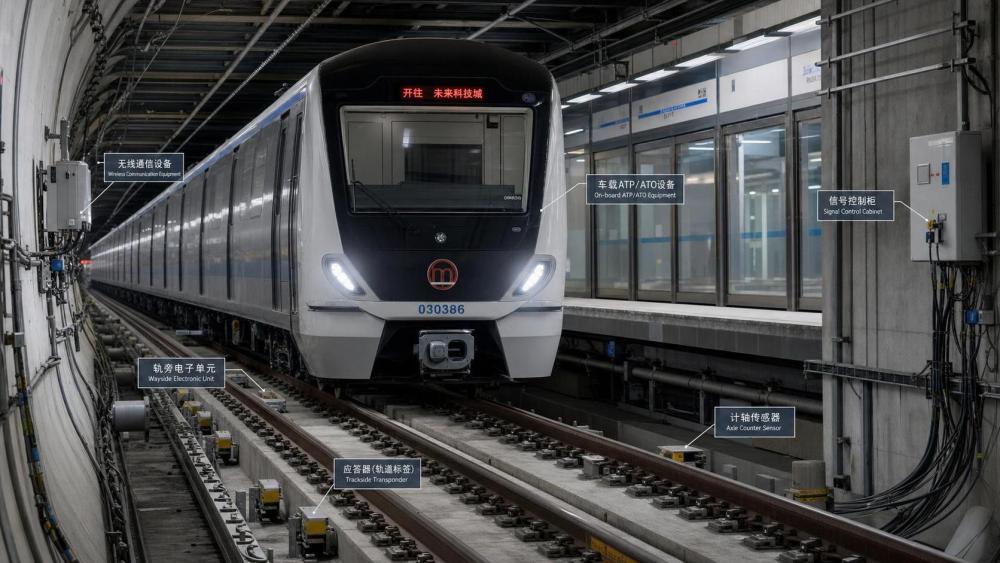
A typical architecture includes odometry, transponders or balises, tachometers, accelerometers, axle-related measurement, and radio links with zone controllers. Some systems add inertial support or advanced sensor fusion for difficult environments.
That is why train positioning technology metro applications cannot be evaluated only by asking whether the train “knows where it is.” The more relevant question is how the system maintains a trusted position under disturbance, transition, and component degradation.
Core contributors to position estimation
- Odometry provides continuous movement estimation between fixed references.
- Trackside references reset accumulated drift and confirm train identity or location.
- Onboard train and route databases translate movement into track-specific position logic.
- Radio communication supports movement authority updates and coordinated supervision.
- Safety software applies integrity rules when measured and expected states diverge.
Where Accuracy Limits Come From
The limits are physical before they are digital. Wheel slip during acceleration and wheel slide during braking distort distance measurement. The effect becomes more pronounced in rain, contamination, gradients, leaf residue, or emergency braking.
Wheel wear adds another layer. As wheel diameter changes over time, odometry scaling shifts unless recalibration and maintenance remain disciplined. Small errors accumulate quickly over long inter-balise distances.
Track geometry also matters. Curves, turnouts, crossovers, and complex depot layouts increase map interpretation complexity. In these areas, a localization error can affect route logic, door-side control, and platform stopping precision, not only headway.
Communication latency is sometimes discussed separately from localization, but operationally it belongs in the same conversation. A correct position delivered too late can still degrade moving block performance.
Safety integrity requirements impose another practical limit. SIL4-oriented logic is designed to distrust uncertain inputs. When confidence drops, the system increases protective margins. This protects operations, but it also reduces capacity and speed flexibility.
Common causes of degraded localization
Why the Industry Is Paying Closer Attention
Interest in train positioning technology metro projects is rising because urban rail operators want both more capacity and more resilience. They are no longer satisfied with headline automation claims alone.
Several trends are driving that shift. One is tighter headway targets on existing lines. Another is the expansion of unattended or highly automated operation, where localization confidence becomes central to safe control.
There is also a procurement reason. Transit authorities increasingly compare lifecycle performance, maintenance burden, upgrade paths, and degraded-mode behavior. That fits the broader AATS approach of linking technical performance with compliance, risk, and long-term asset decisions.
In other words, the market is looking past nominal accuracy and toward operational credibility. That includes how a system behaves after wheel reprofiling, during low-adhesion seasons, across radio handover zones, or in retrofit projects with uneven infrastructure conditions.
How to Read Performance Claims in Supplier Material
A positioning claim should be read in context, not in isolation. “Accuracy” may refer to raw sensor resolution, statistical error under ideal conditions, or a bounded safe estimate used by the signaling application.
The third definition is usually the one that matters most. It describes the position that the CBTC system is willing to trust for movement authority logic.
When reviewing train positioning technology metro proposals, several questions help separate strong engineering from selective wording.
- What is the stated accuracy under dry, wet, low-adhesion, and degraded communication conditions?
- How often is the position estimate refreshed, validated, and corrected?
- What confidence interval or safety envelope is attached to the reported position?
- How much balise density is required to sustain target performance?
- What fallback mode applies when sensor disagreement exceeds thresholds?
- How much maintenance intervention is needed to keep the model valid?
These questions matter because two systems with similar nominal accuracy can produce very different availability, headway stability, and maintenance cost profiles.
Typical Operating Scenarios That Expose Limits
Not every route stresses localization in the same way. The best evaluation approach is scenario-based rather than generic.
High-density city center sections
Short headways amplify every uncertainty margin. Conservative position confidence can quickly translate into reduced throughput, especially during peak recovery after a dwell overrun.
Junctions and crossover zones
Track logic becomes more complex, and position ambiguity carries higher operational consequence. Route confirmation and train length supervision become tightly linked.
Depots and transition areas
Lower speeds do not remove the challenge. Transitions between protected and less structured areas can reveal weaknesses in map handling, reference updates, and mode management.
Retrofitted legacy lines
Infrastructure constraints often limit optimal balise placement and radio design. In such cases, train positioning technology metro modernization depends on careful compromise, not ideal architecture.
Practical Evaluation Priorities
A disciplined review looks at the full chain: sensing, fusion, communication, safety logic, maintenance, and evidence from operation. It also checks whether testing reflects real environmental stress.
That is where cross-domain thinking becomes useful. The same mindset used in aerospace and advanced transit safety analysis applies here: do not focus only on peak performance; examine tolerance, redundancy, and behavior near limits.
Useful evaluation priorities include:
- Consistency of localization in adverse adhesion conditions.
- Evidence of stable performance after wheel wear and maintenance cycles.
- Clarity of degraded-mode rules and recovery times.
- Traceability from localization assumptions to headway claims.
- Compatibility with future upgrades, predictive maintenance, and digital diagnostics.
For many projects, the most credible solution is not the one with the smallest quoted error. It is the one with the strongest evidence that uncertainty remains controlled across the full operating envelope.
A Sound Next Step for Decision-Making
Metro localization should be treated as a system capability, not a component feature. That framing improves how train positioning technology metro options are compared, specified, and validated.
A practical next step is to build a review matrix that links route conditions, target headway, braking behavior, maintenance assumptions, and safety margins to each supplier claim. This makes hidden tradeoffs visible early.
It also helps separate theoretical precision from dependable operational performance. In CBTC, that distinction is where capacity, resilience, and risk are really decided.
Related News
- How CBTC supports subway train density management at peak hoursSep 26, 2026Subway train density management: discover how CBTC uses moving-block control, real-time supervision, and smarter regulation to boost peak-hour capacity safely.
- How a CBTC fallback system keeps trains moving after link lossSep 24, 2026CBTC fallback system: learn how rail operators maintain safe train movement, restore positioning, and limit disruption after communication link loss.
- How safe train control technology reduces headway without raising riskAug 23, 2026Safe train control technology explained: learn how moving block, SIL4 design, and fail-safe control cut headway while protecting braking distance, reliability, and real-world rail capacity.
- EASA Tightens SIL4 Rules for EU-Bound CBTC ExportsAug 09, 2026CBTC exports to the EU face tighter SIL4 compliance as EASA updates rules. Learn the March 2027 deadline, IV&V impact, and how suppliers can protect market access.