




Search
Related News
- 00
0000-00
How digital transformation improves aerospace fastener traceability - 00
0000-00
GE Aerospace Completes Key Open Fan Low-Pressure Turbine Tests in Poland - 00
0000-00
How creep limits high-temperature materials for advanced propulsion - 00
0000-00
Honeywell Joins Xiamen Aviation Park, Complementing Taikoo Landing Gear Repairs - 00
0000-00
How single-crystal casting expertise builds aerospace process moats
When do ultra high temperature alloys outperform nickel superalloys?




For a turbine hot-section evaluator, the material decision rarely begins with a clean temperature number. A component may see a short peak temperature, a lower but sustained metal temperature, severe centrifugal stress, combustion gases, thermal gradients, vibration, coating damage, and a repair cycle that changes the economics of the entire engine program. Under those conditions, the question is not whether ultra high temperature alloys are more advanced than nickel superalloys. It is whether they create a usable margin where a mature nickel-based system has reached its practical limit.
Nickel superalloys remain the reference material family for many blades, vanes, discs, combustor structures, and high-temperature industrial components because they combine strength, creep resistance, castability, repairability, and a deep qualification history. Ultra-high-temperature materials can outperform them, but only when their specific strengths address the actual failure mechanism. In some applications, the alternative brings a meaningful increase in temperature capability. In others, it introduces brittleness, oxidation risk, processing complexity, or inspection challenges that outweigh the theoretical advantage.
This distinction matters especially in aero-engines, hypersonic propulsion, rocket hardware, and emerging high-speed transport systems, where a material choice can affect cooling architecture, component geometry, maintenance intervals, certification evidence, and supply-chain resilience.
Start with the operating metal temperature, not the advertised gas temperature
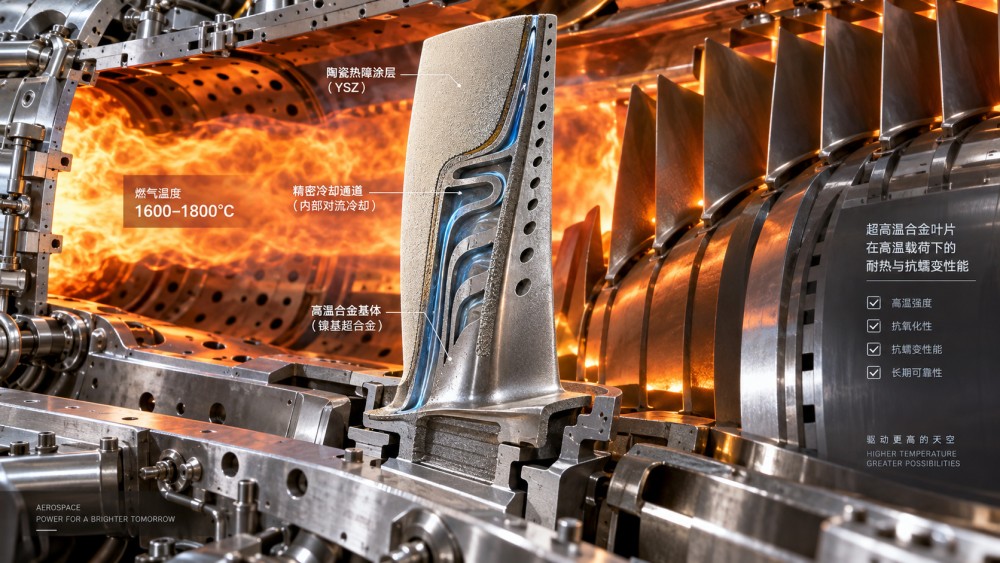
A common error in early material screening is to compare the alloy’s nominal temperature capability with turbine inlet temperature or combustor gas temperature. The component does not experience the gas temperature uniformly. Internal cooling, film cooling, thermal barrier coatings, local heat transfer, geometry, and duty cycle determine the actual metal temperature. A turbine blade may operate in a gas stream far hotter than its substrate because its cooling passages and coating system keep the metal within a survivable range.
That is why nickel superalloys remain competitive in extremely hot engines. Directionally solidified and single-crystal nickel alloys, paired with advanced coatings and sophisticated cooling, provide an integrated solution rather than a substrate-only solution. Replacing the substrate with an ultra-high-temperature alloy may be justified only if it allows the system to do something the nickel solution cannot do efficiently: retain strength at a higher metal temperature, reduce cooling air demand, survive a more aggressive thermal transient, or maintain integrity in a location where coating or cooling protection is limited.
For evaluation purposes, separate four temperatures: bulk gas temperature, local surface temperature, substrate metal temperature, and the temperature at the most highly stressed feature. The last two usually decide the material selection. A small trailing edge, attachment region, cooling-channel wall, or welded transition may govern long before the broad airfoil section does.
Where ultra high temperature alloys gain a real advantage
The term “ultra high temperature alloys” covers several material approaches rather than one uniform class. Depending on the application, it may include refractory-metal-based alloys, refractory-metal silicide systems, intermetallic materials, and emerging composite or multiphase systems designed for temperatures beyond the useful range of conventional nickel superalloys. Their performance should never be assumed from the label alone.
They are most likely to outperform nickel superalloys when a component faces a combination of high metal temperature and sustained mechanical loading. Nickel alloys derive much of their high-temperature strength from a carefully engineered gamma/gamma-prime microstructure. At increasingly high temperatures and long exposures, that strengthening structure can lose stability, creep resistance declines, and the available design margin narrows. Certain refractory-rich systems preserve higher-temperature strength more effectively because of their higher melting points and different strengthening mechanisms.
In practical terms, an ultra-high-temperature material becomes attractive when the project needs one or more of the following:
- Higher load-bearing capability at elevated metal temperature, particularly where creep deformation rather than short-duration tensile strength is the limiting concern.
- Reduced dependence on cooling air, which can improve engine-cycle efficiency if the material, coating, and geometry can work as a qualified system.
- Greater resistance to shape loss during long dwell periods, such as in stationary high-temperature structures or components exposed to extended cruise or sustained power settings.
- Survivability in locally extreme zones where nickel superalloy temperature margin is consumed by hot streaks, leading-edge heat flux, thin-wall geometry, or restricted cooling passage space.
- Compatibility with an advanced thermal-protection concept that is ineffective or uneconomic with a conventional nickel substrate.
The word “sustained” is important. A material that retains very high strength in a short laboratory test may not be the better candidate after thousands of hours of creep, repeated start-stop cycles, oxidation exposure, and accumulated thermal strain. For hot-section engineering, time at temperature is often as important as temperature itself.
Creep resistance is often the decisive comparison
Technical teams frequently focus on ultimate tensile strength because it is familiar and easy to communicate. For rotating hot-section parts, however, creep and stress rupture are often more meaningful. A blade that elongates gradually under centrifugal load can close clearances, alter aerodynamic performance, disturb cooling flow, or eventually fail even though its short-term tensile strength appears adequate.
Ultra high temperature alloys can outperform nickel superalloys when they show lower creep strain rates and longer rupture life at the required combination of temperature, stress, and exposure time. Yet this conclusion must be based on representative conditions. Test data generated on simple specimens may not transfer directly to a thin-walled airfoil with drilled cooling holes, casting porosity, orientation effects, residual stress, and a complex thermal field.
Single-crystal nickel superalloys also set a demanding benchmark. Their directional microstructure is intentionally aligned to resist the stresses experienced by turbine blades. A candidate ultra-high-temperature material must be compared not merely with a generic cast nickel alloy, but with the best applicable nickel grade, processing route, coating package, and cooling design. Otherwise, the comparison can exaggerate the benefit of the alternative.
For static structures such as combustor liners, nozzle elements, exhaust hardware, and thermal shields, the ranking may change. There, deformation control, oxidation, thermal fatigue, distortion, and joining behavior may matter more than centrifugal stress. The material with the highest creep strength is not automatically the component with the best service life.
Oxidation and environmental attack can reverse the result
Many refractory-based materials have impressive high-temperature strength in controlled environments but face a critical weakness in oxygen-bearing combustion gases. Some oxidize rapidly or form volatile oxides at temperatures where a nickel superalloy, supported by an aluminide or MCrAlY coating, has a well-understood protective response. This is one of the most important reasons that promising laboratory materials do not always become production hot-section components.
A decision team should treat oxidation protection as part of the material system, not as a downstream coating choice. Ask whether the protective layer adheres through thermal cycling, whether it can accommodate differences in thermal expansion, how it behaves at edges and cooling-hole exits, and whether minor impact damage creates a fast path for substrate attack. Hot corrosion, water vapor, salt exposure, sulfur-bearing contaminants, and deposit-induced attack also need consideration where the operating environment warrants it.
Nickel superalloys often retain an advantage when environmental durability, coating maturity, and field repair are more valuable than an incremental increase in unprotected temperature capability. An ultra-high-temperature candidate is strongest when it has either intrinsic oxidation resistance appropriate to the service environment or a proven environmental barrier system with realistic durability.
Thermal cycling, toughness, and manufacturability are not secondary issues
High-temperature strength does not guarantee tolerance to real engine operation. Aircraft engines and transport power systems cycle. They accelerate, decelerate, shut down, restart, ingest contaminants, and experience local temperature non-uniformity. A material with limited ductility or low fracture toughness may be vulnerable to thermal shock, foreign-object damage, handling damage, or crack growth from manufacturing defects.
This is where conventional nickel superalloys benefit from decades of process knowledge. Foundries understand grain control, hot isostatic pressing, heat treatment, non-destructive inspection response, weld repair limitations, and defect acceptance criteria. Supply chains know how to machine them, coat them, and document them for aerospace use. The cost is not simply the price of the alloy; it includes the maturity of the manufacturing route.
Ultra high temperature alloys can be justified despite these disadvantages when the component can be designed around their limitations. A static, relatively simple geometry may be a better early application than a highly cooled single-crystal rotating blade. Additive manufacturing, powder metallurgy, diffusion joining, or near-net-shape processing may open opportunities, but each route creates its own questions around porosity, anisotropy, contamination, post-processing, and batch-to-batch repeatability.
Evaluators should ask a blunt question early: can the material be made into the required shape, inspected to a meaningful standard, and repaired or replaced within the intended service model? If the answer is uncertain, its thermal advantage must be substantial enough to fund a development and qualification program.
A component-by-component decision is better than an engine-wide verdict
It is rarely sensible to declare that an entire engine or propulsion system should “move beyond nickel.” Material architecture works best when each zone receives the material system suited to its temperature, stress, environment, and manufacturing needs. Nickel superalloys may remain optimal for blades and discs, while ultra-high-temperature materials are explored for nozzle throats, combustor-adjacent structures, leading-edge inserts, thermal shields, or specialized uncooled parts.
For aerospace suppliers, this selective approach also reduces qualification risk. Instead of replacing a safety-critical rotating component immediately, a program can validate oxidation behavior, thermal expansion compatibility, joining methods, and inspection capability in a more manageable application. The evidence produced can then support a later move into higher-consequence hardware.
Advanced rail and transit systems create a different but relevant context. Most high-speed rail traction hardware does not operate at aero-engine temperatures, so ultra-high-temperature alloys are not a default choice. They may, however, become relevant in specialized brake, exhaust, power-generation, fire-resistant, or high-heat industrial support applications. In those cases, maintainability, cost, corrosion resistance, and field replacement usually outweigh extreme-temperature capability. The same principle holds: select for the actual failure mode, not for the most impressive material specification.
Use a weighted selection matrix, but do not let it hide uncertainty
A disciplined comparison should score nickel superalloys and candidate ultra-high-temperature alloys against the component’s real requirements. Useful criteria include sustained temperature capability, creep rupture behavior, low-cycle and thermo-mechanical fatigue, oxidation and hot-corrosion resistance, density, stiffness, thermal conductivity, thermal expansion, coating compatibility, manufacturability, inspectability, repairability, availability, and qualification burden.
Weighting must reflect the application. For a rotating blade, creep, fatigue, density, casting quality, and coating integration may dominate. For a nozzle structure, oxidation, thermal shock, joining, and distortion may carry more weight. For a procurement team, a technically superior material without stable source qualification, traceability, or export continuity may represent a lifecycle risk rather than an upgrade.
Where evidence is incomplete, record uncertainty separately from performance. A candidate may receive a high predicted score for high-temperature strength but a low confidence rating because long-duration environmental testing is limited. This prevents a spreadsheet from converting an immature assumption into an apparently firm engineering conclusion.
Questions that should be answered before approving a change
Before moving from a nickel superalloy baseline, technical evaluators should be able to answer several practical questions. What failure mechanism is the existing material approaching: creep, oxidation, thermal fatigue, coating spallation, local melting risk, or inadequate cooling margin? What metal-temperature reduction in cooling demand is realistically achievable, rather than theoretically possible? Will the candidate require a new coating, new joining method, or revised geometry? Can its behavior be demonstrated after representative dwell cycles and environmental exposure? And does the expected efficiency, durability, or payload benefit justify qualification cost and schedule risk?
If these answers remain vague, a better nickel alloy, a refined single-crystal process, improved film cooling, a thermal barrier coating upgrade, or a geometry change may deliver the needed margin with less program disruption.
The practical threshold for choosing ultra high temperature alloys
Ultra high temperature alloys outperform nickel superalloys when their superior high-temperature strength and creep resistance remain intact in the real service environment—and when that advantage translates into a component-level benefit such as lower cooling demand, longer life, higher operating temperature, or a feasible design that nickel cannot support. They do not win merely because their melting point is higher or because a data sheet reports exceptional strength at one temperature.
For most mature aero-engine applications, nickel superalloys remain difficult to displace because they are part of a proven ecosystem of directional solidification, coatings, cooling technology, repair practice, and qualification data. The strongest case for an alternative emerges at the edge of that ecosystem: in hotter local zones, sustained high-load duty, uncooled or lightly cooled structures, and new propulsion architectures where the full material system can be designed from the start.
The most reliable selection decision is therefore comparative and component-specific. Define the metal temperature and failure mode, test environmental durability alongside mechanical strength, account for processing and lifecycle realities, and value confidence as highly as peak capability. That approach gives advanced materials a fair evaluation without overlooking why nickel superalloys have remained central to high-temperature engineering for so long.
Related News
- GE Aerospace Completes Key Open Fan Low-Pressure Turbine Tests in PolandOct 28, 2026GE Aerospace completes Open Fan low-pressure turbine tests in Poland. Explore what this milestone means for future engine efficiency, suppliers and aircraft procurement.
- How creep limits high-temperature materials for advanced propulsionOct 27, 2026High temperature advanced propulsion materials face creep limits. Explore alloy options, cooling strategies, and test evidence to make smarter, more reliable material selections.
- How single-crystal casting expertise builds aerospace process moatsOct 26, 2026Discover how aerospace process moats emerge from single-crystal casting expertise, consistent yields, and qualification—and what makes turbine blade suppliers hard to replace.
- GE Aerospace Accelerates T901 Turboshaft Development for US ArmyOct 24, 2026GE Aerospace accelerates T901 turboshaft development for the US Army’s ITEP. Explore the 3,000-shp engine’s efficiency goals and potential role in the UH-60 Black Hawk.