




Search
Related News
- 00
0000-00
How digital transformation improves aerospace fastener traceability - 00
0000-00
GE Aerospace Completes Key Open Fan Low-Pressure Turbine Tests in Poland - 00
0000-00
How creep limits high-temperature materials for advanced propulsion - 00
0000-00
Honeywell Joins Xiamen Aviation Park, Complementing Taikoo Landing Gear Repairs - 00
0000-00
How single-crystal casting expertise builds aerospace process moats
How crystal orientation affects aerospace superalloy creep analysis




Crystal orientation can change a turbine blade’s creep strain, deformation pattern, and rupture life even when alloy chemistry and heat treatment remain unchanged. In single-crystal nickel-based superalloys, creep properties belong to a defined crystallographic direction under defined loading and temperature conditions—not simply to an alloy grade. A material curve measured along a nominal [001] direction is therefore not automatically valid throughout a cooled blade.
The decisive question in aerospace superalloy creep analysis is whether the test specimen, material model, and component share a sufficiently representative relationship between crystal orientation and stress. Answering that requires more than checking the angle between the casting growth direction and the blade axis. Local stress direction, secondary orientation, deformation mechanisms, and the acceptance criteria for casting defects all affect the interpretation.
Why the same alloy responds differently along different directions
Single-crystal turbine-blade alloys contain a nickel-rich gamma matrix reinforced by ordered gamma-prime precipitates. Removing conventional grain boundaries eliminates an important source of high-temperature weakness, but it does not make the material mechanically isotropic. Elastic stiffness and plastic deformation remain dependent on crystallographic direction.
At temperatures where matrix dislocation glide is important, deformation commonly involves the face-centered cubic {111}<110> slip systems. The applied stress drives each system through its resolved shear stress. Under uniaxial loading, this relationship can be written as:
τ = σ cos φ cos λ
Here, σ is the applied axial stress, φ is the angle between the loading direction and the slip-plane normal, and λ is the angle between the loading direction and the slip direction. Rotating the crystal changes these angles, even if the nominal applied stress remains constant. It changes which systems are favorably loaded and how deformation is distributed among them.
This relationship explains why orientation matters, but it is not a complete creep-life model. The active mechanism also depends on temperature, stress, precipitate structure, and prior exposure. Dislocations may move through gamma channels, interact with gamma/gamma-prime interfaces, or participate in precipitate shearing through mechanisms involving fault formation. Climb and diffusion-assisted processes become important in appropriate high-temperature regimes.
Consequently, a higher initial resolved shear stress does not translate directly into a fixed reduction in rupture life. Interactions among slip systems, evolving internal stresses, and microstructural change can alter the response during exposure. Orientation rankings established in one temperature–stress regime should not be transferred to another without supporting data.
Primary alignment does not describe the full crystal orientation
Single-crystal blades are commonly grown with a <001> direction approximately aligned with the blade’s principal spanwise loading direction. This alignment supports useful high-temperature performance in relevant service regimes. It should not be interpreted as proof that [001] is universally the most creep-resistant direction at every temperature and stress.
The primary orientation describes the alignment of the selected crystal axis relative to a component reference direction. The secondary orientation describes rotation about that axis relative to another reference, such as a chordwise direction. A primary deviation angle alone leaves this rotational information unresolved.
For an ideal crystal loaded uniaxially exactly along [001], rotating the crystal about that loading axis does not change the axial creep response. A blade, however, is not a uniaxial test bar. Cooling passages, wall-thickness transitions, platform constraints, bending, and thermal gradients generate transverse and shear stresses. Secondary orientation then changes how these stress components resolve onto the crystal’s deformation systems.
Even primary misalignment requires more information than a single angular magnitude. Tilting away from [001] toward different crystallographic directions can produce different combinations of active slip systems. Two castings with equal primary deviation angles need not have equivalent creep behavior if their tilt directions and secondary orientations differ.
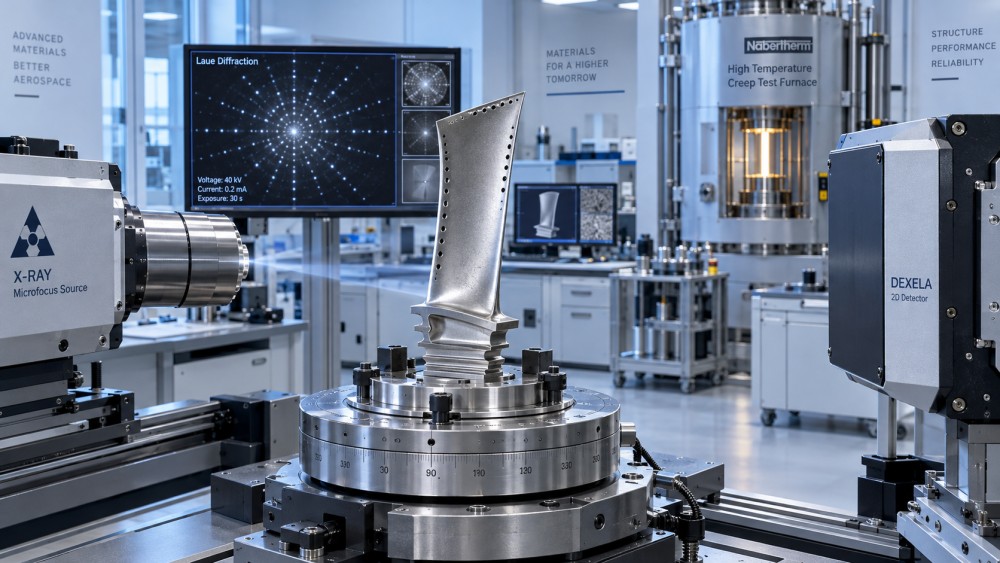
A useful orientation record therefore connects the crystal axes to the actual component coordinate system. It should identify the reference datums, measurement locations, and conventions used to express the orientation. Without that connection, orientation data cannot be transferred reliably into a finite-element material definition.
Orientation changes the creep curve, not just the rupture time
Comparing only stress-rupture life can hide differences that matter to blade functionality. Primary creep, minimum creep rate, accumulated strain, and rupture ductility describe different aspects of the response. A blade can exceed a dimensional limit through extension or distortion before it approaches rupture.
In certain intermediate-temperature, higher-stress regimes, small departures from an ideal orientation can substantially alter primary creep by changing slip-system activity and the development of internal stresses. A material fit based predominantly on minimum creep rate may therefore reproduce the later portion of a test while missing an early strain accumulation that is important for clearance control.
At higher temperatures, gamma-prime precipitates can undergo directional coarsening, often called rafting. Its morphology depends on applied stress, gamma/gamma-prime lattice misfit, and exposure conditions. Crystal orientation and local stress state influence the resulting relationship between precipitates, matrix channels, and deformation paths. Rafting is not inherently beneficial or detrimental in all conditions; its effect depends on the mechanism controlling creep.
This creates a limitation for extrapolation. A rupture correlation or time–temperature parameter may organize a dataset effectively, but the correlation alone does not establish that the same deformation mechanism persists across the extrapolated range. Combining data from different orientations without retaining their identity can conceal physically different responses behind a smooth fitted curve.
Useful comparisons therefore retain complete strain–time histories alongside rupture results. Where microstructural evolution is relevant, interrupted tests and post-test examination can help distinguish a change in deformation mechanism from ordinary specimen scatter.
What a creep test standard establishes—and what it does not
ASTM E139 addresses creep, creep-rupture, and stress-rupture testing of metallic materials. ISO 204 addresses metallic-material creep testing in tension. These standards provide frameworks for conducting and reporting tests, including control and measurement of relevant test conditions. They do not establish a universal allowable crystal misorientation for an aerospace blade, nor do they make results from different orientations interchangeable.
Orientation acceptance limits belong to the applicable component drawing, material specification, qualification basis, or customer requirement. A casting can satisfy its specified orientation limit without every coupon result inside that limit being interchangeable for life prediction. Acceptance compliance and constitutive-model representativeness are separate questions.
A creep dataset intended to support component assessment needs sufficient information to distinguish orientation effects from other sources of variation:
- Measured specimen orientation: the loading-axis direction in crystal coordinates, its measurement uncertainty, and secondary orientation where relevant.
- Material condition: alloy identity, heat treatment, prior exposure, and relevant microstructural characteristics.
- Test definition: temperature, load or stress-control basis, gauge geometry, strain measurement method, and the reported failure or termination criterion.
- Specimen origin: whether the sample came from a separately cast bar or a component location, with its extraction direction recorded.
- Crystal integrity: evidence of local misorientation, low-angle boundaries, recrystallized regions, or other defects that could affect interpretation.
Laue diffraction can establish crystal orientation, while electron backscatter diffraction can resolve local orientation variations on suitably prepared surfaces. The method and sampling strategy must match the question. A single orientation measurement cannot, by itself, demonstrate that an entire complex casting is free from local crystallographic defects.
Comparisons also need to control material variables. Differences in dendritic segregation, porosity, precipitate distribution, and heat-treatment response can otherwise be misattributed to orientation. Separately cast test bars require a demonstrated relationship to the component material condition rather than an assumption of equivalence based on chemistry alone.
Representing orientation in the component model
An isotropic creep law driven by von Mises stress cannot distinguish two crystal orientations subjected to the same macroscopic stress tensor. Such a law can still serve as a calibrated engineering approximation within a restricted domain. The restriction needs to cover the orientations, stress states, temperatures, and response measures for which its accuracy has been demonstrated.
Anisotropic elastic properties are also important. Under a uniform imposed axial force, orientation-dependent stiffness does not by itself change the nominal axial stress in a simple bar. In a constrained blade with thermal gradients, however, stiffness affects local stress generation and redistribution. Combining anisotropic creep with an inappropriate elastic description can therefore distort the stress history that drives creep.
Crystal-plasticity creep models represent deformation through individual crystallographic systems. For slip system α, the resolved shear stress is obtained from the stress tensor and the slip direction and plane normal expressed in a common coordinate frame:
τα = sα · σ · nα
The orientation transformation must be implemented consistently. Mixing crystal-to-component and component-to-crystal rotation conventions can produce plausible-looking results for the wrong alignment. Simple checks using known loading directions and expected symmetry are essential before evaluating a full blade.
Greater model complexity does not guarantee better predictions. Slip-rate parameters, hardening or recovery terms, temperature dependence, and any microstructural evolution laws need supporting calibration data. A fit to one orientation under uniaxial tension does not uniquely validate transverse, shear, or multiaxial behavior. Independent tests at additional orientations and relevant temperatures are needed to evaluate those predictions.
If an effective anisotropic creep model is used instead of crystal plasticity, the same evidence requirement applies. It must capture the directional response relevant to the component, not merely reproduce a single longitudinal creep curve.
From orientation tolerance to blade-life uncertainty
Centrifugal loading creates a strong spanwise tensile contribution, but local creep damage does not necessarily follow that direction. Around cooling holes and geometric transitions, the principal stress directions can differ from the nominal blade axis. Those directions can change again as creep redistributes stress or operating conditions vary.
The component assessment should therefore use the local stress tensor and temperature history, rather than a single nominal axial stress. Orientation influences the creep strain rate and its direction; the failure assessment must separately address the relevant endpoint. Accumulated strain, rupture, and creep–fatigue damage are not interchangeable criteria.
A practical sensitivity study evaluates the nominal orientation together with credible deviations within the permitted casting range. The range should preserve direction information rather than apply only a maximum angular offset. Secondary rotation deserves explicit variation where transverse and shear loading are significant.
Orientation uncertainty should also be distinguished from parameter uncertainty. The former reflects measurement limits and casting variation; the latter reflects uncertainty in the fitted creep response. If they are combined into one unexplained material factor, it becomes difficult to determine whether tighter casting control or additional testing would actually improve confidence.
Local defects need separate treatment. A low-angle boundary or recrystallized region is not simply another uniform crystal rotation: it introduces an interface or altered microstructure that may enable different damage processes. A homogeneous single-crystal model cannot establish the acceptability of such a feature merely by assigning it a different orientation.
The strongest basis for a life decision is a traceable chain from measured component orientation to representative test data, a validated directional material model, and the local service stress–temperature history. Where that chain is incomplete, the useful result is a clearly bounded prediction or sensitivity range—not a precise life value whose apparent accuracy exceeds the underlying evidence.
Related News
- GE Aerospace Completes Key Open Fan Low-Pressure Turbine Tests in PolandOct 28, 2026GE Aerospace completes Open Fan low-pressure turbine tests in Poland. Explore what this milestone means for future engine efficiency, suppliers and aircraft procurement.
- How creep limits high-temperature materials for advanced propulsionOct 27, 2026High temperature advanced propulsion materials face creep limits. Explore alloy options, cooling strategies, and test evidence to make smarter, more reliable material selections.
- How single-crystal casting expertise builds aerospace process moatsOct 26, 2026Discover how aerospace process moats emerge from single-crystal casting expertise, consistent yields, and qualification—and what makes turbine blade suppliers hard to replace.
- GE Aerospace Accelerates T901 Turboshaft Development for US ArmyOct 24, 2026GE Aerospace accelerates T901 turboshaft development for the US Army’s ITEP. Explore the 3,000-shp engine’s efficiency goals and potential role in the UH-60 Black Hawk.