




Search
Related News
- 00
0000-00
How digital transformation improves aerospace fastener traceability - 00
0000-00
GE Aerospace Completes Key Open Fan Low-Pressure Turbine Tests in Poland - 00
0000-00
How creep limits high-temperature materials for advanced propulsion - 00
0000-00
Honeywell Joins Xiamen Aviation Park, Complementing Taikoo Landing Gear Repairs - 00
0000-00
How single-crystal casting expertise builds aerospace process moats
How fatigue requirements shape aerospace structural material selection




Fatigue requirements are often the point at which an apparently attractive aerospace material choice becomes a difficult engineering decision. A bracket, wing fitting, fuselage frame, nacelle support, or engine-adjacent structure may meet static strength targets and still be unsuitable for service if repeated loading creates crack-growth risk that cannot be managed economically or safely. For technical evaluators, aerospace structural material selection is therefore not a simple comparison of tensile strength, density, and purchase price. It is a decision about how a material will behave after millions of load reversals, thermal excursions, vibration cycles, moisture exposure, manufacturing stresses, and scheduled inspections.
In aerospace programs, fatigue is not an isolated laboratory property. It is a system-level requirement connecting structural design, manufacturing route, joining method, surface condition, corrosion protection, nondestructive inspection, maintenance philosophy, and certification evidence. The preferred material is rarely the one with the highest headline value. It is the one whose fatigue performance remains credible in the actual geometry, environment, and service spectrum of the component.
Why static strength does not settle the material decision
A material data sheet may show high yield strength and excellent specific strength, yet those values say little about how a real part will respond to small defects, fastener holes, sharp transitions, fretting contact, or variable-amplitude loads. Aerospace structures experience takeoff and landing cycles, gust loads, cabin pressurization, maneuver loads, runway vibration, acoustic excitation, and local thermal gradients. The cumulative effect is what drives fatigue design.
For metallic structures, a critical concern is often whether a small crack will initiate and, once present, how rapidly it will grow. Some aerospace aluminum alloys offer an excellent weight and manufacturing balance but may need careful corrosion control and damage-tolerance substantiation in highly stressed zones. Titanium alloys can provide strong fatigue and corrosion performance at relatively low density, but their machining cost, forging capability, surface sensitivity, and joining constraints can change the total program equation. High-strength steels may remain essential in landing gear and heavily loaded mechanisms, while requiring rigorous protection against corrosion, hydrogen-related damage, and stress concentrations.
Composite structures bring a different fatigue question. Carbon fiber reinforced polymers do not generally develop fatigue cracks in the same manner as metals, but they can accumulate matrix cracking, fiber-matrix debonding, delamination, impact damage, and environmental degradation. Their response depends heavily on laminate architecture, resin system, fiber orientation, manufacturing quality, and load path. A comparison based only on “metal versus composite fatigue life” can therefore mislead a procurement or engineering review.
Start with the load spectrum, not the candidate material list
Effective aerospace structural material selection begins by defining what the component truly sees in service. A wing skin panel, for example, is governed by a broad spectrum of pressurization, bending, and gust loads. An engine pylon fitting may see vibration, thermal effects, and localized stress transfer. A landing gear component faces severe cyclic loads, occasional high-load events, surface damage risk, and exposure to contaminants. Treating each part as if it experiences one constant stress range produces a fatigue assessment that looks tidy but may not represent operational reality.
Technical evaluators should ask for a load spectrum that identifies expected cycle types, peak events, dwell periods, temperature range, load sequence effects, and mission variation. This matters because fatigue damage can be influenced by the order in which loads occur. A few high-amplitude events may alter the significance of many smaller cycles, particularly where residual stresses or local plasticity are involved.
- What is the expected service life in flights, hours, pressurization cycles, or mission cycles?
- Are loads primarily tension-compression, bending, torsion, vibration, or a combined spectrum?
- Will the part operate near engines, fuel systems, coastal environments, de-icing fluids, or other corrosion-sensitive conditions?
- Does the design include holes, threads, bonded interfaces, fasteners, welds, or contact surfaces that can initiate fatigue damage?
- Is the structure intended to be fail-safe, safe-life, or damage tolerant?
These questions may appear design-led rather than procurement-led, but they directly determine which supplier data are relevant. A material supplier that can offer basic mechanical certificates but cannot explain lot traceability, heat treatment control, grain-flow direction, or fatigue test relevance may not support a critical application, even if the nominal alloy is correct.
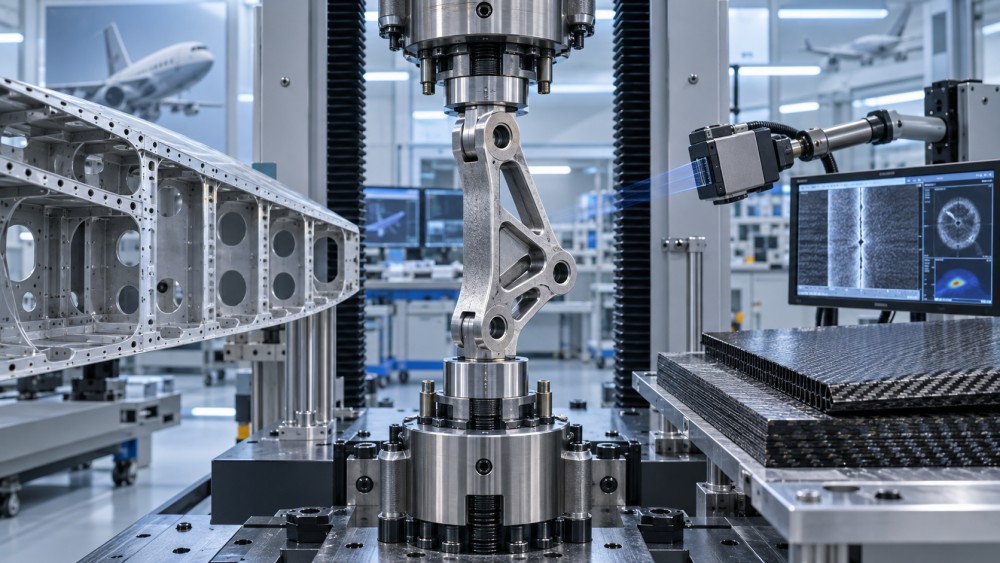
Fatigue life, crack initiation, and crack growth are separate decisions
One common mistake is to use “fatigue strength” as though it were a complete qualification measure. It is not. An evaluator needs to distinguish between resistance to crack initiation and resistance to crack propagation. A smooth laboratory specimen can survive a large number of cycles, while a production component with a notch, bore, or surface imperfection may initiate a crack much earlier.
For damage-tolerant structures, crack-growth behavior may be more influential than conventional S-N curve performance. The key question becomes: if a small flaw exists after manufacture or enters service through damage, can it be detected and removed from service before it reaches a critical size? Fracture toughness, fatigue crack-growth rate, inspection interval, and the reliability of nondestructive testing all belong in the same decision package.
This has practical implications for alloy and process selection. Heat treatment can raise strength but may reduce toughness or alter stress-corrosion resistance. Surface treatments can improve fatigue life by introducing beneficial compressive residual stress, yet an unsuitable coating process or poorly controlled rework can introduce damage. Machining marks, grinding burns, fastener interference, and local geometry changes can dominate the fatigue result more than a modest difference in nominal material grade.
Material families: where the fatigue trade-offs usually sit
Aluminum alloys remain central to airframe construction because they are lightweight, formable, widely understood, and supported by established supply chains. Their fatigue behavior must be assessed in relation to product form, temper, thickness, grain direction, corrosion environment, and joining details. For fuselage and wing applications, inspectors and designers often need a credible crack-management strategy rather than an assumption of infinite life. Aluminum-lithium families may provide weight-saving opportunities, but application-specific fatigue, corrosion, and production evidence still matters.
Titanium alloys are frequently selected for highly loaded fittings, structural attachments, landing gear-related parts, and zones where corrosion resistance and elevated-temperature capability are important. They can offer a compelling fatigue-to-weight balance, particularly where replacement of steel yields meaningful weight reduction. However, titanium is not automatically the best answer. Forging quality, microstructure control, machining practices, galling behavior, and compatibility with adjacent materials deserve close attention. A strong alloy can become an expensive maintenance problem if contact wear or manufacturing variability is underestimated.
High-strength steels continue to serve applications where compact load-bearing capability is paramount. Their fatigue performance can be excellent when processing, surface finish, shot peening, corrosion protection, and hydrogen-control procedures are tightly managed. The trade-off is sensitivity: a small process deviation or protective-coating failure can carry more consequence than it would in a more corrosion-tolerant material system.
Nickel-based alloys may be necessary in engine-adjacent structures and hot zones where temperature retention, oxidation resistance, and creep strength matter alongside fatigue. In these environments, evaluators should consider thermo-mechanical fatigue rather than room-temperature cyclic data alone. Thermal gradients, dwell times, oxidation, and vibration can create a failure mechanism very different from that of a conventional airframe component.
Carbon fiber composites offer major weight-saving potential and can be tailored to directional loads, but their fatigue assessment must include impact tolerance and residual strength after damage. A laminate that performs well in repeated tension may react differently under compression-after-impact, moisture exposure, or complex bolted-joint loading. Selection should include repairability, inspection access, and the organization’s ability to manage composite-specific MRO procedures.
Manufacturing route is part of the material specification
In fatigue-critical aerospace work, “material” cannot be separated from how it becomes a part. A forging, rolled plate, extruded section, machined billet, additive-manufactured feature, and bonded composite laminate may all present different defect populations and directional properties. Two components made from the same alloy designation can have materially different fatigue performance because their processing history is different.
For metallic components, evaluators should review melt route, cleanliness requirements, forging reduction, grain flow, heat treatment windows, machining allowances, and surface finishing. Holes and bores deserve particular care because they are frequent fatigue initiation sites. The choice between drilling, reaming, cold expansion, interference fitting, and subsequent finishing can influence local stress and service life.
For composites, the review should extend to fiber placement, void control, cure cycle consistency, resin content, ply drops, bonded interfaces, and edge finishing. Production qualification must show more than a coupon result from an ideal panel. It should demonstrate that the intended factory process can repeatedly produce the required structure.
Corrosion and fatigue should be evaluated together
Aircraft do not operate in clean, dry laboratories. Humidity, salt, de-icing chemicals, fuel residues, hydraulic fluids, and trapped moisture can turn a manageable fatigue condition into corrosion-fatigue damage. Galvanic interaction is especially relevant where carbon fiber composites meet aluminum or where dissimilar metallic components are joined. Protective layers, sealants, drainage design, fastener selection, and maintainability all influence the long-term outcome.
A technically mature evaluation asks not only whether an alloy resists corrosion, but whether its protection system can survive manufacture, assembly, field repair, and repeated inspection. A coating that performs well on a flat test panel may be difficult to apply consistently inside a complex fitting. Likewise, a material selected for superior corrosion resistance may introduce a weight, cost, or machining burden that is not justified in a protected internal location.
Evidence to request before approving a fatigue-critical material
Certification-ready decisions need traceable evidence, not broad claims. The required package will vary by aircraft program and authority framework, but a robust supplier review should normally connect material pedigree to the exact product form and process route being proposed.
- Applicable material specifications, revision status, chemical composition, and mechanical-property records.
- Fatigue and crack-growth data relevant to the intended stress ratio, temperature, thickness, orientation, and environment.
- Fracture toughness and damage-tolerance inputs where the component design relies on inspectable crack growth.
- Process qualification evidence for forging, heat treatment, machining, coating, bonding, or composite curing.
- Nondestructive testing methods, acceptance criteria, calibration controls, and inspector qualification records.
- Traceability from raw material lot through final part, including treatment batches and deviations.
- Evidence of special-process control, including relevant aerospace accreditation or customer approval where required.
Data transferability deserves scrutiny. Test results from a thin specimen, a different temper, or a polished laboratory surface may not represent a thick forged component with a machined bore. The most useful supplier conversations are specific: which test configuration was used, what was the failure mode, how closely does it match the proposed application, and what assumptions are being carried into the design allowables?
A practical decision path for technical evaluators
When several materials appear viable, avoid choosing by a single weighted score too early. A better sequence is to eliminate options that cannot meet mandatory constraints: operating temperature, certification route, damage-tolerance philosophy, environmental exposure, required product form, and inspection accessibility. Only then should the team compare remaining candidates on weight, recurring cost, availability, manufacturability, and lifecycle burden.
It is also useful to identify the consequence of uncertainty. If fatigue data are limited, can conservative design margins realistically cover the gap? Can the part be inspected at a sensible interval? Is replacement straightforward, or would removal disrupt a major assembly? The answers often reveal that a slightly heavier but better-characterized material is the lower-risk choice for an early production program, while a more optimized option may be appropriate after additional validation.
For buyers and engineering teams using aerospace structural material selection as part of supplier qualification, the decision should end with a controlled requirement set rather than a preferred alloy name alone. Define the approved material condition, product form, process controls, inspection requirements, allowable repair actions, and documentation needed at delivery. That discipline protects the original fatigue rationale as the program moves from design review to serial manufacture and long-term MRO support.
Fatigue requirements do not simply narrow the material shortlist; they expose whether the whole structural solution is credible. The strongest selection is one that aligns material behavior, part geometry, production capability, corrosion control, inspection planning, and service reality—before the first aircraft begins accumulating cycles.
Related News
- How aerospace materials analysis estimates component fatigue lifeOct 25, 2026Explore how aerospace materials engineering analysis combines fatigue testing, service loads, and crack-growth models to estimate component life and guide inspection planning.
- How to define fatigue load spectra for aircraft component testingOct 24, 2026Improve aircraft component testing with fatigue load spectra that reflect real service conditions. Learn how to preserve load sequences, validate severity, and avoid misleading results.
- How to assess fatigue life in lightweight aircraft structural componentsOct 19, 2026Assess fatigue life in lightweight aircraft structural components using load spectra, damage tolerance, and testing. Discover practical steps to build a defensible life assessment.
- How train nose design reduces aerodynamic pressure waves in tunnelsOct 12, 2026Aerodynamic pressure wave trains are reduced by optimized nose geometry. Discover how tapered profiles, area growth, and tunnel design improve comfort and control pressure waves.