




Search
Related News
- 00
0000-00
How load spectra determine fatigue life in aerospace composites - 00
0000-00
How condition monitoring technology sensors detect rail defects early - 00
0000-00
How track design choices affect high-speed rail infrastructure costs - 00
0000-00
How CBTC supports subway train density management at peak hours - 00
0000-00
How traction converter losses affect high-speed rail efficiency
CBTC Signaling Safety Risks That Delay Metro Projects




Why CBTC signaling safety delays appear late but start early
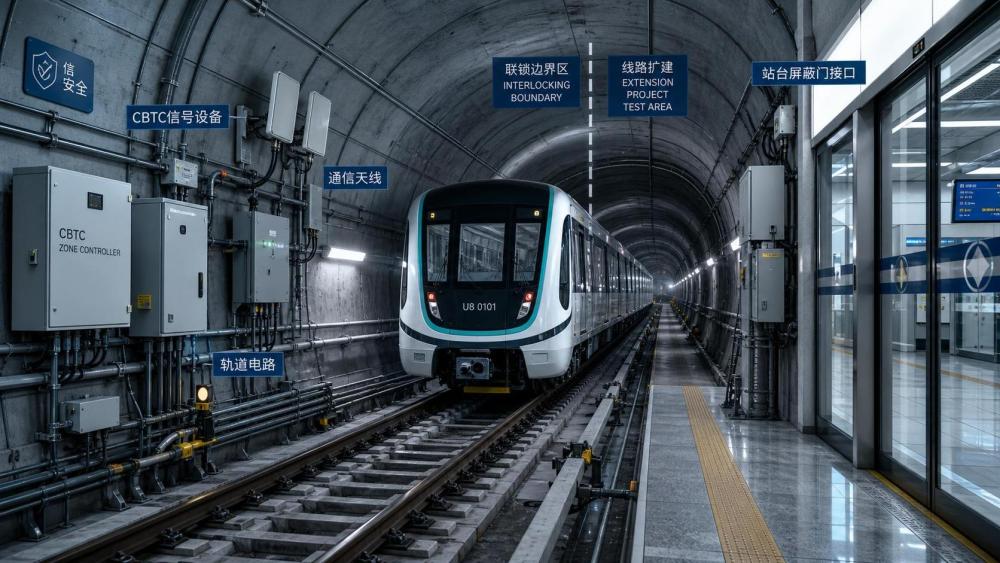
CBTC signaling safety problems rarely begin at trial running. They usually start much earlier, during interface definition, hazard allocation, and schedule planning.
That is why metro projects can look on track for months, then lose time during integration, independent safety assessment, or final acceptance.
In practical delivery work, CBTC signaling safety is not only a technical compliance issue. It is also a sequencing issue across civil works, rolling stock, telecom, power, platform systems, and operations.
AATS often frames this kind of risk in the same way it examines aerospace and advanced transit systems: reliability depends on interfaces, evidence quality, and lifecycle discipline, not just headline specifications.
When those elements are treated separately, delay becomes likely. When they are managed together, CBTC signaling safety supports commissioning instead of blocking it.
The real judgment changes with project stage and operating context
Not every metro project faces the same CBTC signaling safety pressure. A greenfield line, a brownfield upgrade, and an extension connected to an active network behave very differently.
The requirement gap comes from operating constraints. Some projects can isolate testing windows. Others must protect live revenue service, legacy interlockings, or mixed fleet operation.
Safety evidence also changes by environment. High-density urban tunnels, depot transitions, platform screen door interfaces, and degraded mode recovery create different failure paths.
A common mistake is assuming one verified subsystem means overall readiness. In CBTC signaling safety, acceptance depends on how subsystems behave together under normal, fallback, and fault conditions.
Where delays usually hide
- Unclear interface ownership between signaling, rolling stock, telecom, and PSD packages.
- Late hazard log updates after design changes or software revisions.
- Insufficient evidence for SIL4 functions under degraded or emergency modes.
- Mismatch between test scenarios and actual operational rules.
- Compressed integration windows that remove time for retest after anomaly closure.
Greenfield metros usually struggle with integration maturity, not concept design
On new lines, the early assumption is often optimistic: no legacy burden, no old signaling, and a clean architecture. In reality, the pressure shifts to coordination maturity.
CBTC signaling safety on greenfield projects depends on whether design packages mature at the same speed. Train positioning, axle counters, radio coverage, traction return, and depot logic cannot drift independently.
More common delays appear when software baselines are frozen before field conditions are stable. Then commissioning reveals trainborne and wayside behaviors that were never validated together.
The better approach is to tie safety milestones to integration readiness. That means hazard closure should follow verified interfaces, not only document submission dates.
What matters most in this setting
The key judgment is not whether each subsystem passed factory testing. It is whether end-to-end operational scenarios were defined early enough to guide integration logic.
CBTC signaling safety improves when test scripts include turnback, wrong-side platform conditions, communication dropouts, and recovery after power events.
Brownfield upgrades face a different safety problem: coexistence
Upgrading an operating line is usually less forgiving. Here, CBTC signaling safety is shaped by coexistence with legacy assets, restricted possessions, and active service obligations.
The safety question is no longer limited to whether the new system works. It must also prove safe transition logic between old and new regimes.
That includes cutover boundaries, fallback operation, mixed fleet authorization, and temporary rules during migration stages. These details often consume more schedule than hardware installation.
One repeated misjudgment is treating migration as an operations issue only. In practice, migration is central to CBTC signaling safety because many serious hazards appear during transitional states.
This is where broader transport intelligence matters. The same disciplined thinking used in aerospace certification or high-speed EMU system validation also applies here: transitional risk needs explicit proof, not assumption.
Line extensions often fail at the boundaries, not in the new section
Extensions are often underestimated because the new alignment may be short. Yet CBTC signaling safety becomes more sensitive where the extension meets the live network.
Boundary stations, depot access, turnback logic, and timetable compression create tight interaction points. A small inconsistency there can delay the whole opening.
In actual projects, extension work often inherits earlier design assumptions that no longer fit current rolling stock software, revised operating plans, or updated cybersecurity rules.
A sound CBTC signaling safety review therefore checks the boundary condition first. If the handover logic is weak, extra testing in the new section will not solve the real risk.
Useful checks before commissioning windows tighten
- Confirm whether operating rules changed after original design freeze.
- Verify radio and positioning performance at merge and divergence zones.
- Recheck emergency braking curves for updated train consist data.
- Align hazard records with actual boundary test evidence.
Highly automated operation raises the bar for degraded mode proof
On GoA3 and GoA4 lines, CBTC signaling safety extends beyond movement authority accuracy. The harder question is how the system behaves when visibility, communication, or supervisory functions degrade.
This is often where schedule confidence drops. Automatic operation can perform well in nominal conditions, yet certification teams focus on edge cases, remote interventions, and recovery timing.
A project may pass simulation and still face delay if the operating concept does not match the safety case. That gap appears when emergency procedures were written too late or without realistic workload assumptions.
In these scenarios, CBTC signaling safety should be assessed together with OCC procedures, training logic, and maintainability access. Operational resilience is part of the safety argument.
Misjudgments that keep repeating across metro programs
Some errors appear in almost every delayed project, regardless of geography or contract model. They look small early on, then become expensive close to handover.
- Focusing on train headway targets while underestimating evidence needed for CBTC signaling safety approval.
- Treating software updates as minor changes, even when hazard impact has not been reassessed.
- Assuming interface tests can compensate for weak requirements definition.
- Comparing two lines with similar layouts as if their risk conditions were identical.
- Looking only at capital cost while ignoring retest time, access constraints, and migration complexity.
These points matter because CBTC signaling safety is cumulative. Delays usually come from several small gaps interacting, not from one dramatic technical failure.
How to adapt safety planning before delay becomes structural
The most practical step is to align safety planning with real project states rather than formal package boundaries. That changes how risks are exposed and closed.
A useful working structure is to connect each major hazard with four checks: interface owner, test evidence, operational rule, and change-control trigger.
For metro teams reviewing CBTC signaling safety, the following actions usually provide the fastest clarity:
- Map every safety-critical interface to a named verification event.
- Separate nominal testing from degraded and migration testing.
- Review hazard logs after each software or configuration baseline change.
- Check whether commissioning windows allow anomaly closure and retest.
- Reconcile safety documentation with actual operational procedures.
This is also where AATS-style cross-domain analysis is useful. In advanced transport systems, robust delivery comes from linking certification logic, engineering detail, and lifecycle maintainability from the start.
A better next step is to define the project by risk scenario, not by package name
CBTC signaling safety becomes manageable once the project is broken into real operating situations: cutover night, depot exit, lost communication, mixed fleet entry, PSD mismatch, or reduced braking performance.
That view makes schedule risk easier to see. It also shows where evidence is thin, where assumptions are outdated, and where design changes need deeper review.
Before the next milestone, it is worth comparing those scenarios against current interfaces, acceptance criteria, and retest capacity. That exercise usually reveals whether CBTC signaling safety is supporting delivery or quietly delaying it.
Related News
- How CBTC supports subway train density management at peak hoursSep 26, 2026Subway train density management: discover how CBTC uses moving-block control, real-time supervision, and smarter regulation to boost peak-hour capacity safely.
- How a CBTC fallback system keeps trains moving after link lossSep 24, 2026CBTC fallback system: learn how rail operators maintain safe train movement, restore positioning, and limit disruption after communication link loss.
- How safe train control technology reduces headway without raising riskAug 23, 2026Safe train control technology explained: learn how moving block, SIL4 design, and fail-safe control cut headway while protecting braking distance, reliability, and real-world rail capacity.
- EASA Tightens SIL4 Rules for EU-Bound CBTC ExportsAug 09, 2026CBTC exports to the EU face tighter SIL4 compliance as EASA updates rules. Learn the March 2027 deadline, IV&V impact, and how suppliers can protect market access.