




Search
Related News
- 00
0000-00
How digital transformation improves aerospace fastener traceability - 00
0000-00
GE Aerospace Completes Key Open Fan Low-Pressure Turbine Tests in Poland - 00
0000-00
How creep limits high-temperature materials for advanced propulsion - 00
0000-00
Honeywell Joins Xiamen Aviation Park, Complementing Taikoo Landing Gear Repairs - 00
0000-00
How single-crystal casting expertise builds aerospace process moats
Tags
How fireproof composite materials protect aerospace honeycomb panels




Aerospace honeycomb panels are not protected from fire by a single “fireproof” ingredient. Their behavior depends on how the facing laminate, adhesive film, core, edge close-outs, inserts, coatings, and installation details respond as one assembly. A panel can pass a coupon-level flammability test yet fail to provide the required cabin protection if its core contributes smoke, the bondline opens under heat, or an unsealed edge allows flame to enter the cells.
The practical objective is therefore not absolute incombustibility. Organic matrix composites, adhesives, and many honeycomb cores can degrade under sufficient heat exposure. The engineering requirement is to control ignition, flame spread, heat release, smoke, toxic combustion products where applicable, and loss of structural integrity for the panel’s intended location and certification basis. This distinction matters when evaluating fireproof composite materials for aerospace interiors: a material description alone is not evidence of compliant panel performance.
Why honeycomb construction creates a distinctive fire problem
Honeycomb panels combine thin, stiff facings with a lightweight cellular core. This architecture delivers high bending stiffness at low mass, which explains its extensive use in aircraft interiors: sidewalls, partitions, ceiling panels, stowage components, galleys, lavatory modules, cargo liners, floor-adjacent structures, and other non-primary applications. It also creates several routes by which a local fire exposure can become a system-level failure.
First, the exposed facing may shield the core only while it remains continuous. A flame can reach the core through a puncture, cut-out, fastener hole, damaged coating, panel edge, or failed joint. Once combustion gases enter the cells, the honeycomb geometry can channel hot gases laterally. The panel does not behave like a solid laminate; it contains a network of enclosed or partly vented cavities that can retain heat and transport combustion products.
Second, the adhesive system is often the weak thermal link. Even when the facing reinforcement is noncombustible or highly heat tolerant, the resin matrix and bonding film can soften, char, decompose, or lose cohesive strength. Loss of bond between facing and core sharply reduces sandwich stiffness. A panel need not burn through to become unsafe: local delamination, skin buckling, or detachment can compromise containment, retention, or occupant protection functions.
Third, a low-density core can be highly sensitive to edge exposure. Nomex-type aramid paper honeycomb, aluminum honeycomb, thermoplastic honeycomb, and other core families do not respond in the same way to heat. The selection must account for whether the panel is expected to act mainly as an interior finish element, a load-carrying partition, a floor-related component, or a barrier separating zones with different fire hazards.
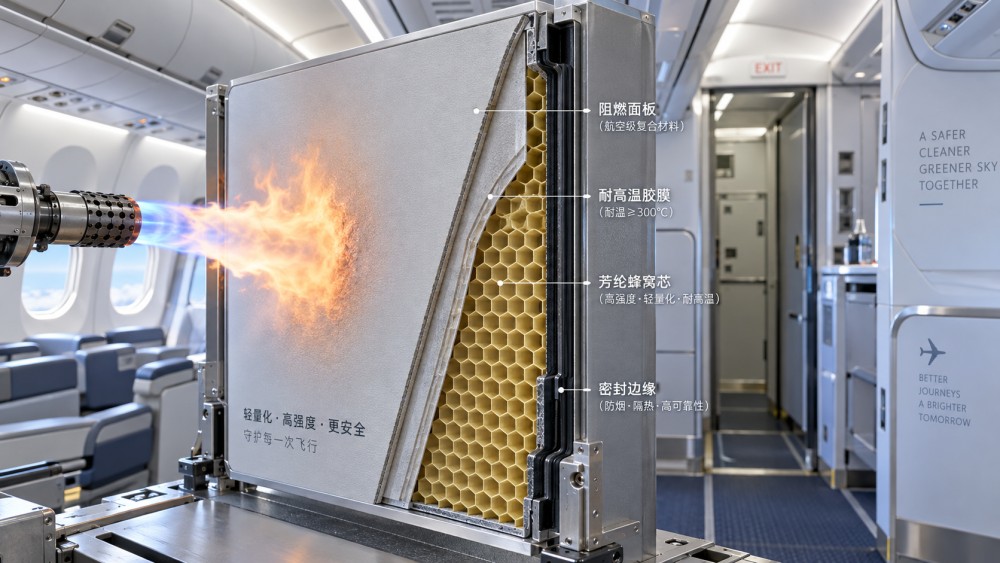
Fire resistance is built from the outside inward
The outer surface is normally the first line of defense. Decorative films, paint systems, gel coats, and surface coatings must resist ignition and limit flame propagation without cracking, peeling, or creating an additional fuel source. Beneath them, the facing laminate must retain enough integrity to delay core exposure. Glass fiber reinforcement is inherently noncombustible, but its behavior is governed by the resin system. Carbon fiber does not itself provide a complete fire solution either: although the fibers can tolerate high temperatures better than many polymer matrices, the matrix can decompose and the laminate can lose mechanical integrity.
Phenolic resin systems are widely associated with low smoke and favorable fire performance in aircraft interior panels. Their char-forming behavior can limit flame spread and heat penetration compared with many conventional thermoset systems. However, phenolics bring manufacturing and qualification considerations, including moisture sensitivity, cure control, brittleness in some formulations, processing emissions, and compatibility with adhesives, decorative layers, and repair methods. A phenolic-faced panel cannot be evaluated simply by assuming every component in the panel will perform like the phenolic laminate.
Epoxy systems can offer strong mechanical properties, process familiarity, and durable bonding, but standard aerospace epoxies are not automatically appropriate for demanding interior fire requirements. Flame-retarded epoxy formulations may be used where the full construction has demonstrated the necessary performance. The key question is not whether the resin is described as flame retardant; it is whether the qualified lay-up, thickness, finish, adhesive, core, and mounting configuration meet the applicable test conditions.
High-temperature thermoplastics and engineered thermosets can also be used in specific panel systems. Their suitability depends on fire behavior, forming process, weldability or bonding method, chemical resistance, smoke performance, and weight. Adding flame-retardant additives may improve one metric while adversely affecting another. For example, an additive can raise viscosity, alter fiber wet-out, reduce toughness, complicate surface finish, or change smoke composition. Material selection must therefore be based on the complete performance envelope rather than a single flammability value.
Core selection determines what happens after the skin is breached
Aluminum honeycomb offers a noncombustible core structure and can be attractive where heat resistance and mechanical stability are priorities. Its limitations are equally relevant: it conducts heat efficiently, may require corrosion protection, can introduce galvanic compatibility issues with carbon fiber facings, and does not by itself stop heat transfer through the panel. An aluminum core with an unsuitable adhesive or decorative facing is still a potentially noncompliant assembly.
Aramid paper honeycomb, commonly associated with Nomex paper systems, provides low weight and good performance for many aerospace interior applications. The paper is typically impregnated with a resin, and the core’s fire response is therefore linked to that impregnation chemistry as well as cell size, density, and panel construction. It may char rather than melt, but charring alone does not establish compliance with a particular aircraft interior requirement. Smoke generation, flame penetration, bondline survival, and post-exposure residual strength remain relevant.
Thermoplastic cores can offer toughness, moisture resistance, and process advantages, but their response to heat requires careful review. Some thermoplastics soften or melt at temperatures well below those that would visibly degrade a metal or aramid core. Melt behavior can be acceptable in a limited application only if the complete panel’s certified fire performance, installation environment, and failure mode support that choice. It is not enough to compare a resin’s melting point with a generic fire temperature.
Core density and cell geometry also matter. Higher density can improve crush resistance and insert retention, but it adds mass. Smaller cells may improve facing support and reduce local buckling, while influencing resin uptake, venting behavior, and manufacturing cost. For fire exposure, these variables affect the volume available for gases, the propagation route after a breach, and the amount of material contributing to smoke or decomposition.
Adhesives, edges, and inserts are often the decisive details
A panel qualification programme that focuses only on face-sheet coupons risks missing the parts most likely to fail in service. Honeycomb panels contain bonded interfaces, and each interface has a temperature-dependent strength profile. Adhesive films must retain sufficient performance during manufacturing, storage, humidity exposure, operational temperature cycling, and fire testing. A high-temperature adhesive cannot compensate for a core that produces unacceptable smoke, nor can a compliant core compensate for adhesive-driven delamination.
Edges deserve equal attention. Open honeycomb cells can allow fluid ingress, moisture accumulation, contamination, and fire exposure. Edge close-outs may use potting compounds, machined solid inserts, resin-filled cells, metal channels, or bonded caps. These solutions alter local weight, thermal conduction, smoke paths, and damage tolerance. A fire-resistant panel design should specify how cut edges, apertures, service penetrations, and joints are treated—not merely identify the nominal panel material.
Mechanical inserts present another challenge. They concentrate load into a locally modified core region, where potting compounds and fastener interfaces can act differently under heat than the surrounding panel. The evaluation should consider pull-out retention after thermal exposure where the component’s function depends on it. This is particularly important for partitions, monuments, equipment covers, and panels that must remain attached during a fire event.
Certification is based on the installed article, not a generic material claim
For transport-category aircraft, the relevant regulatory framework commonly includes FAA 14 CFR §25.853 and EASA CS 25.853 for compartment interiors. The detailed requirement depends on the item’s location, size, function, and aircraft certification basis. The associated test methods are set out in Appendix F to Part 25 in the FAA framework, with corresponding EASA provisions. Vertical and horizontal Bunsen burner tests are frequently discussed, but they are not interchangeable, and they do not cover every interior fire hazard.
For some cabin interior materials, heat-release testing under Appendix F Part IV—often called the OSU heat-release test—is a critical requirement. Smoke density requirements may also apply to specified materials and configurations, using the prescribed test method. A panel that self-extinguishes in a small-flame test can still be unsuitable if it exceeds applicable heat-release or smoke limits. Conversely, an individual constituent may have favorable published test data but lose compliance when combined with a different decorative film, adhesive, or backing layer.
Other requirements may apply depending on the panel’s location and function. Thermal/acoustic insulation has dedicated flammability requirements under §25.856. Cargo compartment liners, materials in designated fire zones, and components exposed to flammable fluids are governed by different provisions. Structural panels may also require evaluation under load, vibration, environmental conditioning, and damage-tolerance criteria that go beyond cabin material flammability tests.
Certification evidence should identify the exact tested construction: facing ply schedule, resin formulation, core type and density, adhesive, surface finish, thickness, edge treatment, and orientation where relevant. Substituting a coating supplier, changing decorative film thickness, or moving from one adhesive film to another can invalidate assumptions based on prior test reports. For a production programme, configuration control is not administrative detail; it is part of the fire-performance control system.
What a technically credible evaluation should examine
The starting point is the panel’s failure consequence. A lightweight ceiling trim panel, a lavatory partition, a galley sidewall, and a cargo liner may all use sandwich construction, but they do not carry the same fire, smoke, retention, abuse, and environmental obligations. The intended installation should define the test path rather than allowing a supplier’s standard material datasheet to define it.
Evaluation should then distinguish four questions that are often conflated:
- Will the surface ignite and propagate flame? This concerns exposed finish, facing chemistry, orientation, thickness, and test configuration.
- How much heat and smoke will the construction contribute? This requires attention to all combustible constituents, including adhesives, films, coatings, core impregnation, and close-out materials.
- Will the sandwich remain intact? This concerns bondline stability, core degradation, skin wrinkling, fastener retention, and the panel’s required post-exposure function.
- Is the delivered configuration controlled? This concerns traceability, qualified material sources, batch control, cure records, inspection criteria, and treatment of approved deviations.
A common error is to select the highest-temperature constituent and assume it governs the assembly. In a honeycomb panel, the limiting component is often a thin adhesive layer, a paint system, a core splice, an exposed edge, or a hardware insert. Another error is to treat fire performance and structural performance as separate approvals. They are linked: increasing resin content or adding a heavy surface barrier can alter panel mass, stiffness, fatigue response, manufacturing void content, and bond durability.
Balancing fire performance against operational constraints
The most robust solution is not automatically the heaviest barrier system or the most heat-resistant resin. Aircraft interiors operate under strict mass, maintainability, appearance, cleaning-chemical resistance, acoustic, and repairability constraints. A coating that improves flame resistance but cracks under flexural loading or cannot tolerate cabin cleaning agents creates a different reliability problem. Likewise, a panel with excellent test performance but poor damage tolerance may expose the core after routine service impacts.
For this reason, fire-resistant composite selection should include environmental conditioning and realistic damage assumptions wherever the qualification basis requires them. Moisture can affect certain core and adhesive systems; thermal cycling can introduce interfacial stress; repeated removal can damage edge close-outs and fastener regions. The relevant question is whether the panel retains its required fire performance in its controlled, serviceable condition—not whether a pristine laboratory coupon performs well.
Fireproof composite materials in aerospace should therefore be understood as engineered panel systems with controlled failure modes. A compliant design slows ignition and flame spread, limits heat and smoke contribution where required, prevents rapid core involvement, and preserves enough mechanical integrity for its installed function. The defensible choice emerges from the certified assembly definition, the specific aircraft zone, and the consequences of bondline, edge, or core failure—not from a broad claim that a resin, fiber, or honeycomb material is “fireproof.”
Related News
- How fireproof composite materials protect aerospace honeycomb panelsOct 08, 2026Fireproof composite materials aerospace guide: learn how facings, cores, adhesives, and edge seals protect honeycomb panels while supporting certification-ready fire performance.
- When sandwich panel honeycomb is the right choice for lightweight structuresOct 05, 2026Sandwich panel honeycomb delivers lightweight stiffness for aerospace and rail. Explore load paths, durability, sealing, and smart core selection.
- When sandwich panel honeycomb is the right choice for lightweight structuresOct 02, 2026Sandwich panel honeycomb delivers lightweight stiffness for aerospace and rail. Explore load paths, durability, sealing, and smart core selection.
- How to Verify Certified Aerospace Structural Materials Before SourcingJul 06, 2026Certified aerospace structural materials: learn how to verify certifications, traceability, test reports, and supplier compliance before sourcing to reduce risk and buy with confidence.