




Search
Related News
- 00
0000-00
How train crossing pressure waves in China affect nearby structures - 00
0000-00
How fatigue fracture analysis testing identifies crack initiation risks - 00
0000-00
How a CBTC fallback system keeps trains moving after link loss - 00
0000-00
When should a transit system engineering consultant join an EPC project? - 00
0000-00
What drives aerospace forging price for titanium engine casings?
Single-Crystal Casting Standards That Affect Blade Quality




Why do single-crystal casting standards matter so much for blade quality?
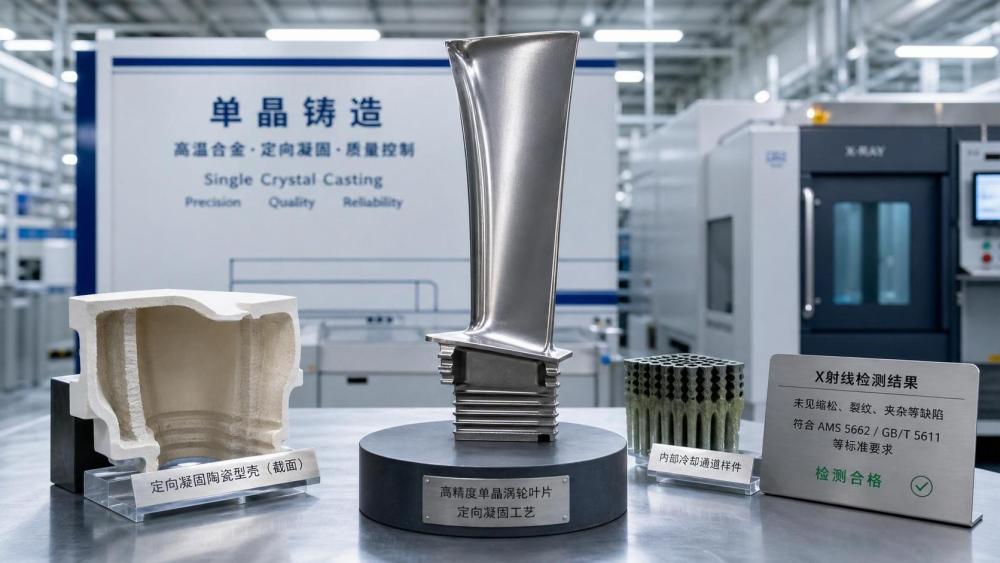
Single-crystal casting standards shape far more than paperwork. They influence whether a blade can survive heat, stress, and long service exposure without hidden weakness.
In aero-engine applications, a small casting deviation may later appear as creep damage, coating failure, or premature crack initiation. That is why single-crystal casting standards matter early.
The most practical view is simple. Standards define what must be controlled, how it is verified, and what defect level is still acceptable.
For turbine blades, these controls usually cover crystal orientation, grain structure, chemical composition, porosity, inclusions, dimensional accuracy, heat treatment response, and traceability.
AATS often frames this issue within the wider reliability chain of aerospace materials, cooling design, creep resistance, and safety certification. That broader context matters because casting quality is never isolated.
If single-crystal casting standards are weak or unevenly applied, later process steps can only hide problems, not remove them. Inspection then becomes expensive, reactive, and incomplete.
Which standards and control points usually affect blade acceptance?
Many searches focus on one named standard, but blade quality is usually affected by a stack of requirements rather than a single document.
In practice, single-crystal casting standards connect material specifications, process qualification, heat treatment rules, non-destructive testing, metallographic acceptance, and customer drawing limits.
The specific numbering differs by engine program, region, and prime contractor. The recurring control points are more important than the label.
- Seed selection and withdrawal rate control during directional solidification.
- Primary and secondary crystal orientation tolerance.
- Limits on stray grains and recrystallization risk.
- Alloy chemistry verification and melt cleanliness.
- Core stability, wall thickness consistency, and cooling passage integrity.
- Radiographic, fluorescent penetrant, and metallographic inspection criteria.
A useful question is not only “Which standard applies?” but also “Which clause can block downstream airworthiness or service reliability?” That is where review effort should concentrate.
This is similar to rail safety systems and transit infrastructure control logic covered by AATS. Reliable output depends on disciplined process windows, not on final inspection alone.
When a blade fails quality review, what is usually wrong?
The visible defect is often not the original problem. A rejected blade may show pore clusters or geometry drift, while the root cause sits in mold condition, thermal gradient, or shell consistency.
More common rejection drivers under single-crystal casting standards include orientation deviation, freckles, stray grain formation, shrinkage porosity, ceramic inclusions, and unstable internal passages.
These issues matter differently. Some mainly reduce yield. Others directly affect creep life, fatigue margin, or cooling efficiency during operation.
A table like this helps separate cosmetic concern from structural risk. That distinction is essential when disposition decisions affect delivery, certification evidence, and service exposure.
How do you judge whether single-crystal casting standards are truly being met?
Passing an inspection report is not the same as having a capable process. The stronger judgment method is to look at consistency across batches, not isolated acceptance results.
In actual production, single-crystal casting standards are met only when process discipline and evidence quality move together. One without the other creates future audit risk.
A practical review usually includes four layers.
- Process capability: stable furnace profile, repeatable withdrawal control, qualified shell system.
- Material integrity: alloy traceability, chemistry consistency, contamination control.
- Inspection depth: orientation checks, NDT coverage, destructive validation where required.
- Change management: controlled response when tooling, core design, or heat treatment shifts.
Need extra caution when paperwork looks complete but rejection patterns drift. That often signals a process window narrowing before a formal nonconformance becomes obvious.
This is where compliance insight becomes useful. AATS regularly connects process capability with certification readiness, which is often the missing bridge in technical reviews.
Are all nonconformities equally serious, or do some deserve faster escalation?
They are not equally serious. Some deviations affect yield or rework cost. Others create direct uncertainty in blade life prediction, which should be escalated much faster.
The better approach is to rank findings by service consequence, not by how easy they are to document.
High-priority escalation usually applies when the defect touches crystal continuity, load-bearing sections, cooling effectiveness, or heat treatment response. Those areas influence in-service risk directly.
Lower-priority issues may still matter, especially if repeated. Dimensional drift at a noncritical feature can reveal tool wear or shell instability that later reaches critical geometry.
A balanced escalation screen can help.
This avoids the common mistake of treating every deviation as equal, which usually overloads teams while masking the truly dangerous signals.
What should be reviewed before approving a supplier or process route?
A supplier review should go beyond certificates. The real question is whether the process can repeatedly satisfy single-crystal casting standards under production pressure.
A useful pre-approval review looks at evidence from qualification, production, and corrective action history together.
- Check how orientation data is measured, stored, and trended across lots.
- Review scrap and rework patterns by defect type, not only total yield.
- Confirm whether internal cooling features are validated after design or tooling changes.
- Look for links between casting, heat treatment, coating, and final inspection records.
- Assess readiness for customer audits, Nadcap-related expectations, and traceability demands.
In many cases, the deciding factor is not the lowest rejection rate shown in one period. It is the clarity of control when abnormal results appear.
That is especially relevant in aerospace supply chains, where blade quality interacts with coating systems, cooling design, and engine reliability models across the full lifecycle.
So what is the smartest next step if blade quality risk is under review?
Start by mapping each major defect risk to the exact requirement inside the applicable single-crystal casting standards. That turns a general concern into a workable control plan.
Then compare three things side by side: process window evidence, inspection results, and service-critical blade features. Gaps between those three usually reveal the real exposure.
If a review is still broad, narrow it to orientation control, stray grain prevention, porosity behavior, cooling passage consistency, and change management discipline. Those areas usually drive the biggest decisions.
For organizations tracking aerospace materials and transport safety through AATS, this kind of structured review supports stronger compliance judgment and more realistic supplier comparisons.
Single-crystal casting standards are most valuable when they are used as operating tools, not archive documents. That shift helps reduce defects, improve blade reliability, and support safer long-term performance.
The practical next move is clear: define acceptance priorities, trend recurring causes, and verify whether current evidence truly matches the blade’s thermal and mechanical duty.
Related News
- What drives thermal barrier coating cost for turbine blade repairs?Sep 18, 2026Thermal barrier coating cost for turbine blade repairs depends on condition, repair scope, coatings, inspection, and turnaround. Learn how to compare quotes confidently.
- How to evaluate a thermal barrier coating supplier for turbine bladesSep 07, 2026Thermal barrier coating supplier evaluation guide for turbine blades—compare process control, approvals, testing, traceability, and lifecycle value with confidence.
- When do ultra high temp materials outperform nickel superalloys?Aug 31, 2026Ultra high temp materials outperform nickel superalloys when heat, cooling demand, weight, and lifecycle limits require smarter material choices. Explore key selection factors.
- What to check before choosing a single crystal turbine blade supplierAug 25, 2026Single crystal turbine blade supplier selection starts with process control, alloy capability, cooling feature accuracy, traceability, and lead-time risk. Learn what buyers should check before requesting quotes.