




Search
Related News
- 00
0000-00
What drives rail vehicle dynamics cost during high-speed bogie design? - 00
0000-00
How rail transit integration testing exposes interface failures before commissioning - 00
0000-00
How to verify aircraft composite material certification for flight use - 00
0000-00
How to qualify titanium aircraft forgings for fatigue-critical parts - 00
0000-00
How to prepare objective evidence for a Nadcap audit
What Drives Commercial Aircraft Components Cost in 2026?




Commercial aircraft components cost is becoming a sharper board-level issue in 2026 because pricing no longer reflects raw material value alone. It now captures supply chain fragility, certification pressure, advanced processing, labor constraints, and lifecycle risk. For companies tracking aerospace sourcing through platforms such as AATS, the real question is not only why parts cost more, but which cost drivers are structural and which can still be managed.
Why cost pressure is intensifying in 2026
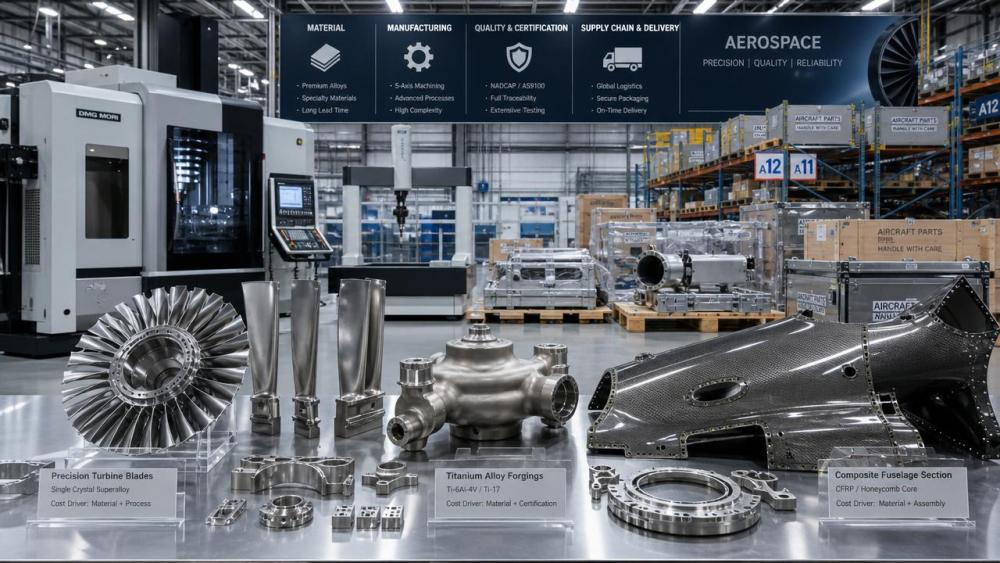
Commercial aviation demand is recovering unevenly, while production systems remain tight.
That imbalance pushes commercial aircraft components cost upward across structures, engines, interiors, fasteners, forgings, and repair-critical assemblies.
In many categories, buyers are no longer paying only for a part number. They are paying for qualified capacity, process stability, traceability, and delivery certainty.
This matters because aerospace components sit inside long certification cycles. If one supplier fails to deliver, switching sources is rarely quick or cheap.
As a result, the commercial aircraft components cost discussion now links engineering, procurement, compliance, and financial planning much more tightly than before.
The cost base starts with materials, but does not end there
Titanium, nickel-based superalloys, aluminum-lithium alloys, and carbon fiber composites remain essential to lightweight and high-temperature aircraft design.
These materials are expensive by nature, yet material price is only one layer of the total equation.
A titanium forging, for example, carries melting cost, billet preparation, forging yield loss, heat treatment, machining time, inspection burden, and documentation overhead.
Composite structures show a similar pattern. Fiber and resin matter, but scrap rate, autoclave occupancy, layup complexity, cure control, and repairability also affect price.
AATS regularly covers this broader technical-commercial relationship. That perspective is useful because aerospace cost inflation often hides inside process capability rather than headline commodity prices.
Material-intensive categories facing the strongest pressure
- Engine hot-section parts using single-crystal superalloys and advanced cooling designs.
- Structural titanium forgings with high buy-to-fly ratios.
- Composite fuselage and wing components requiring strict cure consistency.
- Precision machined housings, casings, and safety-critical fittings.
Process complexity is a major hidden driver
Aerospace buyers often compare quoted prices, but the more revealing comparison is process depth.
Commercial aircraft components cost rises sharply when a part requires multi-step forging, five-axis machining, coating, nondestructive testing, special heat treatment, and serialized traceability.
Even a geometrically simple component may become expensive if tolerance windows are narrow and rejection risk is high.
Engine-related parts show this clearly. Film cooling holes, creep resistance targets, and thermal barrier coatings all add manufacturing difficulty and qualification effort.
The same logic applies to structural parts. Weight reduction targets often demand thin-wall machining, challenging forming paths, and lower process margins.
Why processing costs stay elevated
Certification and compliance now shape pricing more directly
In 2026, compliance is not a side cost. It is part of the product itself.
Commercial aircraft components cost reflects AS9100 controls, Nadcap process discipline, first article inspection, batch traceability, and customer-specific qualification requirements.
This is especially true when buyers need export readiness, dual-source validation, or entry into tightly regulated international programs.
A lower quote may look attractive, yet if certification maturity is weak, total risk-adjusted cost usually climbs later through delays, rework, or audit failure.
That is why compliance insight has become part of commercial intelligence, not just quality management.
Supply chain structure matters as much as factory capability
Many aerospace programs still depend on narrow supplier pools for castings, forgings, advanced coatings, and precision machining.
When one node weakens, commercial aircraft components cost can rise across the chain, even for companies with strong final assembly demand.
Lead times, inventory buffers, and transport volatility now feed directly into quoted pricing.
This pattern is familiar in other advanced transport sectors as well. High-speed rail and signaling systems also show how reliability-driven industries pay premiums for qualified continuity.
That cross-sector perspective is one reason an intelligence framework like AATS is relevant. It connects engineering detail with procurement consequences.
Common supply-side pressures in 2026
- Limited melting, forging, and special-process slots.
- Persistent labor shortages in certified production environments.
- Longer qualification times for new suppliers.
- Higher inventory carrying costs for critical spares and raw stock.
- Geopolitical exposure affecting sourcing routes and export approvals.
How different component groups behave commercially
Not every part category responds to the market in the same way.
Some parts are material-driven. Others are process-driven, certification-driven, or aftermarket-driven.
Understanding that distinction improves forecasting and sourcing priorities.
What the cost trend means in practice
The practical impact of commercial aircraft components cost is broader than purchase price variance.
It affects bid competitiveness, program margins, inventory strategy, aftermarket support, and capital allocation.
For exporters, pricing pressure can also influence market entry timing and the attractiveness of localized manufacturing partnerships.
For investment evaluation, cost behavior can indicate whether a supplier owns defensible know-how or simply benefits from temporary scarcity.
That distinction is important when comparing businesses exposed to turbine blades, casings, composites, fasteners, or repair ecosystems.
How to assess commercial aircraft components cost more accurately
A more useful evaluation starts with structure, not just quotes.
The goal is to separate temporary inflation from deeper technical cost drivers.
- Map which parts are constrained by certified process capacity.
- Track material exposure by titanium, nickel alloy, and composite content.
- Review buy-to-fly ratios for machined and forged structural items.
- Check whether lead time risk is being priced into current offers.
- Compare supplier maturity in traceability, Nadcap readiness, and requalification resilience.
- Include aftermarket supportability when judging initial unit price.
Usually, the strongest sourcing decisions come from combining technical review with market intelligence rather than treating them as separate functions.
That is also where specialized platforms add value, especially when they connect materials science, certification, maintenance demand, and supplier visibility in one place.
Where to focus next
Commercial aircraft components cost in 2026 is shaped by a layered mix of materials, processing, compliance, and constrained capacity.
The most useful next step is to build a component-level view of exposure instead of relying on average inflation assumptions.
Start with the parts that combine high certification burden, difficult materials, and limited supplier depth.
Then compare not only price, but also qualification durability, process transparency, and lifecycle support.
That approach creates a better basis for sourcing decisions, supplier evaluation, and long-range aerospace planning as cost pressure continues to evolve.
Related News
- What aerospace materials engineering certification should verify for fastener traceabilityAug 19, 2026Aerospace materials engineering certification should verify full fastener traceability, lot control, and process linkage. Learn what to check before approving supplier paperwork.
- Anatel Approves Spacesail Constellation for Commercial Use in BrazilAug 16, 2026Anatel approves Spacesail’s LEO constellation for commercial use in Brazil, marking a first for Chinese satellite access in Latin America and opening new telecom opportunities.
- EASA Tightens Fastener Certification for EU ExportsAug 04, 2026EASA tightens fastener certification for EU exports: dual Nadcap HT and NDT approvals are now mandatory. Learn how the rule affects customs clearance, supplier qualification, and on-time aerospace deliveries.
- Aerospace Industrial Depth Suppliers: How to Judge Capacity and QualityJul 08, 2026Aerospace industrial depth suppliers should be judged by process control, quality systems, capacity, and program proof. Learn the key checks to reduce sourcing risk.