




Search
Related News
- 00
0000-00
How condition monitoring technology sensors detect rail defects early - 00
0000-00
How track design choices affect high-speed rail infrastructure costs - 00
0000-00
How CBTC supports subway train density management at peak hours - 00
0000-00
How traction converter losses affect high-speed rail efficiency - 00
0000-00
How train crossing pressure waves in China affect nearby structures
Tags
此处默认显示内容标题




Commercial Aircraft Composite Technology: A Project Leader's Guide to Delivery, Certification, and Lifecycle Value
Commercial aircraft composite technology delivers value only when weight savings, production maturity, certification evidence, and maintenance planning are managed as one program decision.
For project leaders, the central question is not whether composites outperform metals in theory. It is whether the selected solution can be delivered reliably.
Carbon fiber structures can reduce mass, improve fatigue performance, and enable integrated aerodynamic shapes. They can also introduce supply, inspection, repair, and certification risks.
The strongest business case links composite selection to aircraft-level targets: fuel burn, payload, range, emissions, production rate, dispatch reliability, and total ownership cost.
Projects fail when material engineering, industrialization, quality assurance, and airline support teams work from separate assumptions about the final aircraft configuration.
Start with the Aircraft-Level Decision, Not the Material Datasheet
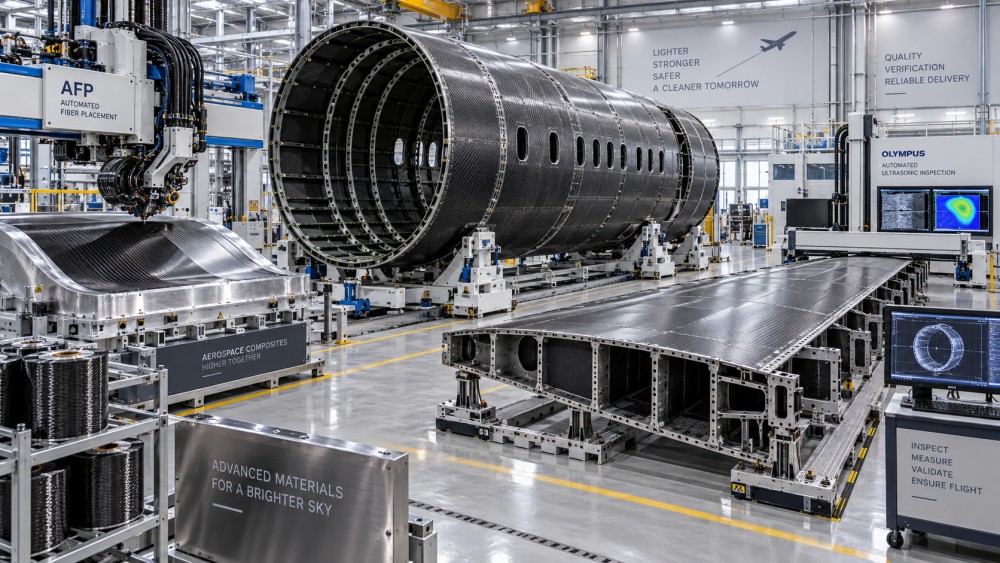
Commercial aircraft composite technology should begin with a clear operational requirement. Project teams must define which aircraft performance, cost, or manufacturing constraint composites will solve.
A composite wing box, fuselage barrel, fairing, nacelle structure, or control surface has different loading conditions, certification pathways, and repair expectations.
Weight reduction remains the most visible benefit, but it should not be treated as an isolated metric. Structural efficiency must support program economics.
Every kilogram removed can reduce fuel consumption or create payload margin. However, those gains may be offset by expensive tooling, scrap, curing capacity, or inspection requirements.
Project managers should establish a baseline against aluminum, titanium, and hybrid alternatives before approving a composite architecture. This creates a defensible investment comparison.
The comparison should include recurring unit cost, non-recurring engineering, manufacturing cycle time, supplier capacity, maintenance burden, and expected fleet utilization.
Composite structures are especially attractive where aerodynamic integration can eliminate fasteners, reduce part count, or create shapes that are difficult to machine conventionally.
They may be less attractive for low-volume parts with limited weight sensitivity, uncertain repair access, or a high likelihood of late design changes.
A practical gate asks whether the program needs a lightweight component or a fully validated production system. The second requirement determines project risk.
Teams should document the decision in measurable terms: target mass, allowable cost, certification milestone, rate readiness, repair time, and service-life assumptions.
Choose Materials and Structural Concepts for the Real Load Environment
Composite selection is not simply a choice between carbon fiber and glass fiber. Fiber type, resin system, layup, core material, and joining approach matter.
Primary aircraft structures commonly use carbon fiber reinforced polymers because they offer high specific stiffness, high specific strength, and strong fatigue resistance.
Yet directional strength is also a limitation. Load paths must be understood precisely because performance changes with fiber orientation, laminate sequence, and manufacturing variation.
Project teams should assess tension, compression, shear, buckling, impact, moisture absorption, thermal cycling, lightning exposure, and long-duration fatigue before freezing the design.
Compression-after-impact performance deserves special attention. Small impact damage can reduce residual strength without producing obvious external visual evidence.
That issue affects allowable values, inspection intervals, protective design features, and repair procedures. It can materially change the lifecycle value of a component.
Hybrid structures often combine composites with titanium or aluminum interfaces. These interfaces require careful management of galvanic corrosion, thermal expansion, fastener loads, and sealing.
Titanium is frequently selected near hot zones, high-load joints, landing gear interfaces, and engine-adjacent structures because it provides durable strength and environmental resistance.
Material trade studies should consider available aerospace-grade supply, approved process specifications, curing equipment, and the supplier's demonstrated experience with similar geometry.
A technically advanced resin system is not automatically the correct choice if its qualification data, repair methods, or production capability are immature.
Build Certification Evidence into the Program Schedule
Certification is a project workstream, not a final approval event. Composite programs need evidence planning from early design through production and continued airworthiness.
Authorities expect applicants to show that materials, processes, structures, and inspection methods consistently meet approved design requirements under representative operating conditions.
The building-block approach remains essential. Teams progressively validate coupons, elements, subcomponents, and full-scale structures before relying on aircraft-level demonstration alone.
This sequence identifies material variability and failure mechanisms early, when design changes remain less expensive. Skipping maturity stages usually transfers risk into certification testing.
Project leaders should create a compliance matrix connecting every requirement to an owner, verification method, test article, report, configuration status, and approval milestone.
Configuration control is particularly important because composite performance depends on details such as fiber placement, cure profile, adhesive preparation, and allowable deviations.
A late manufacturing change may require more than an internal engineering release. It may affect equivalency evidence, process qualification, and regulator acceptance.
Supplier documentation should include material traceability, batch records, process parameters, nonconformance disposition, inspection results, and evidence that approved limits were maintained.
For critical parts, project teams should agree early on which data are supplier-owned, which are program-controlled, and which must be accessible during authority audits.
Certification schedules should include time for retesting, data review, corrective action, and authority questions. Nominal test duration alone is not a credible completion estimate.
Control Manufacturing Variation Before It Becomes a Rate Problem
Many composite programs prove a design in development but struggle when production volume rises. Industrialization readiness must be measured before rate commitments are made.
Automated fiber placement, automated tape laying, resin transfer molding, prepreg layup, and out-of-autoclave processes each create different cost and quality profiles.
The selected process should match part size, geometric complexity, annual volume, tolerance requirements, labor availability, and the manufacturer's validated production envelope.
Tooling design is a strategic decision because it influences dimensional stability, thermal behavior, access for layup, cure repeatability, and turnaround time.
Project managers should monitor first-pass yield, defect types, rework hours, autoclave availability, material expiration loss, and bottleneck operations at each maturity review.
Common defects include porosity, wrinkles, bridging, foreign-object debris, voids, resin-rich areas, delamination, and dimensional distortion after cure or machining.
Non-destructive inspection, often ultrasonic testing, must be designed into the production flow. Inspection capacity can become a hidden rate constraint.
Manufacturing readiness reviews should use representative tooling, operators, facilities, and inspection systems. Demonstrations on idealized development articles are insufficient.
Supplier capability assessments should examine Nadcap-relevant processes, quality management controls, calibration systems, workforce training, and historical corrective-action performance.
A supplier with attractive piece pricing but unstable process capability can create more program cost than a higher-priced supplier with proven repeatability.
Manage the Supply Base as a Technical and Commercial System
Commercial aircraft composite technology depends on a supply chain that includes fibers, resins, prepregs, adhesives, cores, tooling, processing equipment, and inspection services.
Single-source dependency can be acceptable only when the program understands lead-time exposure, qualification constraints, inventory policy, financial stability, and contingency options.
Changing an approved material supplier is rarely a simple procurement action. It can trigger equivalency testing, documentation updates, and renewed confidence in process consistency.
Project leaders should map critical materials to aircraft delivery milestones rather than relying only on supplier forecasts or standard enterprise purchasing schedules.
Long-lead items require clear commitments for storage conditions, shelf life, transportation controls, batch segregation, and documented release to production.
Contracts should define technical data packages, change notification periods, intellectual property boundaries, quality escapes, corrective action timelines, and responsibilities for requalification costs.
For outsourced aerostructures, interface control documents should specify load transfer assumptions, datum schemes, drilling responsibilities, assembly tolerances, and acceptance criteria.
Supplier performance reviews should combine delivery metrics with engineering measures. On-time delivery alone does not reveal rising scrap, recurring defects, or weak configuration discipline.
Dual sourcing should be assessed early because later qualification may be expensive. The alternative supplier needs comparable materials, processes, equipment, and quality evidence.
The most resilient programs treat suppliers as controlled engineering partners while retaining enough internal knowledge to challenge assumptions and manage technical change.
Plan Inspection, Repair, and Lifecycle Support Before Entry into Service
Airlines and lessors evaluate composites through operational outcomes. They need predictable inspection, repair, turnaround, and residual-value performance across global support networks.
Damage tolerance planning should identify likely service events, including ramp impacts, bird strikes, lightning exposure, hail, tool drops, fluid contamination, and maintenance-induced damage.
Each scenario should have defined detection methods, allowable damage limits, repair disposition paths, and approved instructions available to frontline maintenance organizations.
Some composite repairs require controlled temperature, vacuum equipment, specialized materials, and trained technicians. These requirements can affect aircraft availability at remote stations.
Project leaders should determine whether line maintenance can perform temporary repairs, whether regional MROs can complete permanent repairs, and where manufacturer support is necessary.
Digital inspection records can improve fleet learning by linking recurring damage locations to operating conditions, repair outcomes, material batches, and structural design details.
Predictive maintenance has value when it focuses on credible failure mechanisms. Data collection should support inspection optimization rather than create unmanageable information volume.
Lifecycle cost models should include inspection labor, repair kits, training, spares, engineering support, and potential downtime. Purchase price does not represent service economics.
Recycling and end-of-life treatment also deserve attention, particularly as aircraft operators face sustainability reporting expectations and material recovery requirements.
A maintainable composite structure can preserve its weight advantage through service. A difficult-to-repair structure may shift cost and schedule pressure to operators.
Use Risk-Based Governance to Keep the Program Deliverable
Composite projects need governance that connects engineering evidence to management decisions. Senior stakeholders require clear visibility into technical maturity, cost exposure, and schedule confidence.
A useful risk register separates design risk, material risk, process risk, supplier risk, certification risk, and in-service support risk. Combining them obscures ownership.
Each major risk should include a measurable trigger. Examples include failed coupon tests, declining yield, overdue qualification reports, supplier capacity gaps, or inspection backlogs.
Program reviews should focus on evidence instead of optimistic status language. Completed tests, controlled processes, demonstrated yield, and approved repair data are stronger indicators.
Decision gates should prevent premature release into production. Entry criteria may include stable design configuration, qualified suppliers, validated tooling, inspection capability, and certification alignment.
Contingency planning should evaluate practical alternatives, such as revised layups, backup materials, additional tooling, temporary capacity, or phased production-rate increases.
Teams should also protect change authority. Commercial pressure can encourage late substitutions, but ungoverned changes can create disproportionately large compliance and delivery consequences.
For global programs, governance must account for export controls, customer-specific requirements, local certification expectations, and communication across engineering, procurement, and manufacturing locations.
The project manager's role is to convert technical uncertainty into visible decisions. That requires asking for evidence early, assigning accountable owners, and preserving schedule margin.
When these controls are in place, commercial aircraft composite technology becomes a managed industrial capability rather than a high-profile engineering gamble.
Conclusion: Judge Composite Technology by Deliverability, Not Promise
Commercial aircraft composite technology can create substantial aircraft value through lower weight, integrated structures, durability, and improved aerodynamic freedom. Its benefits are real but conditional.
Project leaders should approve composite solutions only when the program can demonstrate structural suitability, certification readiness, manufacturing repeatability, supplier resilience, and maintainable service support.
The best decisions combine engineering depth with commercial discipline. They compare alternatives at aircraft level, identify lifecycle obligations early, and govern change with reliable evidence.
For aerospace organizations, composites are no longer merely advanced materials. They are a cross-functional delivery challenge that directly influences performance, production economics, and fleet confidence.
Related News
- Sep 28, 2026Commercial aircraft composite technology guide for project leaders: improve certification readiness, production control, repair planning, and lifecycle value.
- How do composite wing structures withstand flight-cycle fatigue?Sep 07, 2026Composite wing structures withstand flight-cycle fatigue through optimized laminates, durable joints, strict quality control, testing, and inspection strategies.
- When do composite aircraft structural materials outperform aluminum?Aug 21, 2026Aircraft structural materials composites outperform aluminum when weight savings, fatigue life, corrosion resistance, and lifecycle value matter most. Discover the key conditions that drive better aircraft structure decisions.
- Extreme Engineering Analysis for Carbon Fiber Wings: What Drives Fatigue LifeAug 03, 2026Extreme engineering analysis reveals what truly drives carbon fiber wing fatigue life—from laminate design and resin behavior to defects, load spectra, and damage tolerance. Learn what evaluators must verify.