




Search
Related News
- 00
0000-00
How train crossing pressure waves in China affect nearby structures - 00
0000-00
How fatigue fracture analysis testing identifies crack initiation risks - 00
0000-00
How a CBTC fallback system keeps trains moving after link loss - 00
0000-00
When should a transit system engineering consultant join an EPC project? - 00
0000-00
What drives aerospace forging price for titanium engine casings?
Moving Block Signaling Safety Risks and SIL4 Design Priorities




Why is moving block signaling safety under closer scrutiny now?
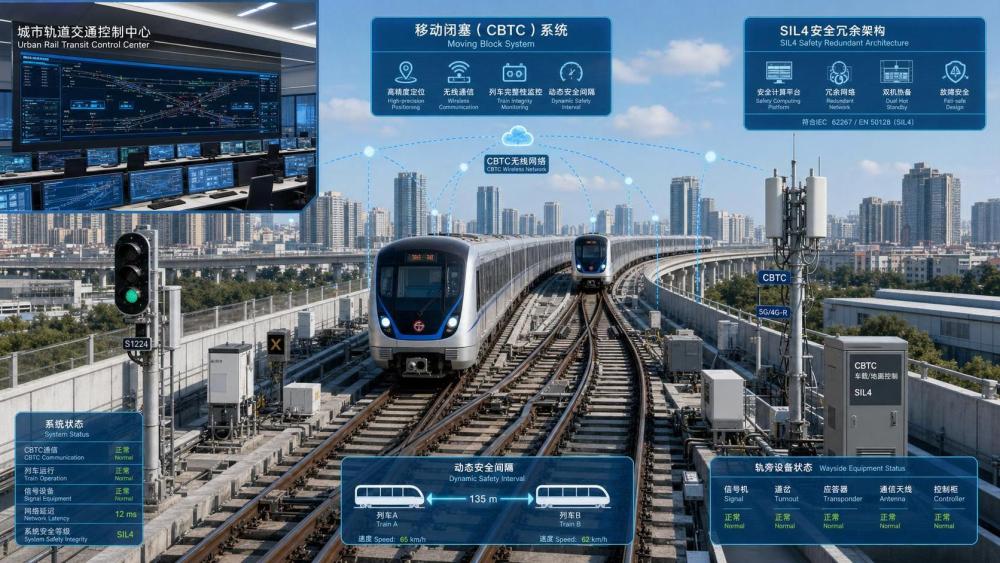
Rail operators want shorter headways without losing control margins. That goal makes moving block signaling safety a daily engineering issue, not only a design topic.
In fixed block systems, track is divided into predefined sections. In moving block control, safe separation follows the train dynamically.
That flexibility improves line capacity, especially in dense metro and high-frequency transit corridors. It also increases dependence on position accuracy, communication integrity, and fail-safe logic.
The concern is simple. If the system misjudges distance, speed, braking curve, or train identity, the safe envelope becomes unreliable.
For organizations tracking advanced transport safety, this topic sits beside other high-reliability questions seen across AATS coverage, from aero-engine thermal margins to EMU dynamic stability.
The common thread is the same. High performance only matters when safety assumptions remain valid under stress, fault, and degraded operation.
What actually creates risk in a moving block environment?
Many people treat moving block signaling safety as a software question. In practice, the risk comes from system interaction.
A CBTC architecture links onboard controllers, zone controllers, train positioning, radio networks, interlocking, braking performance data, and operational rules. A weakness in one layer can undermine the whole protection chain.
The highest-risk conditions usually include the following:
- Position uncertainty caused by odometry drift, balise reading errors, wheel slip, or map mismatch.
- Communication delay, packet loss, or session handover failure between train and wayside.
- Incorrect braking model assumptions, especially under low adhesion or degraded train loading data.
- Unsafe fallback transitions when the system drops from full moving block operation to restrictive modes.
- Data inconsistency between interlocking status, route authority, and train localization.
More commonly, accidents are not triggered by one dramatic failure. They emerge from several tolerable deviations happening at the same time.
That is why moving block signaling safety reviews must look beyond component reliability. Interface behavior, timing assumptions, and degraded states deserve equal attention.
A quick judgment table for common hazard points
The table below helps organize where risk usually appears first and what evidence should be checked during reviews.
Where does SIL4 fit, and what should the design priority be?
SIL4 is often mentioned as a target, but the label alone does not guarantee safe operation. The real issue is whether the architecture supports demonstrable fail-safe behavior.
For moving block signaling safety, SIL4 design priorities usually start with hazard control rather than feature expansion.
A strong design approach normally gives priority to:
- Deterministic response to lost communication, inconsistent data, and uncertain position.
- Independence between safety functions and non-safety service layers.
- Redundant sensing or cross-check logic where single-source data can drift.
- Strict configuration control across onboard and wayside software baselines.
- Evidence-based verification, including fault injection and degraded mode testing.
In actual projects, a useful question is not only “Is this SIL4-certified?” A better question is “Which hazardous failure paths are closed, and which remain sensitive to assumptions?”
That distinction matters during acceptance, retrofit, and lifecycle maintenance. Documentation quality, traceability, and proof of safety intent become as important as the hardware itself.
How do you judge whether a moving block system is truly robust in operation?
Operational robustness is revealed in abnormal conditions. A system that performs well only in nominal traffic does not settle the moving block signaling safety question.
A more reliable judgment combines technical evidence with operating context. That is especially relevant in mixed fleets, retrofit corridors, and high-density urban lines.
Useful review points include:
- How the system behaves during radio shadow, handover interruption, or partial equipment isolation.
- Whether braking curves are updated for seasonal adhesion changes and wheel condition trends.
- How maintenance teams detect silent degradation before it becomes a safety event.
- Whether software changes are assessed for timing side effects, not only logic correctness.
- How emergency rules align with field reality, including driver display, dispatch response, and recovery sequencing.
This is where broader transport intelligence is useful. AATS often connects design assurance with lifecycle evidence, because reliability in service is rarely explained by certification paperwork alone.
In other words, moving block signaling safety should be reviewed as a living control system, not a one-time approval package.
What mistakes appear most often during implementation or compliance review?
Several recurring mistakes weaken otherwise advanced systems. Most of them come from overconfidence in nominal design assumptions.
One common error is treating train localization as a solved subsystem. In reality, position confidence must be monitored continuously and tied to movement authority rules.
Another weak point is incomplete degraded mode definition. If fallback logic is vague, human intervention may happen too late or in the wrong sequence.
There is also a tendency to validate interfaces in the lab, then underestimate field variation. Electromagnetic conditions, maintenance quality, and rolling stock differences can change behavior significantly.
Need-to-check items are usually more practical than long theory lists:
- Confirm hazard logs reflect real operational scenarios, not only design intent.
- Check that SIL4 claims are linked to verified subsystem boundaries.
- Review software update governance across onboard, wayside, and maintenance tools.
- Test unusual transitions, including restart, route cancellation, and train separation recovery.
- Compare safety assumptions with maintenance capability and inspection intervals.
When those checks are missing, compliance may look complete on paper while risk remains hidden in interfaces and operations.
So what should be reviewed first before approving or upgrading a system?
Start with the safety case structure. If the argument for moving block signaling safety is difficult to follow, deeper weaknesses usually appear later.
Then focus on a few hard questions. Are position uncertainty limits explicit? Are braking assumptions conservative enough? Do fail-safe responses happen within defined time windows?
It also helps to compare the project in four linked dimensions:
A sound review process should connect design, operation, and maintenance. That is the practical path to sustaining moving block signaling safety over time.
If the next step is an upgrade, retrofit, or supplier comparison, begin by mapping hazard assumptions, interface dependencies, and SIL4 evidence gaps. That creates a clearer basis for technical judgment and compliance planning.
Related News
- How a CBTC fallback system keeps trains moving after link lossSep 24, 2026CBTC fallback system: learn how rail operators maintain safe train movement, restore positioning, and limit disruption after communication link loss.
- How safe train control technology reduces headway without raising riskAug 23, 2026Safe train control technology explained: learn how moving block, SIL4 design, and fail-safe control cut headway while protecting braking distance, reliability, and real-world rail capacity.
- EASA Tightens SIL4 Rules for EU-Bound CBTC ExportsAug 09, 2026CBTC exports to the EU face tighter SIL4 compliance as EASA updates rules. Learn the March 2027 deadline, IV&V impact, and how suppliers can protect market access.
- How Unmanned Rail Operations Signaling Affects Headway, Safety, and Recovery TimeAug 07, 2026Unmanned rail operations signaling shapes headway, safety, and recovery time. Discover how CBTC, positioning accuracy, and degraded-mode design determine real driverless rail performance.