




Search
Related News
- 00
0000-00
What drives thermal barrier coating cost for turbine blade repairs? - 00
0000-00
What drives rail grinding vehicle cost over its service life? - 00
0000-00
How an aerospace quality management system supports Nadcap compliance - 00
0000-00
How avionics systems integration affects aircraft certification risk - 00
0000-00
How finite element aerospace structural analysis predicts wing fatigue life
Moving Block Control vs Fixed Block: Capacity and Risk Tradeoffs




The choice between moving block control and fixed block signaling has become a board-level issue for modern rail programs. It shapes how much capacity a line can unlock, how much operational risk it absorbs, and how confidently long-term investment can be justified. In networks where reliability, safety integrity, and asset productivity matter at the same time, moving block control is no longer a niche technical topic. It sits at the intersection of CBTC performance, lifecycle maintenance, project finance, and transport resilience.
Why the comparison matters now
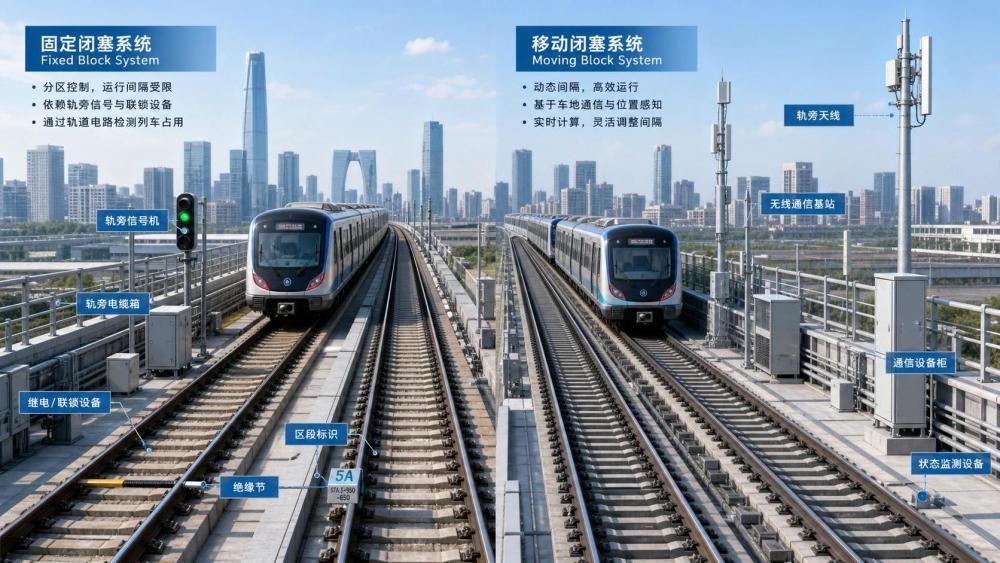
Urban corridors are carrying more passengers, while new high-frequency services are expected to run without expanding every section of physical infrastructure. That pressure pushes signaling strategy into a wider business conversation.
Fixed block systems remain familiar and proven. They divide the track into predefined sections, and only one train can occupy each section at a time. The logic is understandable, maintainable, and often easier to certify in legacy environments.
Moving block control works differently. Instead of relying only on static track sections, it calculates a safe separation envelope based on real-time train position, speed, braking performance, and system status. That dynamic spacing can reduce headway and increase throughput.
From an AATS perspective, this comparison reflects a broader trend across advanced transport systems. Performance gains increasingly depend on precise control, digital visibility, redundancy, and safety-certified software rather than only heavier physical expansion.
A practical view of fixed block and moving block control
The simplest way to understand fixed block is to picture a line segmented into reserved intervals. Safety is achieved by keeping trains apart through those intervals, with margins added for uncertainty.
Moving block control replaces much of that static margin with continuously updated intelligence. It still protects safe braking distance, but it does so with more responsive data and control logic.
That difference sounds straightforward, yet the implications are significant. Capacity can improve, but dependence on communication quality, train positioning accuracy, onboard systems, and fail-safe design also rises.
The core tradeoff in one view
Where moving block control creates real value
The main business case for moving block control is not technology for its own sake. It is the ability to move more trains, more smoothly, on the same corridor while maintaining a high safety standard.
That matters most when adding new tracks is difficult, depot access is constrained, or timetable recovery is already weak. In those settings, even modest headway improvement changes revenue potential and service credibility.
There is also a secondary value stream. Better train localization and control data support predictive maintenance, fault diagnosis, and performance benchmarking. For integrated transport portfolios, those data layers can improve both operations and infrastructure planning.
AATS often covers similar decision patterns in aerospace and rail. Higher-performance systems usually bring tighter tolerances, more advanced materials or software, and stronger dependence on certification discipline. Moving block control follows that same industrial logic.
Typical value drivers
- Shorter safe headways on congested lines
- More stable service under variable operating conditions
- Improved platform and junction utilization
- Better visibility for maintenance and incident analysis
- Stronger long-term case for digitalized network management
The risks are different, not smaller
A common mistake is to frame moving block control as a simple upgrade path from fixed block. In reality, it changes the risk structure of the network.
Fixed block tends to carry more visible physical constraints. Moving block control reduces some of those constraints, but it introduces stronger dependence on software assurance, communication continuity, sensor integrity, and graceful degradation.
That means attention must shift from track occupancy alone to system architecture. SIL4 safety functions, redundancy design, failover logic, train positioning confidence, and cyber resilience all become central to the business case.
Brownfield deployments deserve extra caution. Legacy rolling stock, mixed signaling territory, interface complexity, and phased commissioning can dilute the theoretical capacity benefit if transition planning is weak.
Risk areas that deserve early review
- Radio and communication network resilience
- Onboard equipment reliability across fleet age variations
- Verification and validation burden during certification
- Fallback mode performance during degraded operation
- Cybersecurity governance across suppliers and operators
Different corridors need different answers
Not every line benefits equally from moving block control. The strongest fit usually appears in dense metro environments, automated operations, and corridors where headway reduction produces immediate network value.
In lower-frequency routes, a fixed block design may remain commercially rational. If traffic density is moderate and operational patterns are stable, the extra complexity of moving block control may not pay back quickly enough.
High-speed and intercity projects need a more nuanced view. Capacity still matters, but braking curves, mixed traffic, infrastructure exposure, and interoperability requirements can alter the design balance.
This is where broader transport intelligence becomes useful. The same discipline used to evaluate bogie dynamics, aerodynamics, maintenance intervals, or materials reliability should also shape signaling choices. The question is not only what performs best in simulation, but what remains robust across decades of operation.
How to evaluate the tradeoff in business terms
A sound comparison should move beyond headline claims about more capacity or smarter control. The real issue is whether moving block control improves the full operating model.
That means examining capacity uplift, but also availability, maintainability, vendor dependency, certification schedule, training burden, spare strategy, and upgrade flexibility.
A fixed block system can look less advanced yet remain stronger in a risk-adjusted investment model. Conversely, moving block control can produce superior value when service demand is high and digital operations are already mature.
Useful decision questions
- What headway reduction is actually achievable after migration constraints?
- How much of the benefit depends on fleet retrofit quality?
- What degraded mode capacity is acceptable during failures?
- How exposed is the program to single-supplier architecture?
- Can maintenance teams support the software and data burden?
What to examine before the next decision gate
The most useful next step is to translate signaling choice into a corridor-specific evaluation framework. Compare fixed block and moving block control against actual service density, infrastructure constraints, fleet condition, and recovery requirements.
It also helps to align signaling with adjacent priorities. Those include maintenance strategy, cybersecurity policy, fleet modernization, supplier qualification, and future automation plans.
AATS tracks these decisions in the same way it tracks advanced aerospace and rail technologies: by linking performance claims to material evidence, safety assurance, certification readiness, and lifecycle economics.
When the comparison is framed that way, moving block control becomes easier to judge. It is not simply better or worse than fixed block. It is a strategic option whose value depends on whether its capacity gains outweigh its integration, assurance, and operational risks in a specific network context.
The strongest decisions usually come from building that context first, then testing which signaling architecture supports it with the least long-term friction.
Related News
- How safe train control technology reduces headway without raising riskAug 23, 2026Safe train control technology explained: learn how moving block, SIL4 design, and fail-safe control cut headway while protecting braking distance, reliability, and real-world rail capacity.
- EASA Tightens SIL4 Rules for EU-Bound CBTC ExportsAug 09, 2026CBTC exports to the EU face tighter SIL4 compliance as EASA updates rules. Learn the March 2027 deadline, IV&V impact, and how suppliers can protect market access.
- How Unmanned Rail Operations Signaling Affects Headway, Safety, and Recovery TimeAug 07, 2026Unmanned rail operations signaling shapes headway, safety, and recovery time. Discover how CBTC, positioning accuracy, and degraded-mode design determine real driverless rail performance.
- EASA Extends SIL4 Rules to CBTC CertificationAug 07, 2026EASA extends SIL4 rules to CBTC certification, reshaping market access, audits, and procurement. Learn what suppliers, bidders, and EU-focused buyers must prepare now.