




Search
Related News
- 00
0000-00
What drives thermal barrier coating cost for turbine blade repairs? - 00
0000-00
What drives rail grinding vehicle cost over its service life? - 00
0000-00
How an aerospace quality management system supports Nadcap compliance - 00
0000-00
How avionics systems integration affects aircraft certification risk - 00
0000-00
How finite element aerospace structural analysis predicts wing fatigue life
CBTC System Specifications That Matter in New Metro Projects




In new metro programs, the real value of CBTC is not the acronym itself, but the way communication-based train control system specifications shape capacity, safety margins, expansion plans, and long-term operating discipline.
A line can look technically complete on paper and still face costly constraints later if the specifications behind train control were defined too narrowly, too vaguely, or without enough attention to integration.
That is why communication-based train control system specifications deserve close review at the earliest project stage, especially when tender strategy, civil interfaces, rolling stock compatibility, and lifecycle maintenance are all moving in parallel.
Why specifications matter before equipment is selected
CBTC is often discussed as a signaling solution, yet in practice it is a system architecture decision that influences timetable ambition, depot operation, resilience strategy, and future network growth.
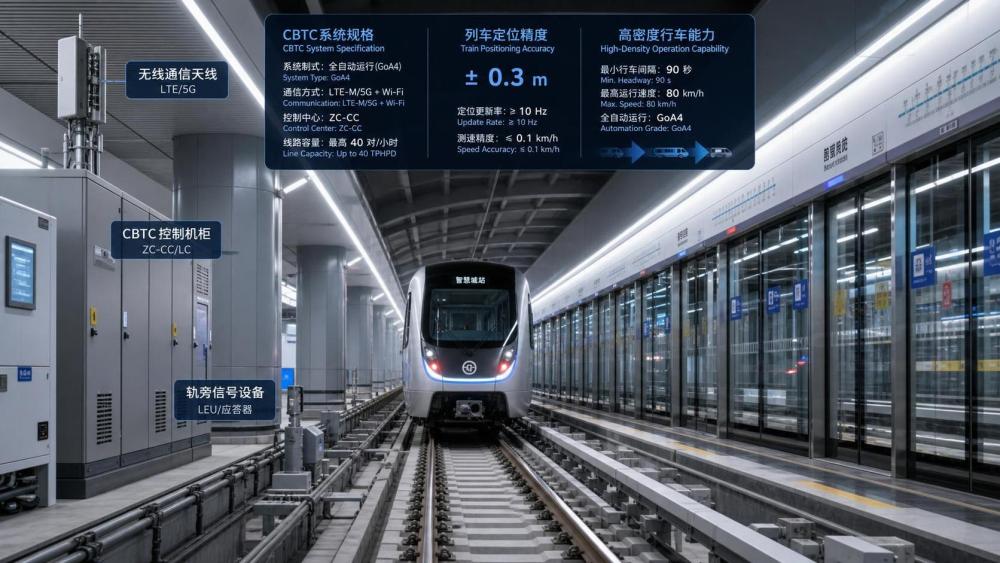
When specifications are well structured, vendors can respond against measurable requirements instead of broad claims about performance or automation capability.
This is especially important in large transport programs covered by AATS, where system reliability, safety integrity, maintainability, and procurement clarity must align across multiple engineering packages.
A strong specification framework also reduces the gap between commercial evaluation and operational reality. That gap is where many metro projects lose time during design review, interface testing, and trial running.
The core of communication-based train control system specifications
At a basic level, CBTC combines continuous train positioning, secure data communication, movement authority control, and automatic protection functions to support closer headways than conventional fixed-block signaling.
However, communication-based train control system specifications are not limited to moving block language. They define how the entire control environment performs under normal, degraded, and recovery conditions.
The most useful specifications usually describe not only what the system should do, but under which operating assumptions it must do it consistently.
Key technical areas usually hidden behind one acronym
- Train localization accuracy and update rate
- Radio communication coverage, latency, and redundancy
- Safe headway performance under design operating conditions
- ATP, ATO, and ATS functional boundaries
- SIL4 safety architecture and fail-safe behavior
- Cybersecurity controls and secure maintenance access
- Interface requirements with rolling stock, PSDs, SCADA, and telecom systems
If these areas are described only at headline level, bidders may price against different technical assumptions, making later comparison difficult and negotiation less transparent.
Which CBTC parameters influence project outcomes most
Not every parameter carries the same project weight. Some specifications directly affect business case assumptions and should be reviewed as decision-level items, not buried in annexes.
Safe headway and throughput
Headway targets often drive the entire signaling concept. Yet the stated minimum headway must be tied to dwell time variability, rolling stock braking performance, junction operation, and terminal turnback design.
A low theoretical headway is not enough. Communication-based train control system specifications should state the operational conditions under which that value is sustained.
Availability and degraded mode operation
New metro lines rarely fail because one subsystem lacks sophistication. More often, disruption grows because degraded mode logic is weak or poorly coordinated between control center, trainborne equipment, and field devices.
Specifications should define availability targets, fault recovery times, fallback modes, and service continuity expectations during communication loss, equipment isolation, or partial network outages.
Positioning performance
Precise train positioning affects movement authority calculation, stopping accuracy, and confidence in automation. This matters even more where platform screen doors, tight curves, or mixed operating patterns are involved.
Inconsistent wording here can lead to expensive retuning during integration and trial operation.
Communications resilience
Because CBTC depends on continuous data exchange, radio design is never a side topic. Coverage overlap, packet loss tolerance, interference management, and redundancy strategy should be treated as core system requirements.
What the industry is watching now
Current attention is moving beyond classic capacity claims. Metro owners now want communication-based train control system specifications that support digital maintenance, cybersecurity governance, and scalable network modernization.
That broader view fits the AATS perspective, where transport safety is linked with lifecycle discipline, data quality, and asset reliability, not only headline operating speed.
Cybersecurity and secure remote access
As diagnostics and software support become more connected, specifications should address authentication, access logging, patch management, segmentation, and incident response obligations.
Migration and brownfield compatibility
Many new projects are not isolated greenfield systems. Extensions, phased commissioning, and coexistence with legacy signaling make migration rules a high-value part of the specification set.
Maintainability data
Owners increasingly need fault diagnostics, condition indicators, spare strategy inputs, and maintainability reporting defined from the start. Otherwise, advanced control systems can become black boxes after handover.
How to read specifications in a practical project context
A useful review method is to test every major requirement against a real operating scenario rather than reading the document only as a compliance checklist.
For example, ask how the communication-based train control system specifications behave during terminal reversal, depot entry, PSD misalignment, communication handover failure, or partial power restrictions.
This exposes whether the specification reflects actual railway behavior or only ideal design conditions.
Useful questions during tender and design review
- Are performance values linked to verified operating assumptions?
- Do interface requirements clearly assign responsibility across packages?
- Is degraded mode capacity quantified, not just described?
- Are cybersecurity and software support obligations contractually visible?
- Can the architecture support future line extensions or fleet changes?
- Will maintainers receive the data needed for predictive maintenance?
These questions help separate technically mature proposals from attractive but incomplete claims.
Where specification discipline creates long-term value
Well-defined communication-based train control system specifications do more than support safe operation on opening day. They improve procurement comparability, shorten integration debate, and reduce ambiguity in acceptance testing.
They also create a better foundation for asset management. That matters when the line reaches fleet expansion, software updates, midlife refurbishment, or network-level traffic optimization.
In broad transport intelligence environments such as AATS, this is the recurring pattern: the strongest infrastructure decisions are usually made where technical detail and commercial clarity meet early enough.
For the next step, it is worth mapping current project objectives against a short list of critical CBTC requirements, then checking which ones are measurable, testable, and future-ready before procurement moves too far ahead.
Related News
- How safe train control technology reduces headway without raising riskAug 23, 2026Safe train control technology explained: learn how moving block, SIL4 design, and fail-safe control cut headway while protecting braking distance, reliability, and real-world rail capacity.
- EASA Tightens SIL4 Rules for EU-Bound CBTC ExportsAug 09, 2026CBTC exports to the EU face tighter SIL4 compliance as EASA updates rules. Learn the March 2027 deadline, IV&V impact, and how suppliers can protect market access.
- How Unmanned Rail Operations Signaling Affects Headway, Safety, and Recovery TimeAug 07, 2026Unmanned rail operations signaling shapes headway, safety, and recovery time. Discover how CBTC, positioning accuracy, and degraded-mode design determine real driverless rail performance.
- EASA Extends SIL4 Rules to CBTC CertificationAug 07, 2026EASA extends SIL4 rules to CBTC certification, reshaping market access, audits, and procurement. Learn what suppliers, bidders, and EU-focused buyers must prepare now.