




Search
Related News
- 00
0000-00
How derailment prevention systems are evaluated for high-speed rail safety - 00
0000-00
When does bridge structural health monitoring justify the cost - 00
0000-00
Anatel Approves Spacesail Constellation for Commercial Use in Brazil - 00
0000-00
China Rolls Out Nationwide Cross-Border RMB and FX Cash Pooling for Multinationals - 00
0000-00
How often should rail corrugation inspection be done?
CBTC Signaling Systems: How to Evaluate Capacity, Headway, and Upgrade Risk




For urban rail programs, the appeal of CBTC signaling systems usually starts with capacity. Yet the harder evaluation lies elsewhere: whether shorter headways can be delivered without creating fragile operations, costly interfaces, or future upgrade bottlenecks.
That question matters more as networks age, ridership patterns shift, and authorities demand higher availability from the same infrastructure. In this setting, CBTC signaling systems are no longer judged only by technical novelty, but by lifecycle performance, migration practicality, and investment resilience.
Why CBTC evaluation has become more demanding
CBTC signaling systems support train separation through continuous communication, more accurate train positioning, and tighter control logic than legacy fixed-block approaches.
In principle, that enables reduced headway, more stable service recovery, and better use of existing track assets. In practice, results depend on rolling stock, telecom architecture, interlocking boundaries, depot operations, and maintenance discipline.
This is why transit investment reviews now look beyond headline throughput claims. Platforms such as AATS increasingly frame CBTC within a wider reliability and safety context, similar to how aerospace programs assess performance together with certification, redundancy, and long-term supportability.
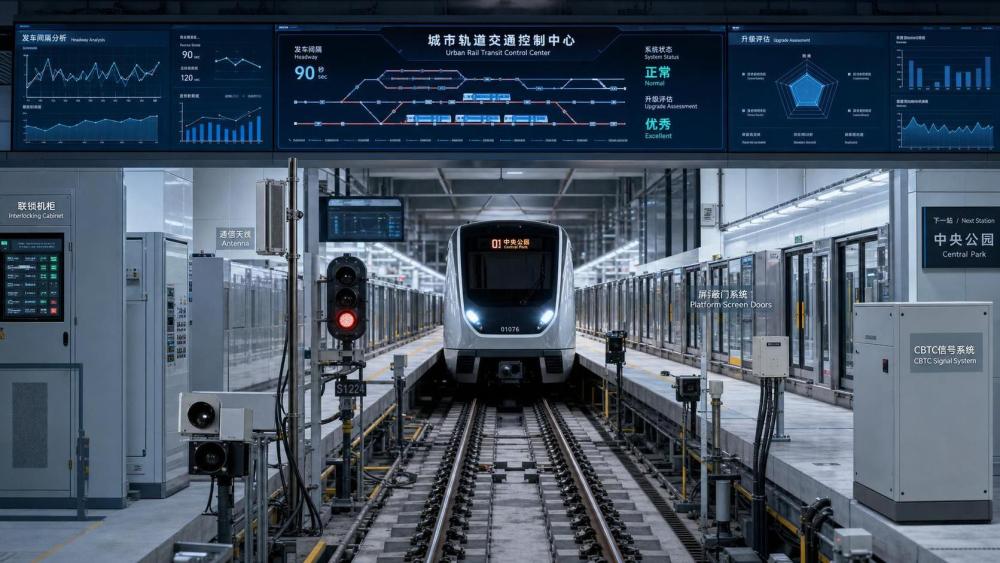
The useful comparison is not only between old and new signaling. It is between competing modernization paths, each carrying different interface complexity, outage exposure, software dependency, and upgrade sequencing risk.
Capacity is more than trains per hour
A common mistake is to treat capacity as a single figure. For decision-making, it helps to separate theoretical capacity, deliverable peak capacity, and sustained operating capacity.
Three layers of capacity
A supplier may present strong simulation results, but those numbers are incomplete without assumptions on dwell time distribution, door performance, junction conflicts, and turnaround margins.
More importantly, CBTC signaling systems should be tested against non-ideal conditions. Real networks operate with variable passenger loading, maintenance windows, platform constraints, and occasional telecom interference.
Headway claims need operational context
Short headway is often the headline promise of CBTC signaling systems. However, minimum safe headway and usable service headway are not the same thing.
Minimum safe headway comes from train performance curves, braking assurance, moving block logic, and position confidence. Usable headway depends on station dwell variation, passenger exchange, and how quickly the line recovers from minor delay.
Questions that sharpen the evaluation
- What headway is achieved in automatic operation versus mixed manual operation?
- How does the system perform at terminal stations and flat junctions?
- What happens to headway when one train underperforms or loses communication briefly?
- Which assumptions are built into braking distance, wheel condition, and adhesion margin?
- How much schedule recovery is possible without increasing passenger crowding?
These questions matter because the commercial value of CBTC signaling systems lies in reliable throughput, not simply in an impressive minimum interval achieved under controlled testing.
The interface map often defines the real project risk
Many signaling upgrades fail to meet expectations because the interface burden was underestimated. A CBTC program touches more than onboard controllers and zone equipment.
It usually interacts with interlocking, ATS, telecom networks, platform screen doors, rolling stock wiring, traction power behavior, depot systems, and cybersecurity controls.
From a project controls perspective, each interface adds test effort, approval cycles, and possible delay. In brownfield rail programs, this is often where schedule erosion begins.
High-impact integration constraints
- Legacy rolling stock with limited space, cooling margin, or power quality stability
- Mixed fleet operation requiring multiple onboard baselines
- Aging wayside rooms that cannot easily support new telecom and redundancy layouts
- Possession windows too short for efficient migration testing
- National approval regimes that extend software change validation
This is where a broader advanced transport lens becomes useful. AATS often treats reliability engineering, safety integrity, and maintainability as connected decisions rather than separate workstreams, and that framing fits CBTC well.
Upgrade risk is not only a commissioning issue
Modernization risk starts long before cutover weekend. It begins with architecture choices that determine how flexible the line remains over the next fifteen or twenty years.
A system that delivers strong early performance may still create future exposure if it depends on proprietary interfaces, narrow spare part channels, or difficult software version control.
What to examine in upgrade planning
For many operators, the best option is not the most advanced architecture on paper. It is the one that keeps future fleet changes, line extensions, and software refreshes manageable.
Where CBTC signaling systems create the most value
The strongest business case usually appears where demand is growing but civil expansion is constrained. In those cases, better train separation and control quality can postpone expensive infrastructure additions.
CBTC signaling systems also create value on lines that suffer from unreliable recovery after small disturbances. Better train regulation, more accurate occupancy awareness, and improved automation can reduce service instability.
Another important scenario is mixed modernization, where vehicles, depot assets, and maintenance systems are being renewed in parallel. Then the signaling choice influences not only operations, but procurement timing and long-term MRO cost.
That broader view aligns with how AATS covers transport technology. Rail signaling is treated as part of an integrated safety and performance chain, not as an isolated equipment package.
A practical framework for comparing options
When several vendors or migration concepts are under review, a simple comparison matrix helps keep discussions grounded in evidence.
Key comparison dimensions
- Peak and sustained headway under defined operating assumptions
- Degraded-mode behavior after communication loss or equipment isolation
- Compatibility with existing fleets, depots, and telecom backbone
- Evidence of commissioning performance on comparable brownfield lines
- Cybersecurity maintenance burden across the support period
- Obsolescence management and contract clarity for future upgrades
What matters is consistency. The same assumptions should apply across all bids, especially for dwell time, turnaround, temporary speed restrictions, and failure recovery logic.
It also helps to separate vendor claims from operator obligations. Some performance gains are only possible if timetable design, maintenance response, and staff procedures are upgraded at the same time.
What to do before locking the roadmap
Before committing to a CBTC program, it is worth building a short decision file around five items: baseline constraints, target service pattern, migration window, safety approval path, and long-term support model.
That exercise often reveals whether the real bottleneck is signaling, terminal layout, rolling stock readiness, or a hidden interface outside the core CBTC scope.
The next step is to test each option against real operating conditions rather than ideal diagrams. For CBTC signaling systems, durable value comes from verified resilience, not from the narrowest theoretical headway alone.
A disciplined review of capacity, headway, and upgrade risk gives transit programs a firmer basis for tender design, technical clarification, and phased modernization decisions.
Related News
- EASA Tightens SIL4 Rules for EU-Bound CBTC ExportsAug 09, 2026CBTC exports to the EU face tighter SIL4 compliance as EASA updates rules. Learn the March 2027 deadline, IV&V impact, and how suppliers can protect market access.
- How Unmanned Rail Operations Signaling Affects Headway, Safety, and Recovery TimeAug 07, 2026Unmanned rail operations signaling shapes headway, safety, and recovery time. Discover how CBTC, positioning accuracy, and degraded-mode design determine real driverless rail performance.
- EASA Extends SIL4 Rules to CBTC CertificationAug 07, 2026EASA extends SIL4 rules to CBTC certification, reshaping market access, audits, and procurement. Learn what suppliers, bidders, and EU-focused buyers must prepare now.
- EU Tightens SIL4 Rules for CBTC VerificationAug 06, 2026EU Tightens SIL4 Rules for CBTC Verification: learn how the new ERA-backed third-party requirement reshapes EU certification, project timelines, and export readiness for rail suppliers.