




Search
Related News
- 00
0000-00
How rail fail safe systems prevent unsafe routes during signal faults - 00
0000-00
What should a rail signaling supplier provide for SIL4 projects? - 00
0000-00
What drives thermal barrier coating cost for turbine blade repairs? - 00
0000-00
What drives rail grinding vehicle cost over its service life? - 00
0000-00
How an aerospace quality management system supports Nadcap compliance
Unmanned Train Dispatch CBTC: Key Failure Risks and Control Points




Why unmanned train dispatch CBTC failures behave differently in real operations
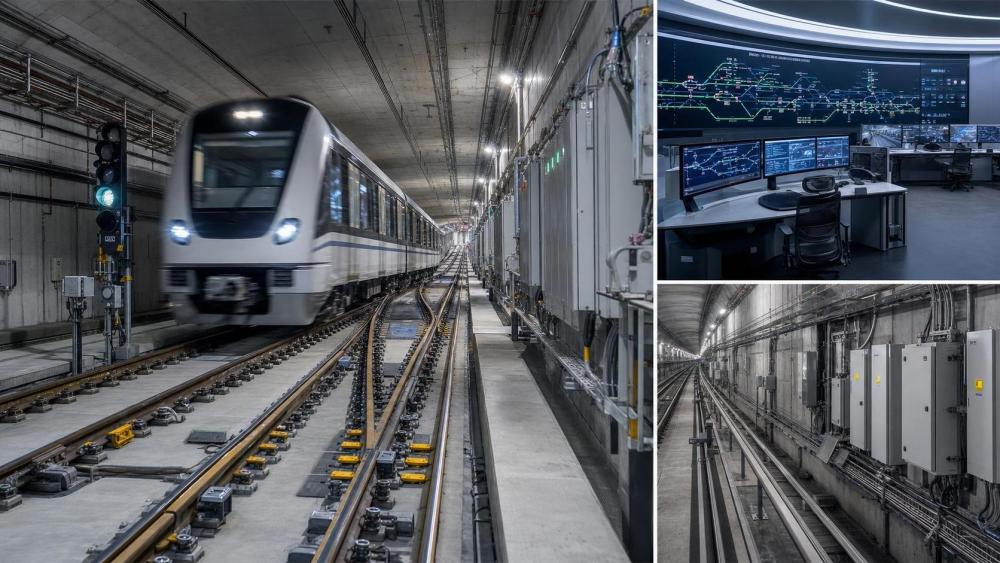
Unmanned train dispatch CBTC is rarely judged by one fault alone.
What matters is how a small deviation travels through train control, wayside logic, communications, and recovery rules.
That is why the same alarm can be manageable on one line and disruptive on another.
A compact airport people mover, a dense metro trunk, and a mixed-speed suburban corridor do not stress unmanned train dispatch CBTC in the same way.
In practice, the control priority changes with headway targets, platform dwell variability, radio coverage, turnout density, and fallback mode design.
For a platform such as AATS, this matters because signaling reliability is not isolated engineering.
It connects to lifecycle maintenance, safety certification, infrastructure readiness, and long-term investment risk.
The core question is simple.
Which failure risks in unmanned train dispatch CBTC can quickly turn from service disturbance into safety-critical exposure, and where should control effort concentrate first?
Dense urban headways usually expose positioning and latency first
The highest pressure scenario is the tight-headway metro core.
Here, unmanned train dispatch CBTC must keep movement authority updates stable while dwell times change minute by minute.
A minor train positioning drift may not trigger immediate danger.
But if it combines with communication latency, the safety margin can shrink faster than operators expect.
More common than total communication loss is timing inconsistency.
Packets arrive, but not within the deterministic window assumed by dispatch logic.
That creates unstable headway control, unnecessary braking, and platform bunching.
In unattended operation, recovery is harder because there is no onboard crew to absorb irregular conditions quickly.
The better control point is not only radio availability.
It is end-to-end delay behavior under peak load, including handover zones, tunnel reflections, and packet queuing during simultaneous route changes.
What deserves closer control in this setting
- Position confidence limits, not only nominal positioning accuracy.
- Latency distribution during rush-hour traffic, not only average network delay.
- Braking curve consistency after temporary speed restriction updates.
- Platform dwell overruns that create dispatch compression upstream.
A frequent misjudgment is to validate unmanned train dispatch CBTC under normal timetable stability, then assume disturbed operation behaves proportionally.
It rarely does.
At junctions and turnbacks, interlocking logic becomes the sharper risk
Lines with frequent turnbacks, crossovers, and terminal reversals create a different pattern.
The issue is less about pure moving block performance and more about logic coordination.
Unmanned train dispatch CBTC depends on clean agreement between route status, point machine feedback, train occupancy, and automatic departure conditions.
If the interlocking state changes late, dispatch can hold trains too long or release authority too conservatively.
If feedback is inconsistent, the system may force protective downgrades that collapse throughput.
This is where SIL4 discipline has operational meaning.
Safe failure is necessary, but excessive nuisance trips also damage line resilience and maintenance credibility.
In actual deployment, the best question is not whether interlocking and CBTC are both certified.
It is whether their failure assumptions match during abnormal route permutations.
Mixed-speed or retrofit lines often fail at the interfaces
Not every line is built as a clean, new unattended system.
A more demanding case is retrofit deployment across legacy traction, older interlockings, inherited cable routes, and partial radio upgrades.
In that environment, unmanned train dispatch CBTC can look compliant in subsystem tests but become fragile at the interfaces.
Redundancy switching is a typical example.
A backup path exists on paper, yet switchover timing may exceed the tolerance of dispatch or onboard control.
The result is not necessarily an unsafe state.
More often, it is a cascade of emergency restrictions, train resets, and timetable erosion.
Mixed-speed lines add another complication.
Dispatch logic must accommodate different acceleration profiles, braking behavior, and stopping precision while preserving safe movement authority.
That increases sensitivity to model error.
A common oversight is to compare rolling stock compatibility only by headline interface standards.
Operational compatibility depends more on timing, failover sequence, and degraded mode behavior.
A practical way to judge retrofit readiness
- Map every interface that can delay authority updates or status confirmation.
- Test redundancy under live traffic patterns, not only isolated bench conditions.
- Review degraded mode throughput, because safe operation can still mean unacceptable service collapse.
- Check maintenance diagnostics depth, especially for intermittent communication and switchback faults.
The biggest differences appear when comparing maintenance environments
Two lines may use similar unmanned train dispatch CBTC architectures and still carry different residual risk.
The difference often comes from maintenance maturity.
On networks with strong condition monitoring, fault logs are correlated across onboard, wayside, and telecom layers.
Transient anomalies get investigated before they become repeated service events.
On weaker networks, teams may replace modules repeatedly without isolating root timing or configuration issues.
That is expensive and technically misleading.
AATS regularly frames transport reliability in lifecycle terms, and this is exactly where that view helps.
Unmanned train dispatch CBTC should be assessed like other advanced safety systems.
Not only by design intent, but by maintainability, evidence quality, and long-cycle degradation patterns.
This is especially relevant for rail systems that share high-reliability thinking with aerospace programs.
In both sectors, hidden failure accumulation matters more than isolated visible defects.
Points that are often underestimated
- Configuration drift between software baselines and actual field assets.
- Temporary workarounds that remain in place after fault clearance.
- Environmental effects in tunnels, depots, and equipment rooms.
- Maintenance windows too short for meaningful integrated verification.
Control priorities should change with the operating scenario
There is no single checklist that fits every unmanned train dispatch CBTC project.
Still, some control priorities consistently separate robust lines from fragile ones.
First, validate fault chains, not isolated components.
A radio delay, a route status lag, and a braking update conflict can interact in ways factory tests never reveal.
Second, define acceptable degraded performance before incidents occur.
A line that remains technically safe but operationally unusable still carries high business risk.
Third, treat redundancy as a timed behavior, not a box-ticking feature.
Fourth, connect dispatch reliability with maintenance evidence.
Failure recurrence should be reviewed by scenario, location, and trigger sequence.
That approach makes unmanned train dispatch CBTC decisions more precise than relying on generic availability figures.
Before the next project step, narrow the scenario and test the assumptions
The most useful next move is to define the real operating scene before comparing technical claims.
Clarify whether the line is headway-limited, junction-heavy, retrofit-constrained, or maintenance-limited.
Then test unmanned train dispatch CBTC against that condition, not against a generic reference line.
Review position confidence, communication timing, interlocking coordination, and redundancy switching as one connected chain.
It is also worth documenting which degraded modes remain acceptable for service continuity and which require immediate operational restriction.
When those boundaries are explicit, safety review, maintenance planning, and investment judgment become far more reliable.
That is usually the point where unmanned train dispatch CBTC moves from theoretical capability to dependable unattended operation.
Related News
- How safe train control technology reduces headway without raising riskAug 23, 2026Safe train control technology explained: learn how moving block, SIL4 design, and fail-safe control cut headway while protecting braking distance, reliability, and real-world rail capacity.
- EASA Tightens SIL4 Rules for EU-Bound CBTC ExportsAug 09, 2026CBTC exports to the EU face tighter SIL4 compliance as EASA updates rules. Learn the March 2027 deadline, IV&V impact, and how suppliers can protect market access.
- How Unmanned Rail Operations Signaling Affects Headway, Safety, and Recovery TimeAug 07, 2026Unmanned rail operations signaling shapes headway, safety, and recovery time. Discover how CBTC, positioning accuracy, and degraded-mode design determine real driverless rail performance.
- EASA Extends SIL4 Rules to CBTC CertificationAug 07, 2026EASA extends SIL4 rules to CBTC certification, reshaping market access, audits, and procurement. Learn what suppliers, bidders, and EU-focused buyers must prepare now.