




Search
Related News
- 00
0000-00
How finite element aerospace structural analysis predicts wing fatigue life - 00
0000-00
What drives rail vehicle dynamics cost during high-speed bogie design? - 00
0000-00
How rail transit integration testing exposes interface failures before commissioning - 00
0000-00
How to verify aircraft composite material certification for flight use - 00
0000-00
How to qualify titanium aircraft forgings for fatigue-critical parts
Predictive Maintenance Software: Features That Matter Most




In aerospace and advanced transit, predictive maintenance software is judged less by visual appeal and more by its ability to turn scattered condition data into reliable maintenance action. When assets include aero-engine parts, high-speed EMUs, CBTC equipment, and rail infrastructure, the software must support availability, traceability, and risk control across long operating cycles.
Why this topic is gaining weight
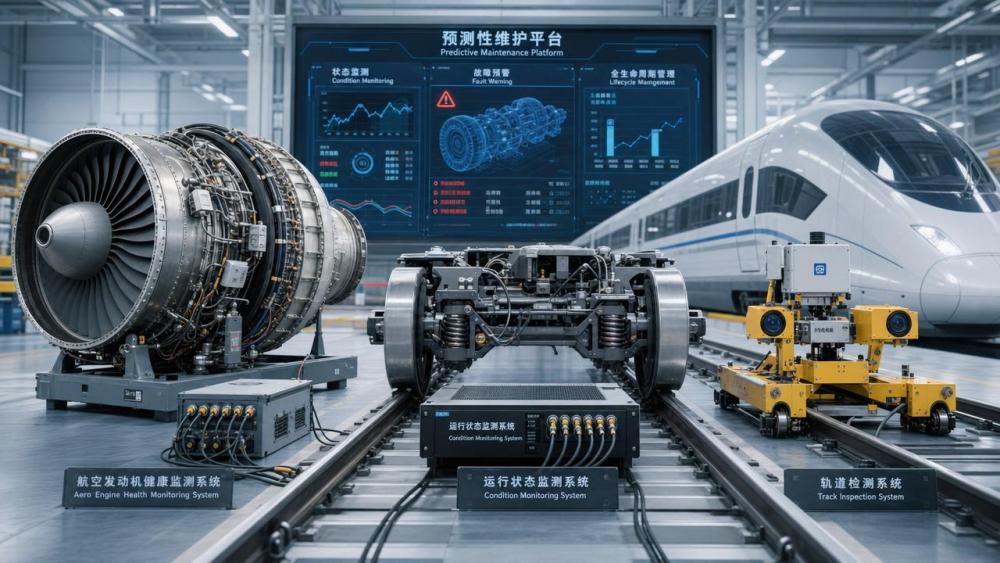
The pressure is rising from both directions. Assets are becoming more complex, while downtime is becoming more expensive.
A turbine blade, traction system, bogie, pantograph, or signaling cabinet does not fail in the same way. Yet all require earlier warning and better planning.
That is why predictive maintenance software now sits close to engineering, MRO, compliance, and procurement decisions. It affects inspection timing, spare parts strategy, service intervals, and lifecycle cost assumptions.
In sectors covered by AATS, the issue is not abstract digital transformation. It is whether data from vibration, temperature, fatigue, wear, geometry drift, and control-system events can reduce operational risk.
What predictive maintenance software should actually do
At a basic level, predictive maintenance software gathers condition data, connects it with asset history, and identifies patterns that suggest future failure or performance loss.
That sounds simple, but useful platforms do more than issue alerts. They translate technical signals into maintenance priorities that can be scheduled, justified, and audited.
In practice, this means linking several layers:
- sensor inputs from equipment, vehicles, engines, and infrastructure;
- inspection records such as laser checks, NDT findings, and manual observations;
- maintenance logs, replacement history, and failure codes;
- operating context, including load, route, speed, environment, and duty cycle.
When these layers remain disconnected, teams get alarms without decisions. When they are connected well, the software begins to support root-cause analysis and maintenance timing.
Features that matter most
Not every feature carries equal value. For high-reliability transport systems, several capabilities deserve closer attention.
Asset context and hierarchy
The software should reflect real asset structures. An engine is not one item. A trainset is not one item. Critical parts, subassemblies, and dependencies must be visible.
Without this hierarchy, alerts cannot be tied to maintenance responsibility or operational consequence.
Integration with existing systems
Predictive maintenance software should not become another isolated dashboard. It needs clean data exchange with CMMS, ERP, SCADA, fleet systems, inspection tools, and reliability databases.
Integration depth often matters more than interface style. If work orders, spare parts, and event histories stay outside the workflow, the prediction remains incomplete.
Model transparency
Black-box predictions create hesitation in safety-sensitive environments. Users need to understand which variables drive the recommendation and how confidence is expressed.
That does not mean every model must be simple. It means the software should explain why a bearing, blade set, or signal unit has moved into a higher-risk state.
Decision support, not alert volume
A platform that produces thousands of warnings may still fail operationally. The stronger approach is ranked action support: what needs inspection, what can wait, and what requires immediate intervention.
Traceability and compliance readiness
In aerospace and rail, maintenance decisions may later need technical review. Predictive maintenance software should preserve source data, assumptions, thresholds, and action history.
That is especially relevant where certification, SIL4 logic, maintenance release, or contractor accountability are involved.
How value appears in real operating environments
The business case is rarely just labor savings. The bigger value often appears in avoided disruption, better asset planning, and lower uncertainty.
Across these settings, predictive maintenance software becomes more valuable when failure modes are expensive, safety exposure is high, and inspection windows are limited.
What often gets overlooked during evaluation
Many evaluations focus too much on analytics claims and too little on operating reality. Several practical questions deserve equal weight.
Data quality before model quality
If tags are inconsistent, histories are incomplete, or failure labels are weak, even advanced predictive maintenance software will struggle. Data discipline is part of software value.
Failure modes are not generic
A platform may perform well in rotating machinery and poorly in signaling electronics or composite structure inspection. Evaluation should follow actual failure physics and maintenance workflows.
Thresholds need operational meaning
A risk score alone is not enough. Teams need thresholds that align with service planning, spares availability, route constraints, and safety review procedures.
Scalability includes governance
Scaling from one depot, line, or fleet to a wider network requires version control, role management, and consistent rule handling. This is often harder than building a first pilot.
A practical way to compare options
A useful comparison framework combines technical depth with lifecycle relevance. Short demonstrations rarely show this clearly.
- Map the most costly failure modes before reviewing vendors.
- Check whether the predictive maintenance software supports those specific modes with credible data inputs.
- Test integration with one maintenance workflow, not just one data stream.
- Review how recommendations are explained and logged.
- Measure value through avoided disruption, planning accuracy, and risk reduction, not only alarm accuracy.
This approach is particularly relevant for organizations comparing platforms across aerospace parts, rolling stock, signaling systems, and infrastructure assets.
Where to look next
The strongest decisions usually start with a narrow operational question, not a broad software ambition. Which assets create the highest service risk? Which inspection cycles carry the most uncertainty? Which failure patterns already have usable data?
From there, predictive maintenance software can be judged against real maintenance economics and safety expectations. For sectors followed by AATS, that means connecting materials behavior, vibration trends, signaling reliability, MRO practice, and compliance logic into one decision framework.
A careful next step is to define evaluation criteria around integration, explainability, asset criticality, and lifecycle impact. That creates a clearer basis for comparing platforms and for deciding where predictive maintenance should deliver value first.
Related News
- How rail transit integration testing exposes interface failures before commissioningSep 12, 2026Rail transit integration testing exposes hidden interface failures before commissioning, helping projects prove safe operations, reduce delays, and protect launch readiness.
- What drives rail transport systems cost in major transit projects?Aug 28, 2026Rail transport systems cost explained: explore civil works, signaling, rolling stock, integration, and lifecycle factors to build smarter transit budgets.
- When does bridge structural health monitoring justify the costAug 16, 2026Bridge structural health monitoring helps justify costs when closures are costly, inspections are difficult, and uncertainty drives risk. Learn when it pays.
- China Rolls Out Nationwide Cross-Border RMB and FX Cash Pooling for MultinationalsAug 15, 2026China rolls out nationwide cross-border RMB and FX cash pooling for multinationals, boosting treasury efficiency, FX risk control, and EPC export execution. See what it means for global manufacturers.